
ERICKHILL EMF Meter
4.4Editor score
Electric and magnetic field detection
Rechargeable handheld design
Audible and visual alarms
EMF Meters Detectors guide comparing accuracy, field coverage, alerts, displays, portability, and features for home and professional use.
EMF Meters Detectors help users identify electric, magnetic, and radio-frequency fields around appliances, wiring, wireless equipment, and workplace electronics. A useful detector combines broad measurement coverage with readable displays, dependable alerts, and practical controls. The best model depends on whether you need a quick household scan or more advanced environmental monitoring.
The products in this guide were compared using the supplied specifications, including supported field types, frequency ranges, alarm behavior, display features, power options, accessories, and intended applications. The list covers basic single-purpose meters as well as multifunction devices with RF detection, environmental readings, graphing, and spectrum-analysis features.
Each review explains the strongest capabilities, notable limitations, and the situations in which the meter makes the most sense. Ratings and specifications reflect the available product information, while market conditions and product prices can change, so shoppers should confirm current details before purchasing.
4.4Editor score

4.6Editor score

4.1Editor score
This side-by-side comparison highlights the field types, frequency coverage, alert systems, displays, and power features that distinguish each EMF meter, helping buyers match a detector to their intended environment.



The ERICKHILL EMF Meter is a rechargeable handheld detector designed to measure both low-frequency electric and magnetic fields. It carries a 4.4 rating and separates itself from simpler one-mode indicators through numerical readings, selectable units, automatic alerts, and a clear LCD. Its stated applications include home inspections, office checks, appliance testing, and paranormal investigations.
We may earn a commission when you buy through this link, at no additional cost to you.
Electric measurements cover 1V/m to 1999V/m, while magnetic readings span 0.01μT to 99.99μT and 0.1mG to 999.99mG. When the electric field exceeds 40V/m or the magnetic field surpasses 0.4μT, equivalent to 4mG, the screen turns red, an indicator flashes, and an audible alarm sounds. A mute function allows quieter operation without removing visual warning information.
The data hold function is a welcome addition for users comparing readings in different positions, while the rechargeable battery and five-minute automatic shutdown make the device convenient for room-by-room scans. A meaningful limitation is that it focuses on electric and magnetic fields rather than radio-frequency signals, so it cannot replace a dedicated Wi-Fi, cellular, or microwave detector. Accurate magnetic readings also depend on the appliance being powered on and the top sensor being positioned close to the source.
This is a practical choice for users who want to investigate electrical and magnetic fields around household electronics, power lines, induction equipment, and workstations without committing to a more complex analyzer. It is particularly useful for checking shielding products before and after installation, although the data should be treated as an environmental screening tool rather than a substitute for professional safety instrumentation. For those needs, its readable display, dual alerts, and rechargeable design offer a strong balance of capability and simplicity.
The red screen, flashing indicator, and buzzer provide three ways to recognize a threshold exceedance. This is particularly useful during a slow sweep around appliances because the user does not need to stare continuously at the numerical display.
Freezing a reading helps when documenting an exposed location or moving the meter without losing the measurement. The same function supports basic before-and-after comparisons when assessing whether shielding changes the observed field level.
We may earn a commission when you buy through this link, at no additional cost to you.
The TF2 EMF Pollution Meter combines magnetic, electric, and RF detection in one professional-oriented instrument. Its 4.6 rating reflects a well-rounded feature set, and the product stands out for fast signal updates rather than relying on slow averaging that can hide brief peaks. It is designed to help users investigate cell phones, towers, Wi-Fi routers, Bluetooth devices, power lines, and smart meters.
We may earn a commission when you buy through this link, at no additional cost to you.
The meter uses a three-axis magnetic sensor, a single-axis electric-field sensor, and a single-axis RF sensor. Electric readings can use a standard or weighted frequency response, while RF readings are unweighted. For magnetic and RF modes, bars update instantly for fast digital signals, and RF and numeric averages refresh four times per second. This responsiveness makes the TF2 useful when moving through a room or trying to locate the strongest source.
Its RF coverage extends from 20MHz to 6GHz, which includes many 5G signals but not experimental millimeter-wave systems. The device does not detect radioactivity, and buyers who require a wider RF range or spectrum analysis should examine alternatives with a 10GHz limit. The supplied package includes a 9V battery, quick-start card, detailed manual, and soft-shell zipper case. AlphaLab also provides a one-year manufacturer limited warranty and unlimited consulting support.
The TF2 is best for users who want meaningful coverage of all three major EMF categories in a portable device. It is more technically complete than a basic magnetic-field indicator, yet simpler to carry than a dedicated spectrum-analysis system. Apartment residents, home inspectors, and users working with smart-home equipment can use it to compare readings around different sources. The rapid response and weighted options justify its place as the Editor's Choice for this roundup, while the exclusions should be considered if advanced RF research is the main objective.
Rapid bar and average updates reduce the chance that a brief signal peak will disappear before it is noticed. The result is more useful for tracing changing sources such as active wireless equipment.
The choice between standard and weighted frequency responses gives users additional context when evaluating electric fields. This is valuable for health-oriented environment checks where the shape of the field may matter.
We may earn a commission when you buy through this link, at no additional cost to you.
The GQ EMF-390 is an advanced 3-in-1 meter aimed at users who need more than a simple field-level alert. It has a 4.6 rating and combines multiple high-sensitivity sensors for identifying sources such as power lines, smart meters, cell phones, microwave equipment, and static. Its RF capabilities extend to 10GHz, giving it broader coverage than many competing devices in the guide.
We may earn a commission when you buy through this link, at no additional cost to you.
A major strength is the built-in RF spectrum analyzer and GQ RF Browser for real-time monitoring. Instead of only reporting a general level, the device can help users recognize common sources and understand the surrounding RF activity. A data logger adds value for repeated or timed monitoring, while the 5G detection capability makes it relevant for users tracking contemporary wireless networks.
This sophistication also creates a tradeoff. Compared with pocket-sized indicators or straightforward electric-and-magnetic meters, the EMF-390 demands more attention during setup and interpretation. The supplied information does not describe the same detailed measurement ranges or alarm thresholds provided for several simpler products, so buyers seeking explicit specifications should consult the manufacturer's documentation before deciding that it meets a particular safety standard.
The EMF-390 is best suited to technically curious users, wireless enthusiasts, home inspectors, and anyone who wants to compare RF channels rather than merely see whether a signal exists. It is less compelling for a shopper whose only goal is a quick check of a household appliance for electric and magnetic fields. Within this list, however, it is the clearest choice for advanced spectrum analysis and logged RF monitoring.
The integrated analyzer and RF Browser turn the meter into a tool for observing the radio-frequency environment in more detail. That makes it useful for identifying changes around routers, cellular equipment, and other active transmitters.
Data logging is helpful when readings need to be captured over time instead of recorded manually. It can support more systematic comparisons between rooms, periods of the day, or devices operating in different states.
We may earn a commission when you buy through this link, at no additional cost to you.
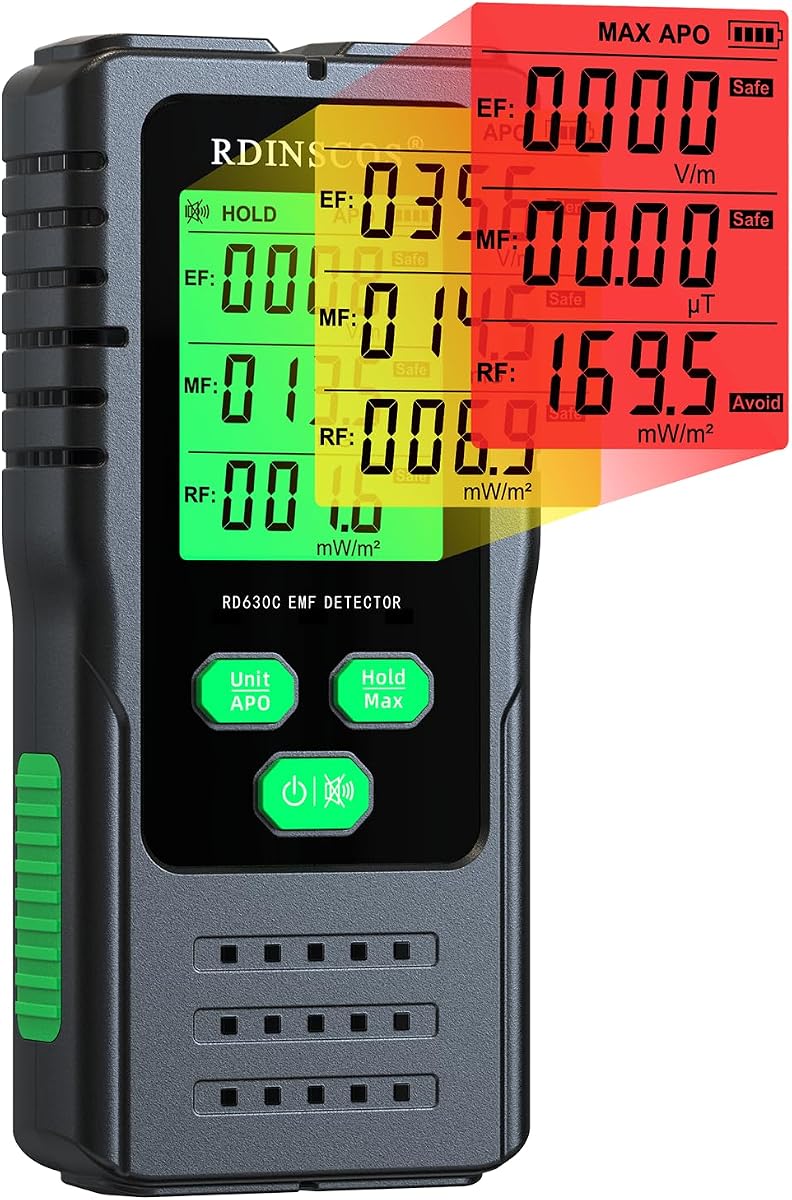
The RDINSCOS RD630 is a compact detector designed for quick scans around homes, offices, smart meters, and cell towers. Its 4.4 rating and straightforward design make it approachable for users who want a single device capable of checking AC magnetic, AC electric, and microwave fields without navigating a large analyzer interface.
We may earn a commission when you buy through this link, at no additional cost to you.
The tri-color LCD uses green, yellow, and red to communicate relative levels, while an audible alert provides another indication when readings exceed the specified levels. Its backlight makes the screen easier to see in dim rooms, and the lightweight housing supports one-handed operation while moving around furniture or checking different sides of an appliance.
Power management is unusually flexible for a simple meter. The device shuts down automatically after 15 minutes of inactivity to conserve its battery, and users can disable that behavior by pressing and holding the APO button for continuous measurement. That makes it suitable for a longer scan as well as a quick check. The trade-off is that the listed features do not include environmental temperature, humidity, detailed RF spectrum analysis, or documented high-end accuracy specifications.
The RD630 is a good match for consumers seeking a pocket-friendly, color-coded tool for general awareness and source location. It avoids the need to interpret complex graphs while still measuring three common field categories. It is less suitable for professional spectrum analysis or rigorous baseline comparison, but for a straightforward household and workplace sweep, its illuminated display, audible alert, and simple controls make it easy to use.
Green, yellow, and red zones allow a user to understand the general reading at a glance. This is helpful during a room sweep when speed and ease of interpretation matter more than a long numerical record.
Automatic power-off protects battery life during intermittent use, while the hold control allows continuous operation when a prolonged investigation is required.
We may earn a commission when you buy through this link, at no additional cost to you.
The POROMETISTO ET01Pro is marketed as a five-in-one meter that measures radio-frequency, electric, and magnetic fields while also reporting temperature and humidity. It has a 4.5 rating and stands out from ordinary EMF indicators through its broad low-frequency range, coverage of modern wireless signals, environmental sensors, and a color-coded analog display.
We may earn a commission when you buy through this link, at no additional cost to you.
The detector covers 40Hz to 100kHz for electric and magnetic fields and 30MHz to 8GHz for RF. Its measurement capability includes 5G and Wi-Fi signals, as well as microwave radiation from appliances. A tri-color analog display with green, yellow, and red bars provides an immediate visual indication, and an audio alarm can be muted for quiet operation or ghost-hunting scenarios.
Additional tools include maximum and minimum value displays, data hold, a low-battery warning, and an automatic shutdown after 15 minutes that can be cancelled. The complete kit includes the meter, three AAA batteries, a screwdriver, velvet bag, and manual. The combination of environmental readings may help identify unusual conditions during property inspections or support ghost-hunting workflows, although it does not establish a causal relationship between EMF and any other environmental factor.
This is a versatile choice for users who want more than a basic field indicator but prefer a color display to a complex spectrum analyzer. The temperature and humidity functions make it especially interesting for bedroom or property-condition monitoring, while the RF coverage handles common wireless sources. Its main limitations are reliance on replaceable batteries and less numerical detail than devices built around a large digital readout.
Temperature and humidity readings add environmental context to an EMF scan. This can make the device useful for room assessments where comfort conditions and electromagnetic activity are being checked at the same time.
The 30MHz to 8GHz RF range covers common Wi-Fi, 5G, and appliance microwave emissions. That makes the ET01Pro useful for testing several modern wireless sources with one device.
We may earn a commission when you buy through this link, at no additional cost to you.
The 3-in-1 Handheld EMF Meter offers electric and magnetic field detection across a stated 20–3500MHz frequency spectrum. It has the highest listed rating in this roundup at 4.7, and its rechargeable design, color interface, alert modes, and waveform display make it an attractive general-purpose option for home and office users.
We may earn a commission when you buy through this link, at no additional cost to you.
Numerical outputs show unusual magnetic-field fluctuations, while the bright color display provides quick visual navigation. Users can select sound or flash alerts and view electric and magnetic waveforms. Those features support more deliberate monitoring because the meter does not limit every observation to a single changing value. The stated uses include checking cell towers and low-frequency appliances, as well as tracking ambient changes during paranormal investigations.
The frequency range is narrower than the 8GHz and 10GHz options elsewhere in the guide, so it may not capture the full range of radio-frequency sources offered by advanced competitors. Temperature measurement is included, but humidity is not listed. It is also important to interpret the advertised range carefully: readers should confirm what components of the stated spectrum correspond to the electric, magnetic, and RF modes before assuming identical coverage across each function.
Despite those limitations, this detector is easy to recommend for users seeking a compact, rechargeable meter with a friendly display and multiple alert options. It suits quick environmental checks, household appliance scans, and paranormal exploration. The simple interface reduces the learning curve, while waveform viewing and audible or visual alerts provide enough feedback for both beginners and experienced users.
Users can choose audible or visual alert modes according to the environment. Sound is useful when looking away from the screen, while flashing feedback can be preferable in quiet rooms or during ghost-hunting sessions.
Displaying electric and magnetic waveforms helps a user see whether a field is steady or changing. That can make source identification more informative than watching a single numerical value alone.
We may earn a commission when you buy through this link, at no additional cost to you.
The TEMIRUP 5-in-1 is a rechargeable EMF reader that measures magnetic, electric, and radio-frequency fields while adding temperature and humidity monitoring. Its 4.6 rating and large color LCD make it particularly attractive for users who prefer detailed numerical information in a portable instrument for home, office, travel, and ghost-hunting applications.
We may earn a commission when you buy through this link, at no additional cost to you.
Magnetic readings can be shown in mG or μT, electric fields use V/m, and RF is expressed in μW/cm². The RF mode covers 30MHz to 8GHz, allowing detection of Wi-Fi, 5G, and microwave emissions. Electric and magnetic modes are intended for fields from televisions, induction cookers, rice cookers, refrigerators, computers, and power lines, giving the device a broad household scope.
A three-color analog area works with the digital display to provide quick and detailed feedback. The meter can show average or peak values, hold a reading, switch temperature units, indicate a low battery, and shut down automatically after 15 minutes of inactivity. The package includes a charging cable, carry bag, and manual. What it lacks compared with the GQ EMF-390 or LATNEX AF-5000 is a dedicated spectrum analyzer, and its RF ceiling is below the 10GHz models.
The TEMIRUP is best for users who want a rechargeable all-purpose meter with environmental readings and flexible display options. It gives enough numerical detail to compare sources and enough alerts to find hotspots quickly. It is less suitable for radio-frequency specialists who need channel-level analysis, but for apartment checks, home-office assessments, wireless-source mapping, and paranormal exploration, it offers a broad and approachable feature set.
Average readings provide a stable view of ongoing field activity, while maximum mode highlights stronger values encountered during a scan. Having both can make comparisons more meaningful.
Temperature and humidity monitoring makes the meter useful for general room assessment in addition to EMF detection. It also provides useful context when documenting the conditions around a particular measurement.
We may earn a commission when you buy through this link, at no additional cost to you.
The KAIWEETS EMF Detector is a rechargeable 3-in-1 meter designed to measure magnetic, electric, and radio-frequency fields. It has a 4.5 rating and distinguishes itself with a live trend graph, simultaneous three-measurement display, automatic peak storage, and a three-axis magnetic sensor that can detect fields regardless of orientation.
We may earn a commission when you buy through this link, at no additional cost to you.
The listed measurement ranges are 0.01–200μT or 0.1–2000mG for magnetic fields, 1–2000V/m for electric fields, and 0.001–200mW/m² for RF. The trend graph turns fluctuating readings into an easier-to-interpret visual signal, while automatic peak recording helps users notice brief spikes near beds, desks, play areas, routers, and appliances.
The product is explicitly positioned as a real-world screening meter rather than lab-grade equipment, so very small changes or results requiring regulated metrology should not be treated as laboratory findings. Even so, its directional flexibility and live display make it a practical tool for locating stronger areas. Backlighting and a sound alarm provide prompt feedback, and the one-touch hold button supports documentation and location-to-location comparisons.
The KAIWEETS is best for home inspectors, concerned parents, and office users who want to map changes across a space without learning a complex analyzer. It also works well for ghost hunting because the graph and audible alert make transient changes easier to notice. For users requiring calibrated certification or advanced RF-channel analysis, the LATNEX or GQ options are more specialized, but this detector delivers a versatile everyday tool at a straightforward level.
A trend graph makes changing readings visible over time rather than presenting only an isolated number. This can help distinguish a sustained field from a brief spike as the meter approaches a source.
Because the magnetic sensor measures in three axes, the meter can detect field strength without requiring users to rotate it around a particular axis. That simplifies scanning around furniture, screens, and power equipment.
We may earn a commission when you buy through this link, at no additional cost to you.
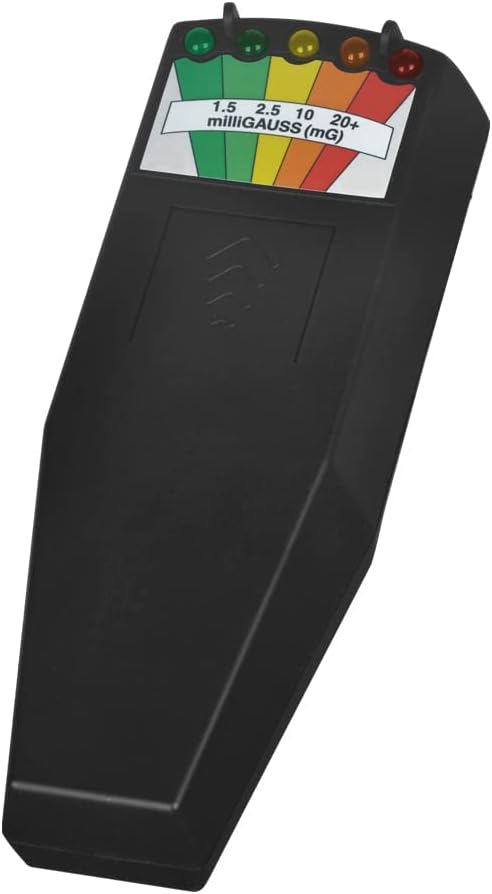
The AceFox EMF Meter is a compact, indicator-style detector intended for home, office, and ghost-hunting use. It has a 4.5 rating and offers a simple alternative to larger multifunction meters. Five colored LED indicators make the result visible in daylight or darkness, and its pocket-friendly shape makes it easy to keep close at hand.
We may earn a commission when you buy through this link, at no additional cost to you.
The device operates on a single battery and reports EMF measurements over a frequency range from 50Hz to 20,000Hz. The supplied information says it can register cell phones within two feet and is intended for checking televisions, computers, microwave ovens, refrigerators, printers, cell towers, and low-frequency household appliances. This makes it accessible for quick comparisons near familiar electronics.
The central limitation is measurement scope. It does not provide the detailed numerical displays, selectable units, temperature and humidity sensors, or broad RF coverage found on several multifunction models. The unit is also described using a milligray-per-second measurement, a specification that some buyers may find less intuitive than microtesla or volts-per-meter. A simple LED response cannot replace a calibrated instrument or spectrum analyzer.
The AceFox is best for casual users who want a lightweight indicator to carry around the home, office, or a paranormal investigation. Its simplicity is a genuine advantage for quick checks, particularly when a glance-based answer is more useful than documentation. Serious users comparing shielding, studying field shapes, or monitoring modern wireless transmissions should choose a more detailed model, but this device provides a convenient entry point for basic awareness.
The five-light display remains visible in bright rooms and dark spaces. It is a practical alternative to relying on a small numerical screen during quick, on-the-go checks.
The compact housing makes the meter easy to carry in a pocket or purse. A device that remains accessible is more likely to be used for regular room and appliance spot checks.
We may earn a commission when you buy through this link, at no additional cost to you.
The LATNEX AF-5000 combines RF, ELF magnetic, and electrical-field measurement in one professionally oriented device. It has a 4.1 rating, the lowest listed among these products, but its distinguishing strength is not customer-rating volume: each unit is individually tested and supplied with a dated calibration certificate under ISO 9001:2015 standards.
We may earn a commission when you buy through this link, at no additional cost to you.
RF detection extends to 10GHz, allowing the meter to monitor routers, cell towers, smart devices, and 5G networks with real-time strength readings. Its magnetic mode works as a three-axis gauss or tesla meter for fields associated with wiring, power lines, and appliances. Electric-field measurement reaches 2000V/m at 50/60Hz, covering standard household AC frequencies.
There are important limits. The electric-field function is not designed for static or high-voltage industrial fields, and readings can vary with distance, angle, and interference from nearby electronics. The supplied information does not mention a built-in spectrum analyzer, so although its RF range is broad, it should not be assumed to offer the channel-level analysis of the GQ EMF-390. Direct phone and email support can help users interpret results, and a two-year warranty adds reassurance.
The AF-5000 is best for users who value documentation, individual certification, and broad field coverage more than an elaborate feature list. It is suited to detailed home and workplace source comparisons, particularly around current wireless systems and standard electrical infrastructure. The recommendation is strongest for buyers who understand measurement limitations and need traceability through a calibration certificate, rather than casual users wanting a simple colored alert.
Every meter is tested and given a dated calibration certificate before shipment. This provides a record that can be valuable for users who want more accountability than a generic product description.
The combination of 10GHz RF detection, three-axis magnetic sensing, and 50/60Hz electric-field measurement covers many modern household and workplace sources. It is a well-rounded choice for comparative environmental surveys.
We may earn a commission when you buy through this link, at no additional cost to you.
The right EMF detector depends on the fields you want to examine, the accuracy and documentation you need, and how much control you want during a scan. The following factors explain the most important differences among the ten models.
Electric, magnetic, and radio-frequency fields behave differently and come from different sources. Electric and magnetic meters are generally used around household wiring and appliances, while RF meters target routers, phones, cellular networks, Bluetooth equipment, and microwave emissions. A three-in-one model is convenient for whole-home checks, although its individual field ranges and axis support still matter. A single-purpose low-frequency meter can be sufficient for simple awareness, while users comparing modern wireless equipment should prioritize explicit RF specifications.
Choose a detector that covers the sources and frequencies relevant to your situation. Do not assume a product mentioning 5G supports every frequency associated with every 5G system.
The listed frequency ceiling indicates how far a meter can extend into the radio-frequency spectrum. Models reaching 6GHz cover many common wireless signals, 8GHz offers additional headroom, and 10GHz options cover the broadest range in this group. Low-frequency meters can focus on power-line and appliance fields, but they cannot substitute for a dedicated RF detector. Pay attention to whether a range applies equally to electric, magnetic, and RF modes.
Prioritize the frequency and source coverage you expect to encounter rather than selecting on the largest printed number alone.
LCD meters generally show numerical values, while tri-color indicators summarize levels with green, yellow, and red. Numerical displays are better for documenting comparisons, and larger color screens can make an instrument easier to use in dim spaces. Graph and waveform views help reveal changes over time, while maximum-value storage preserves peaks encountered during a sweep. Very simple LED products are quick to read but offer less analytical detail.
Choose a simple color display for ease of use or a detailed graph and data log for methodical measurement.
Audible alarms, flashing indicators, screen-color warnings, and red threshold states provide several ways to notice elevated readings. Mute functions are useful in quiet offices, at night, or during paranormal investigations, but they should not remove the only useful warning if visual feedback is limited. Some models define explicit thresholds, while others communicate only relative levels. Buyers should distinguish between a threshold alarm and a general trend alert.
Prefer adjustable or clearly explained alerts, and confirm whether the selected mode still provides visible feedback after muting the sound.
Rechargeable meters suit repeated room-by-room scans and avoid ongoing battery purchases, while replaceable batteries can be practical for travel. Automatic shutdown protects battery life, and a cancellable timer supports continuous work. Carry cases, pouches, batteries, charging cables, and screwdrivers add convenience or help keep the instrument ready. Size and weight also matter: pocket meters suit quick checks, while larger devices may be easier to operate during extended monitoring.
Match power and accessories to how often and where the meter will be used. Portability is most valuable when a user actually carries it.
For serious comparisons, look for documented ranges, units, and a calibration certificate. The LATNEX AF-5000 is individually tested and includes dated certification, while the TF2 includes a one-year manufacturer warranty and consulting support. Higher-end or certified equipment does not eliminate distance, angle, and interference effects, so controlled methodology remains important. A colored warning meter is useful for screening but should not be confused with regulated metrology.
Choose documented specifications and certification when traceability matters. For general awareness, clear units and repeatable readings are often sufficient.
Temperature and humidity readings can complement an EMF scan by documenting surrounding room conditions. They may be useful during property inspections, bedroom checks, or paranormal investigations. Frequency analyzers and browser software serve a different purpose, helping users inspect RF channels in real time. These added functions are useful for advanced work but can make the device more complex than a straightforward home meter.
Select specialty sensors only when they answer a real question. Extra data is valuable when interpreted, but unnecessary features can add cost and complexity.
A home user checking a refrigerator or computer may only need electric and magnetic measurements, while a wireless enthusiast may prioritize RF sensitivity. Paranormal investigators often value audible alerts, muted operation, and clear graph changes. Home inspectors can benefit from calibration records and data logging. Comparing sources also requires a hold function, maximum-value mode, and a consistent scanning method.
Start with your most common task and choose the simplest meter that covers it. Advanced capabilities are most valuable when they directly improve the measurements you need.
Begin by reading the instructions for the selected model and charging it fully or installing fresh batteries. Identify the correct sensing mode for the field being examined, confirm the displayed units, and perform a quick baseline reading in an area away from major sources. Keep the meter away from chargers, phones, computers, and other electronics that could influence low-level measurements.
Move the sensor slowly through the area and approach likely sources one at a time. Hold readings at a consistent distance and angle, record the value, and compare powered-off and operating appliances where appropriate. Use data hold for a stable number, maximum mode to capture peaks, and graphs or logs for repeated scans. Do not infer a health outcome from a reading alone, and remember that distance, direction, orientation, and nearby interference can change results.
After use, switch the meter off and store it in a protective case away from heat, moisture, direct sunlight, and strong impacts. Clean the exterior with a soft dry cloth rather than immersing it or using harsh chemicals. Charge rechargeable models according to the instructions, inspect contacts and cables for damage, and replace batteries promptly when the low-battery warning appears.
The answer depends on the model. Some meters focus on low-frequency electric and magnetic fields, while others add radio-frequency detection for Wi-Fi, cellular, Bluetooth, and microwave sources. A product described as 3-in-1 generally covers magnetic, electric, and RF fields, but buyers should confirm the measurement range of each mode. No meter should be assumed to detect every form of radiation, including radioactivity.
No. A higher reading means the meter is detecting a stronger field at its position, but interpreting health significance requires appropriate standards, context, and the characteristics of the source. Readings change with distance, orientation, and surrounding interference. If a result is concerning, repeat the measurement under controlled conditions and seek qualified advice rather than relying on a consumer meter as the sole basis for a safety decision.
Usually, it can help narrow the search by identifying where levels rise. Start far from suspected equipment, move slowly, and compare readings as you approach different objects. A powered appliance often produces a stronger magnetic reading than when it is off, while wireless equipment may create changing RF levels. Hold, graph, and maximum-value functions make these comparisons easier to document.
Electric-field and magnetic-field readings describe different components of an electromagnetic field. They arise from different combinations of voltage, current, wiring, and equipment operation. A meter that measures both can provide a broader view of a location, but the values use different units and thresholds. Comparing them numerically is less meaningful than tracking each field type separately over repeated scans.
Some models can detect microwave emissions, particularly those with an RF mode. The strength and direction of leakage can vary, so a measurement should be taken near the oven door, controls, and seams while it is operating. A detection does not by itself establish that the oven is defective or unsafe, and it cannot replace inspection by a qualified appliance technician.
A calibrated or individually certified instrument is valuable when traceability, repeated professional comparisons, or formal documentation matters. For casual household awareness, a meter with clear units, consistent readings, and useful alerts can still be helpful. In either case, proper technique and repeatable positioning are essential because moving the sensor or changing its angle can significantly affect the result.
A zero can mean the source is switched off, the field is below the meter's detection range, the sensor is too far away, or the meter is not oriented effectively. ERICKHILL specifically notes that its magnetic readings can show zero when an appliance is not operating. Turn the source on, move the top sensor close to it, and verify the selected mode before drawing a conclusion.
It can be useful for a basic before-and-after comparison if the same meter, mode, distance, position, and operating conditions are maintained. Variation in the environment can still affect the result, so multiple readings are better than a single comparison. A meter helps identify observable changes; it does not guarantee the performance or safety claims associated with any shielding product.
The TF2 EMF Pollution Meter is the most balanced all-purpose option, covering magnetic, electric, and RF fields with rapid updates and weighted electric readings. The ERICKHILL EMF Meter is an approachable choice for electric and magnetic investigations, while the LATNEX AF-5000 is the premium recommendation for buyers who prioritize individual calibration, three-axis magnetic measurement, and RF coverage to 10GHz.
Prioritize the field types, frequency range, and documentation required by your actual environment. A simple three-color meter is sufficient for casual source location, a detailed color model is better for comparisons, and a spectrum analyzer or calibrated instrument serves advanced monitoring. Before buying, confirm the supported modes and whether any advertised frequency coverage applies to the field you intend to measure.
Finally, check the current product details, included accessories, warranty information, and market price before making a purchase. EMF detector capabilities and package contents can evolve, and current listings may differ from older product descriptions. Choose the model whose measurement coverage best matches the sources you need to investigate rather than selecting solely by the largest number printed on the box.