
AKASO EK7000
4.4Editor score
4K30 video capture
Electronic image stabilization
Included wrist remote
131-foot waterproof case
An action camera for Go Kart can transform a close race into an immersive record of cornering, acceleration, passing, and the reactions in the paddock. The right model should combine stable video, low-light clarity, simple controls, dependable mounting options, and enough battery life to cover a full session without distracting the driver.
The cameras in this guide were compared using their stated specifications, including sensor size, maximum video resolution, stabilization systems, waterproofing, field of view, displays, remotes, and bundled accessories. The list covers budget, general-purpose, premium, 360-degree, and vertically oriented options for different track setups and recording styles.
Each review explains how a camera can contribute to go-kart footage, from wide-angle helmet views to remotely operated trackside shots. The top three picks balance capability and value, while the remaining models provide worthwhile alternatives for riders seeking different levels of stabilization, resolution, accessories, or smart features. Prices and availability can change.
4.4Editor score

4.6Editor score

4.6Editor score
As an Amazon Associate we earn from qualifying purchases.
This side-by-side comparison highlights the major differences in capture resolution, stabilization, water resistance, displays, and control features, helping you match a camera to your preferred go-kart recording style.



The AKASO EK7000 is an approachable action camera for go-kart enthusiasts who want detailed race footage without moving into a higher-tier system. Its 4.4 rating reflects a favorable balance of useful features, and its headline combination of 4K30 video, 20MP stills, electronic stabilization, Wi-Fi, and a waterproof case gives it considerable flexibility for track days and casual outings.
We may earn a commission when you buy through this link, at no additional cost to you.
For go-kart recording, electronic image stabilization is especially relevant because engines, curbs, kerbs, and steering inputs create continuous vibration. The camera can record 4K at 30 frames per second, while a 4X zoom option may help frame distant parts of a circuit. The included 2.4GHz wrist remote is useful when the camera is mounted on a kart and cannot be reached easily.
The main trade-offs are practical rather than fundamental. The camera does not include a microSD card, so storage must be added separately, and the wrist remote is not waterproof. It also lacks some of the more advanced subject tracking, horizon leveling, and low-light features found in premium models, but it remains a well-rounded option for helmet, chin, kart, or trackside mounting.
This is a strong choice for first-time owners, club racers, and anyone building a useful kit on a budget. Its stabilization, 4K capability, remote control, and protective housing cover the essentials, while Wi-Fi transfer makes it convenient to review and share race clips from a phone or tablet.
Electronic image stabilization helps reduce visible shake as the kart crosses rough sections or changes direction. Although it cannot reproduce a dedicated gimbal, it is a useful safeguard for creating smoother helmet-mounted and kart-mounted footage.
The included wrist remote lets the driver start or stop recording without reaching the camera. That convenience can prevent awkward hand movements near the mount and makes the EK7000 practical for solo sessions.
We may earn a commission when you buy through this link, at no additional cost to you.
The 1/1.3-inch 4K camera combines a relatively large sensor with a particularly broad set of stabilization tools, making it a flexible choice for go-kart filming. It carries a 4.4 rating and stands out through 360 Lock, TiltGuard, MotionMaster, Night View Mode, and waterproofing to 52 feet without requiring the waterproof housing specified for some competing models.
We may earn a commission when you buy through this link, at no additional cost to you.
A large sensor can be valuable in shaded outdoor circuits and during evening sessions, while the Night View mode offers another route to brighter low-light footage. The three stabilization approaches address different movement patterns: horizon-oriented correction, tilt control, and broader motion smoothing. That combination is useful when footage comes from a moving kart rather than a stationary trackside position.
Its magnetic quick mount also improves the experience of changing between horizontal and vertical framing. A kart can move through the frame quickly, and a secure, quickly repositioned camera is beneficial for capturing driver reactions, passes, and wide circuit views. The stated battery life of up to three hours is also well suited to a full outing.
The main drawback is that its generic title provides less recognizable model identity than established camera brands. Some high-speed resolution information is also presented less clearly than the supplied title suggests. Even so, the sensor, stabilization suite, night mode, and battery specification make this an attractive all-purpose choice for riders who regularly record in changing light.
360 Lock, TiltGuard, and MotionMaster can be selected according to whether the priority is a level horizon, cleaner vertical framing, or general smoothing. This flexibility is useful when switching between a low kart mount and a higher helmet angle.
The 1/1.3-inch sensor and dedicated Night View Mode provide useful tools for circuits shaded by trees, grandstands, or late-evening light. The goal is not to eliminate every trace of low-light noise, but to preserve more usable detail.
We may earn a commission when you buy through this link, at no additional cost to you.
The DJI Osmo Action 4 is the most complete general-purpose recommendation in this guide for recording go-kart sessions. Its 4.6 rating, 1/1.3-inch sensor, 10-bit color, 4K120 capability, 155-degree field of view, and three stabilization modes provide an excellent combination of image quality, flexibility, and rugged performance.
We may earn a commission when you buy through this link, at no additional cost to you.
Wide framing matters on a compact circuit where corners and nearby karts can enter the scene quickly. At 4K, the camera can preserve fine details such as helmet graphics, track markings, and facial reactions, while 4K120 gives editors an option for dramatic slow motion during overtakes. The sensor's larger pixels and automatic white balance also support more credible footage in changing light.
The three stabilization modes are well suited to action recording, while the magnetic quick-release system makes it straightforward to move the camera between horizontal, vertical, and perspective-altered positions. Battery life of up to 150 minutes provides a good chance of covering a race or recreational session. Waterproofing to 18 meters and cold operation down to -20°C broaden the environments in which it can be used.
This camera costs more than entry-level models, and 120 fps footage requires careful exposure and lighting. Some features, including direct DJI microphone connectivity, are also more relevant to dedicated content creators than to track-day riders. Even so, its combination of image quality, stabilization, wide view, waterproof construction, and rapid mounting makes it the strongest all-round choice here.
The 155-degree ultra-wide field of view captures more of the kart's surroundings without relying on digital crop. That gives viewers a stronger sense of speed and helps include rivals entering from the edge of the frame.
The 1/1.3-inch sensor, 2.4-micrometer pixel size, 10-bit color depth, and D-Log M support give editors more latitude for grading. The result can be particularly useful when combining bright track sections with shaded corners.
We may earn a commission when you buy through this link, at no additional cost to you.
The DJI Osmo Action 5 Pro is the premium choice for racers who want the cleanest, most polished action footage and the most convenient control experience. Its 4.6 rating, 1/1.3-inch sensor, 13.5-stop dynamic range, subject centering, dual OLED screens, and industry-leading 360-degree HorizonSteady create a compelling package.
We may earn a commission when you buy through this link, at no additional cost to you.
HorizonSteady is particularly compelling in a go-kart because rapid steering, banking, and uneven track surfaces can tilt a conventional mounted camera. The system is designed to eliminate roll-axis shake while keeping the scene level, allowing viewers to concentrate on the cornering action. Subject centering can also keep a driver or nearby kart aligned in 16:9 and 9:16 formats.
The front and rear ultra-bright OLED touchscreens make setup and playback considerably easier. A driver can frame a selfie view without turning the camera around, while track staff can adjust settings or review footage without removing the camera from its mount. A 1950mAh battery is rated for as much as four hours of recording, with reduced but still substantial cold-weather performance.
This is clearly the most expensive camera in the guide, and its sophisticated feature set may exceed the needs of a casual rider. The color temperature sensor, voice control, ProRes-style workflows, and direct wireless microphone support are most valuable to content creators. For a serious kart racer producing regular highlight videos, however, the improved stability, low-light performance, and battery endurance justify the premium positioning.
The 360-degree HorizonSteady system specifically targets roll-axis movement, one of the most distracting forms of shake in mounted action footage. It is particularly effective during quick direction changes and uneven transitions between straights and corners.
Dual OLED screens allow immediate framing in front-facing and rear-facing positions. This reduces setup time and makes the camera easier for a driver to operate without assistance at the track.
We may earn a commission when you buy through this link, at no additional cost to you.
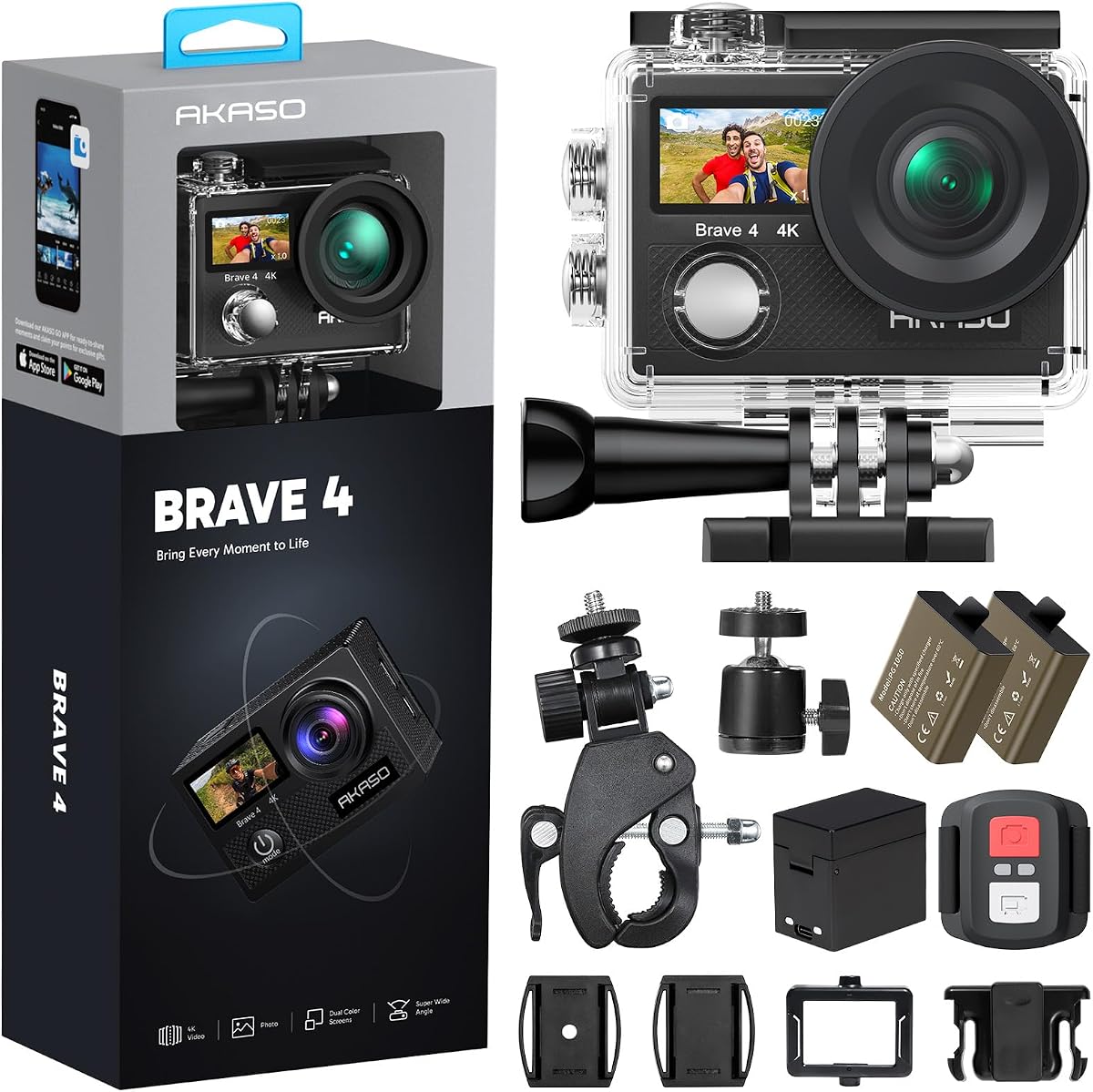
The AKASO Brave 4 is a capable, value-focused action camera for go-kart videos, particularly when a dual-screen design and multiple mounting accessories are priorities. It has a 4.4 rating, records 4K30 video and 20MP photos, and offers a maximum 170-degree perspective with narrower options for more controlled compositions.
We may earn a commission when you buy through this link, at no additional cost to you.
The adjustable view angles are useful on a kart because a very wide mount can show the track and horizon, while a narrower setting can emphasize the driver's face, steering wheel, or another kart. Smart gyroscope-based image stabilization helps smooth movement, and the front and rear screens make it easier to judge framing from different positions.
The camera includes a waterproof housing rated for use to 40 meters, a USB dual charger, and two rechargeable 1050mAh batteries. Each battery is stated to record for up to 90 minutes. Wi-Fi supports app-based transfer and editing, while HDMI offers a straightforward way to view suitable content on a larger television.
The supplied product information does not describe a touchscreen, so setup may require more physical button navigation than modern premium alternatives. The wrist remote is also not waterproof. These limitations do not undermine its core value for dry-track use, and the Brave 4 remains a solid choice for riders who want a broad kit, dual displays, and adjustable framing.
Four field-of-view options allow the operator to balance environmental context with subject focus. A 170-degree view emphasizes speed and surroundings, while 70-degree footage is better suited to close driver-focused compositions.
Two included batteries and a dual USB charger reduce downtime between runs. The camera can remain protected in its waterproof housing for wet sessions or unexpected rain at an outdoor circuit.
We may earn a commission when you buy through this link, at no additional cost to you.
The AKASO Brave 4 64GB Bundle stands out as a ready-to-record package for go-kart users who would rather not purchase essential accessories separately. It retains the Brave 4's 4.4 rating and combines 4K30 video, 20MP photographs, Wi-Fi, HDMI, dual screens, adjustable viewing angles, a 64GB U3 memory card, and two rechargeable batteries.
We may earn a commission when you buy through this link, at no additional cost to you.
Including the microSD card removes one of the most common early obstacles for new owners. A rider can unbox the camera, charge the batteries, format the supplied card, and begin recording. The broad selection of video modes extends beyond 4K30 to include 2.7K30, several 1080p and 720p rates, and high-frame-rate options that can be useful for slow-motion highlights.
For track use, the 170-degree maximum field of view helps communicate speed, while the narrower 140-, 110-, and 70-degree options can isolate the driver or nearby competitors. A smart gyroscope supports steadier footage, and the two screens make front- and rear-facing compositions easier to judge. The waterproof housing and mounting accessories support many activities beyond dry karting.
This bundle does not provide the touchscreen experience or advanced stabilization of premium cameras. The wrist remote is not waterproof, and older physical controls can be less intuitive than touch navigation. Nevertheless, for a beginner or club racer who wants the necessary storage and spare battery already included, it is one of the most practical packages in the guide.
The included 64GB U3 card removes uncertainty about card capacity and speed. It also makes the package more convenient for immediate track use after charging the batteries.
Multiple frame-rate options give editors alternatives for slow-motion corner entries and passing moments. Higher-rate footage is most useful when lighting and shutter exposure can be controlled.
We may earn a commission when you buy through this link, at no additional cost to you.
The Insta360 X3 is the most distinctive choice in the guide because it can capture a complete spherical scene and select the visible direction during editing. Its 4.6 rating, 5.7K 360 Active HDR recording, 4K single-lens mode, and AI-powered reframing give go-kart drivers the ability to simulate cameras that could not be physically mounted around the kart.
We may earn a commission when you buy through this link, at no additional cost to you.
A 360 mount high above the kart can capture the driver, nearby competitors, and the circuit in a single take. The editor can then pan toward an overtake, rotate to show the steering wheel, or choose a wide view for a replay. FlowState Stabilization and Horizon Lock work together to produce smooth, level virtual shots from the surrounding environment.
The X3 also works as a conventional action camera. It can shoot 4K30 wide-angle footage or 2.7K60 MaxView with a super-wide 170-degree field of view, giving users a choice between immersive 360 capture and a more direct single-lens workflow. Its 2.29-inch touchscreen helps with quick adjustments, and waterproof construction suits varied outdoor conditions.
The main drawback is post-production complexity. A 360 workflow requires compatible editing, and storage, processing, and export demands are greater than with standard footage. In return, the X3 offers a perspective system that is especially compelling for recreating race action from unconventional angles. It is best suited to creators who enjoy editing and want one camera to replace multiple fixed perspectives.
A spherical capture can include the kart, competitors, and track in one continuous shot. Later reframing lets the editor follow different action without requiring separate cameras in multiple positions.
FlowState Stabilization and Horizon Lock are particularly helpful because a 360 mount experiences movement from the entire kart. The result is a smooth virtual camera that tracks action around the rider.
We may earn a commission when you buy through this link, at no additional cost to you.
The GoPro HERO12 Black is a strong all-round race recorder with a particular emphasis on resolution, high dynamic range, and rugged construction. Its 4.5 rating and ability to capture 5.3K60 video, 27MP photographs, and HDR stills make it a natural choice for editors who want fine detail from a helmet, chin, or kart-mounted perspective.
We may earn a commission when you buy through this link, at no additional cost to you.
HDR is valuable at outdoor circuits because race scenes often contain deep shade beneath bridges, trees, or grandstands alongside bright open sections. Preserving detail in both areas can prevent shadows from becoming solid black and highlights from losing texture. The 5.3K60 mode also provides considerable latitude for cropping or reframing without a major loss of visual quality.
HyperSmooth 6.0 with AutoBoost is designed for highly active footage and can reduce shakiness while limiting the amount of crop. The camera is waterproof to 33 feet, making it suitable for wet tracks and broader outdoor use. Live streaming and webcam functions are unnecessary for many racers but make the model more versatile when it is not being used on the track.
As with other premium cameras, the HERO12 Black represents a substantial investment, and recording at its highest resolutions consumes more storage and creates demanding files. Users should also account for the cropping associated with maximum stabilization. Even with those considerations, its 5.3K detail, HDR capability, and mature stabilization make it an excellent choice for polished go-kart productions.
HDR for both supported video resolutions and still photographs helps retain information in difficult lighting. That is particularly helpful when a single run moves between open straights and shaded technical sections.
HyperSmooth 6.0 uses sensor data and software to stabilize movement. AutoBoost increases the smoothing effect, making it useful for rough tracks and fast-changing steering inputs.
We may earn a commission when you buy through this link, at no additional cost to you.
The Camlance 48MP camera delivers a large collection of features for riders who want many recording formats and accessories without moving to a premium model. Its 4.3 rating is the lowest in the guide, but the specification list includes 4K60 video, 48MP photos, a 170-degree field of view, 4K vertical capture, 8X zoom, EIS, Wi-Fi, a remote, two batteries, and a 64GB card.
We may earn a commission when you buy through this link, at no additional cost to you.
The included card and spare battery are especially practical for track days because they support a longer session and immediate recording. Four-times-faster 60 fps footage can provide a more fluid look for replay, while 4K vertical framing is useful for social platforms that display mobile video vertically. The remote can start or stop recording when the camera is mounted out of reach.
EIS is designed to improve smoothness during fast movement, and the stated low-light capability can help on shaded or evening tracks. Exposure adjustment gives the operator additional control when automatic results are too dark. The shock-resistant waterproof housing is rated to 40 meters and protects the camera in rain, snow, splashes, and underwater environments.
Digital zoom at 8X should be approached cautiously because enlarging image data can reduce detail, and the generic product title makes the model less easy to identify. The 4.3 rating also suggests some variability in overall user satisfaction. Even so, the extensive bundle and broad feature set make this a compelling option for budget-conscious riders who want flexibility and included essentials.
Dedicated 4K vertical framing makes the camera convenient for mobile-first clips. A driver can capture a run without rotating the housing or applying a later crop when sharing highlights.
The remote, Wi-Fi app connection, and exposure adjustment provide several ways to manage recording. These features are helpful when the camera is fixed to a kart and the driver cannot safely reach it.
We may earn a commission when you buy through this link, at no additional cost to you.
The AKASO Brave 7 LE combines a 4K30 action camera with front and rear color screens, improved stabilization, and a generous set of recording accessories. Its 4.4 rating makes it a strong mid-range choice for go-kart riders who prioritize touch navigation and physical controls over the newest high-frame-rate formats.
We may earn a commission when you buy through this link, at no additional cost to you.
The 2-inch rear touchscreen makes menu changes and framing checks more convenient, while the front display supports driver-facing compositions. EIS 2.0 uses a six-axis gyroscope to combat shake from steering corrections, engine vibration, and uneven track surfaces. A 20MP still-image mode is useful for capturing a sharp frame, a victory pose, or the kart before a race.
The kit includes two 1350mAh rechargeable batteries, a remote, a waterproof housing, and mounting accessories. Wi-Fi supports connection to a phone or tablet, and the camera can work with an external microphone, which is helpful for recording engine sound or post-race interviews with better clarity.
Its primary limitation is that the headline video mode tops out at 4K30, with no stated 4K60 or 4K120 option. The body itself is described as IPX7 water-resistant, while underwater protection to 131 feet depends on the included housing. For many karting sessions, though, the combination of screens, stabilization, batteries, and accessories makes the Brave 7 LE an easy camera to operate.
The dual color displays make it possible to check framing from either side of the kart. The front screen is particularly useful for driver-focused footage, while the rear touchscreen simplifies normal operation.
External microphone support gives creators an option to improve audio capture beyond the built-in microphone. That can be valuable for post-race commentary, engine-focused clips, and paddock interviews.
We may earn a commission when you buy through this link, at no additional cost to you.
A go-kart action camera should be judged by more than headline resolution. Stabilization, field of view, control access, mounting security, low-light performance, battery endurance, and the available storage and accessories all affect whether a camera is convenient and dependable on the track.
Go-karts generate constant vibration, abrupt steering inputs, and rapid changes in direction. Electronic stabilization is essential for producing watchable footage from a kart or helmet mount because it reduces visible shake without requiring a separate powered gimbal. Premium systems may add horizon leveling, roll-axis correction, and subject tracking, while budget models usually provide a simpler electronic stabilization mode.
For most track videos, reliable electronic stabilization matters more than a small increase in nominal resolution. Choose a model with several stabilization options so you can adapt to whether the camera is fixed low on the chassis, attached to a helmet, or held by a trackside operator.
A wide field of view conveys speed by including the kart's surroundings, nearby competitors, and the approach to each corner. Most action cameras provide a broad primary view, and some offer narrower settings for driver-focused compositions. Vertical shooting can also be useful for mobile clips, while a 360-degree camera can capture action from several apparent viewpoints through reframing.
Choose a camera that can frame both the track and the rider without excessive distortion. If you plan to publish vertical highlights, prioritize a native vertical mode or an easy rotation workflow rather than relying entirely on later cropping.
4K30 is a practical standard because it provides enough detail for helmets, liveries, track markings, and facial expressions while remaining easier to edit than ultra-high-frame-rate footage. Models that record 4K60 or 4K120 can produce smoother replays and striking slow motion, but they require more storage, stronger light, and careful exposure control.
Prioritize the frame rates you will actually use. If ordinary race recaps are the goal, 4K30 with good stabilization may deliver a more consistent result than maximum settings. Slow-motion highlights are worth the extra capability only when the camera is used in bright, controlled conditions.
Outdoor circuits may pass through deep shade, tunnels, covered grandstands, or evening light. A larger sensor, larger pixel size, HDR processing, and a dedicated night mode can all help retain usable detail and maintain more natural color. These features also prevent bright skies from overwhelming darker areas of the track.
A larger sensor is broadly useful, but software processing remains important. Compare the camera's stated low-light functions, exposure controls, and HDR capabilities. For regular night racing, a premium model with a large sensor and advanced processing generally has the advantage.
A go-kart mount must remain secure through vibration, cornering load, and repeated starts. Look for strong straps, reliable buckles, adjustable positioning, and a housing that does not obstruct the lens. Magnetic quick-release systems are convenient for changing angles, but they should lock securely before the kart moves.
Front and rear screens, wrist remotes, and phone apps are especially important because a driver should not handle the camera while racing. A remote allows a trackside operator or passenger to start recording, while screens help confirm that the framing is correct before the session.
Battery requirements depend on resolution, frame rate, stabilization, screen use, and temperature. A stated two- to three-hour runtime is generally more realistic for a long karting outing than for continuous maximum-quality recording. Spare batteries, a suitable charger, and a clear battery-management plan are valuable for multi-session track days.
Look for the manufacturer's stated battery capacity and charging method, but allow a margin for high-resolution recording and cold weather. The best practical kit includes at least one spare battery, especially for a camera that cannot be charged comfortably between runs.
Action cameras need a compatible microSD card, and higher-resolution modes require faster, higher-capacity storage. Some bundles include a card, while others require a separate purchase. Battery chargers, waterproof housings, mounting hardware, and remotes also vary widely between packages and can materially change the setup's convenience.
Check the complete contents before buying. A ready-to-record bundle can be ideal for a first kart camera, but it should still include storage with sufficient capacity for the selected resolution. Check the card's speed and capacity requirements rather than assuming any bundled card is suitable for every mode.
Outdoor karting can expose the camera to rain, track spray, mud, dust, vibration, and occasional impacts. Waterproofing gives confidence near wet surfaces, while a rugged housing protects the lens and body during falls or trackside handling. Ratings may apply either to the bare camera or only to its protective housing, so the distinction matters.
For dry indoor circuits, durability and mounting security may matter more than deep-water protection. For outdoor or mixed-use riding, choose a camera with clearly stated waterproofing and a housing that can withstand splashes and impacts. Always dry ports and contacts before opening any enclosure.
Before mounting the camera, confirm that the storage card is inserted, formatted in the camera, and large enough for the chosen video mode. Charge the battery fully, update the app if the model supports one, and test both a short video and a photograph. Confirm the date, resolution, frame rate, stabilization mode, and field of view before the session begins.
Attach the camera using a suitable helmet, chin, chest, or chassis mount. Position it so the lens is unobstructed and pointed in a direction that will not place the driver's hands or body directly in front of it. Tighten every strap and buckle, check the locking mechanism, and briefly run the engine while the camera is powered to identify any vibration or loose movement. Keep controls reachable through a remote rather than touching the camera while moving.
After riding, power the camera down before opening the housing or removing the card. Dry the body, lens, ports, and mount, and keep the camera away from direct heat while it cools. Use a soft, dry cloth for the lens, inspect the seals regularly, and recharge or store batteries according to the manufacturer's guidance. Periodically review footage and back up important clips so a full memory card or failed session does not become the reason a great race is lost.
A helmet, chin, or chest mount can provide a driver-focused perspective, while a chassis or bumper mount can show the kart's relationship to the track and nearby competitors. Choose a position that keeps the lens clear, the view stable, and the mount out of the driver's line of sight. Test the angle during a slow lap before making a full-speed run.
4K is useful when you want detail in helmets, track markings, liveries, or facial expressions, especially if the footage will be cropped during editing. It is not mandatory for basic track recaps, and 1080p may be sufficient for simple sharing. Consider whether your computer, storage, and editing workflow can comfortably handle 4K files.
Stabilization is very important because karts transmit constant vibration and change direction rapidly. Electronic stabilization can produce much smoother footage than an unstabilized mount, while horizon and roll correction can keep the track visually level. The best setting depends on the mount angle and how aggressively the camera moves.
A conventional wide-angle camera can often include both the driver and part of the track, although the framing is fixed. A 360-degree model can capture the full surroundings and allow the editor to choose the viewpoint later. For complete multi-angle coverage, two cameras provide more control, but a 360 model is a convenient single-camera alternative.
A waterproof case is advisable for outdoor tracks because rain, spray, mud, and puddles can reach an ordinary action camera. Some newer models are waterproof without a housing, while others only reach their stated depth rating when enclosed. Check the product's exact wording and keep the housing seals clean and properly seated.
A remote is useful whenever the camera is mounted somewhere the driver cannot safely touch it. It allows recording to start before a run and stop afterward without handling the camera. The supplied remote is normally intended for use within line of sight, and some remotes are not waterproof.
The required space depends on resolution, frame rate, codec, and recording length. 4K modes use substantially more space than standard-definition or 1080p footage, and high-frame-rate options can consume it even faster. Check the camera's stated requirements and choose a compatible card with enough capacity for several runs.
A 360-degree camera is valuable if you want to simulate several viewpoints from one recording. It can place the viewer near the driver's face, track a pass around the kart, or show the circuit from a virtual elevated position. The trade-off is a more involved editing workflow and greater storage and processing demands.
The AKASO EK7000 is the most accessible starting point, combining 4K30 recording, electronic stabilization, a wrist remote, and a protective case. The DJI Osmo Action 4 is the strongest all-round performer, with excellent stabilization, a wide field of view, strong low-light specifications, and versatile recording. The DJI Osmo Action 5 Pro raises the ceiling with superior horizon control, dual OLED screens, and extended battery performance.
Prioritize stabilization, secure mounting, and convenient operation over every headline specification. Wide footage, a level horizon, and simple remote control can matter more during an actual race than minor differences in image quality. Choose 4K60 or 4K120 only if you need slow motion and have suitable storage, light, and editing power.
Finally, check current product listings, package contents, accessory compatibility, and current prices before making a purchase. Stock, bundles, and deals can change, while a camera's included card, batteries, housing, and remote can materially affect its value. Choose the kit that best matches your track, recording style, and editing needs.