
XLR Male to RCA Female Adapter Cable
4.8Editor score
Two complete adapters included
Nickel-plated metal shells
Rivet-secured connector joints
Our RCA to XLR Adapter guide compares 10 top models for connector compatibility, signal quality, durability, channel routing, and straightforward setup at home.
An RCA to XLR adapter connects audio equipment using different connector styles, making it useful for linking mixers, microphones, amplifiers, receivers, and home theater components. The right adapter should provide a secure fit, maintain a stable audio path, and use the gender configuration required by your equipment without adding unnecessary complexity.
We compared all 10 adapters by examining their connector genders, cable or coupler design, channel arrangements, shielding, conductor construction, and intended applications. The list includes compact couplers, short unbalanced cables, color-coded pairs, a stereo splitter, and higher-end reference components, allowing buyers to compare formats as well as features.
Each selection below highlights the configuration that makes it most useful, along with practical trade-offs. Ratings reflect the supplied product data, while prices and availability can change, so readers should verify current listing details, connector compatibility, and their own equipment requirements before purchasing.
4.8Editor score

4.7Editor score

4.8Editor score
The comparison covers compact couplers, unbalanced cable adapters, color-coded pairs, a stereo Y cable, and premium reference adapters, with attention to connector gender, channel support, shielding, and intended equipment connections.
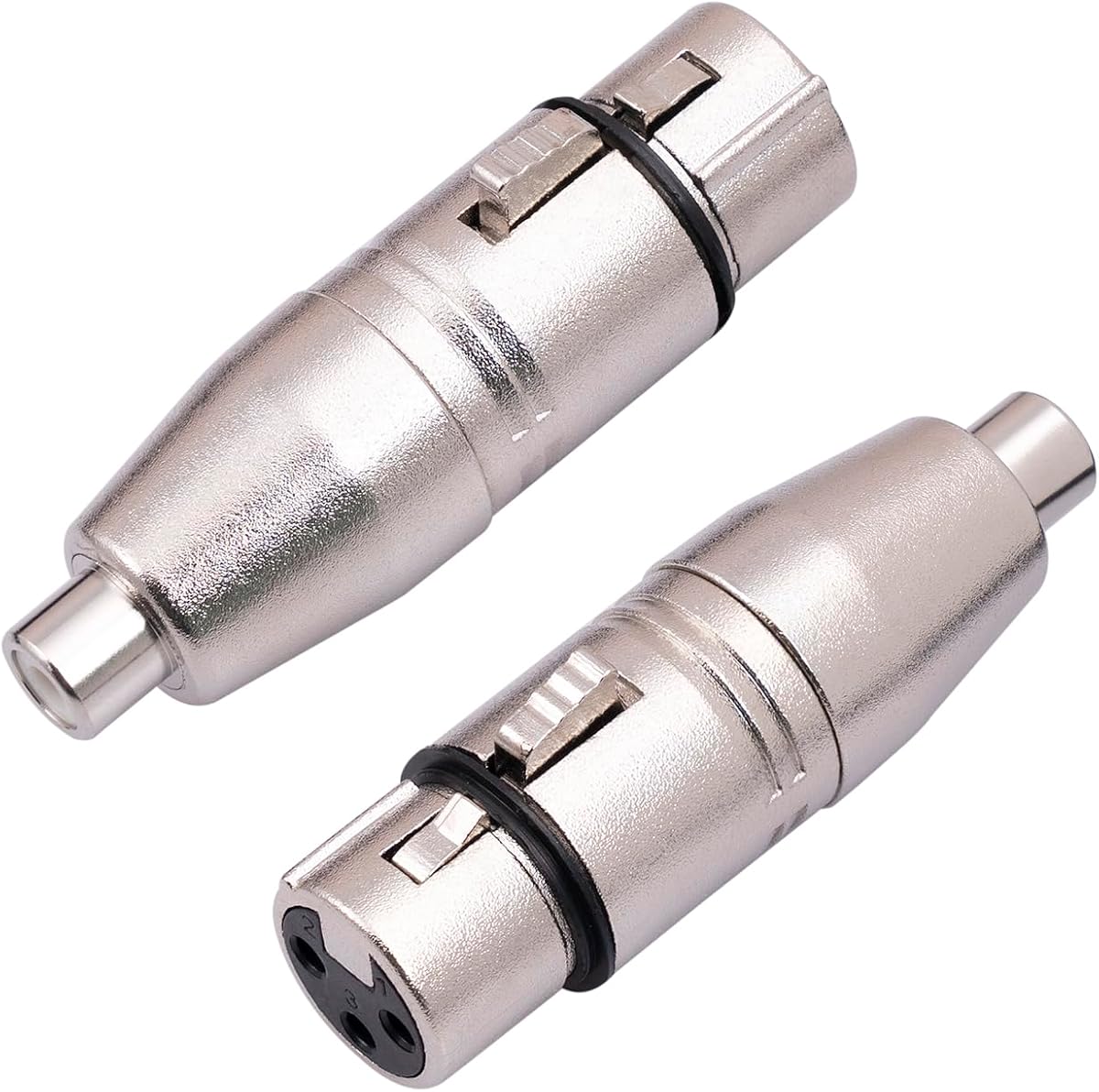


This two-pack is a practical all-around RCA to XLR adapter for users who need to connect an XLR male output to an RCA female input. It carries a 4.8 rating in the supplied data, placing it among the strongest options in the group. Its compact metal-coupler design is especially useful when a short connection is preferable to another full-length cable.
We may earn a commission when you buy through this link, at no additional cost to you.
The adapters use nickel-plated metal shells, while the joint between each XLR and RCA section is secured with rivets rather than screws. That design reduces the number of loose pieces and supports a firm connection. The package includes two adapters, making it practical for left and right channels or for keeping a spare on hand.
The main limitation is its gender configuration. The XLR side is male and the RCA side is female, so it works with an XLR male cable and an RCA male cable rather than accepting a female-ended XLR cable directly. As with all such unbalanced interconnects, it does not transform a balanced source into a truly balanced signal path.
This is a strong recommendation for mixers, amplifiers, players, microphones, and other compatible equipment where compact conversion is the priority. It combines one of the highest listed ratings with a useful two-pack format and sturdy construction, making it an approachable choice for home studios and temporary audio setups.
The coupler format keeps the signal path short and avoids the excess cable loops that can make a crowded equipment rack difficult to organize. It is especially convenient when both connected cables already provide enough length.
Nickel plating and rivet-secured joints provide a more substantial construction than a loose plastic connector set. The two-pack also gives you a ready spare for quick troubleshooting or a second channel.
We may earn a commission when you buy through this link, at no additional cost to you.
This option is built for a specific but common cable problem: joining a male-ended XLR cable to a male-ended RCA cable. Both ends of the adapter are female, allowing each cable to attach securely. Its 4.6 rating reflects solid customer feedback while the full-metal construction supports regular use.
We may earn a commission when you buy through this link, at no additional cost to you.
The electroplated exterior is designed to resist fading and corrosion, and the internal copper-nickel contacts are intended to support reliable connectivity. Rivet-fixed sections eliminate loose screws that could work their way out during repeated plugging and unplugging. Two adapters are included for stereo or spare use.
Because both ports are female, the adapter is less versatile than mixed-gender options. You need a male XLR cable and a male RCA cable to use it. It also provides a conventional unbalanced connection, so it should not be mistaken for a transformer-based balanced-to-unbalanced converter.
Choose this pair when your existing leads all terminate in male connectors and you prefer compact couplers over new cables. It is particularly suitable for mixers, recorders, and amplifiers, provided those devices use compatible RCA connections and accept an unbalanced signal.
The female-to-female format bridges two otherwise incompatible male-ended cables without requiring you to replace either lead. It is a simple way to preserve a cable collection while adding flexibility.
Securing the connector sections with rivets helps maintain alignment and avoids small screws that could be lost during setup or transport. The plated shell also adds resistance to everyday wear.
We may earn a commission when you buy through this link, at no additional cost to you.
This product is a pair of ready-made eight-inch cables with a three-pin male XLR connector on one end and a male RCA connector on the other. It carries a 4.6 rating and is a direct option when both devices require male-ended leads for a standard unbalanced connection.
We may earn a commission when you buy through this link, at no additional cost to you.
The listed conductor design uses 20AWG 4N oxygen-free copper in a shielded twisted-pair arrangement. High-density and aluminum-foil shielding are specified to reduce EMI and RFI interference, while gold-plated contacts and rubber strain relief are intended to improve contact reliability and withstand repeated handling.
Its main limitation is length. Eight inches is useful for equipment positioned close together, but it will not reach across a room or between separate racks. The male-to-male configuration also requires female connections on both connected pieces of equipment; users with existing male cables should check compatibility first.
This two-pack is best for compact studio desks, mixers near receivers, and other short-distance arrangements. It is a convenient alternative to separate couplers because the connector transition is already integrated into each cable, with added conductor and shielding specifications for a fixed-length setup.
The combination of braided and foil shielding is designed to protect the signal from electromagnetic and radio-frequency interference. That makes the cables suitable for connecting nearby powered and digital equipment in the same audio chain.
Unlike loose adapters, each cable provides a fixed transition between XLR and RCA. The two-pack supports left and right routing or gives you a ready replacement for a second connection.
We may earn a commission when you buy through this link, at no additional cost to you.
This two-pack combines an XLR male connector with an RCA female connector and stands out through its red-and-white channel identification. It has a 4.7 rating in the supplied data and is a strong choice for stereo installations where visually distinguishing the two sides can prevent routing errors.
We may earn a commission when you buy through this link, at no additional cost to you.
The contacts use 24K gold plating to reduce electrical resistance and support dependable signal transfer. Inside the solid zinc alloy bodies, oxygen-free copper conductors provide the connection path, while the metal construction is designed to shield against external electromagnetic interference and maintain a gap-free fit.
The configuration works with a male-ended XLR cable and a male-ended RCA lead. It does not include active conversion circuitry, so it should be understood as an unbalanced interconnection rather than a device for creating a balanced signal. Buyers whose equipment already uses that exact connector arrangement will get the most value from it.
This is our Editor's Choice because it combines useful color coding, robust metal construction, and widely applicable home or studio functions in a matched pair. It is particularly helpful for mixers, DJ controllers, stereo interfaces, home receivers, and amplifiers that rely on RCA inputs.
Red and white bodies let you identify left and right immediately. This is particularly useful in complex setups where several similar adapters or cables share the same rack space.
Gold-plated contacts and oxygen-free copper conductors are designed to maintain a clean, low-resistance connection. The zinc alloy shell adds mechanical protection and electromagnetic shielding around the signal path.
We may earn a commission when you buy through this link, at no additional cost to you.
This four-pack is designed for setups that need multiple XLR-to-RCA transitions, multiple spare connections, or a stereo pair in more than one location. Each adapter has a male XLR end and a female RCA end. The supplied 4.3 rating is the lowest in this roundup, so the selection should be based on quantity and construction rather than rating alone.
We may earn a commission when you buy through this link, at no additional cost to you.
The connectors have 5-micron 24K gold-plated contacts intended to reduce resistance and support stable transfer. Durable zinc alloy shells provide physical protection and are described as resisting electromagnetic interference. Red and white channel colors make it easier to keep left and right routing consistent.
As with the other male-XLR-to-female-RCA options, these adapters are passive unbalanced interconnects. They do not include circuitry for converting a balanced signal, and they require a male XLR cable and a male RCA cable. The four-piece quantity can also be more than some single-room installations need.
This set is a good fit for mobile rigs, rehearsal spaces, home studios, or technicians who prefer keeping several identical converters in the same kit. Its value lies in readiness: multiple color-coded adapters reduce the chance of being caught without the correct transition when moving or troubleshooting a setup.
Four matching units make it easy to standardize connections across multiple pieces of equipment. They are also useful as backups in temporary event or rehearsal configurations.
Zinc alloy bodies protect the internal contacts while helping limit interference. Gold plating supports consistent contact quality when the adapters are plugged and unplugged regularly.
We may earn a commission when you buy through this link, at no additional cost to you.
This two-pack provides a straightforward way to join male XLR and male RCA connections using compact adapters. It has a 4.3 rating and shares several design traits with the four-pack version, including gold-plated contacts, zinc alloy shells, and red-and-white channel identification.
We may earn a commission when you buy through this link, at no additional cost to you.
The 5-micron contact plating is designed for low resistance and reliable signal transfer, while the solid metal bodies are intended to protect the internal connection and resist electromagnetic interference. The two included adapters provide enough hardware for one stereo pair, with color coding helping establish consistent channel order.
Users must provide both connecting cables, and the adapters do not create a balanced pathway. The XLR male end also means the attached XLR lead must terminate in a female connector. Any hum, interference, or grounding issue associated with an unbalanced connection may still appear in the finished system.
This pair is a practical choice for a home theater receiver, stereo mixer, amplifier, DJ controller, or interface that accepts RCA and already uses an XLR male lead. It is best for users who value compact metal adapters and color coding but do not need the larger quantity supplied by the four-pack.
The compact adapter format lets existing XLR and RCA cables carry the signal between devices. It is useful when the supplied cables are already long enough to meet in the middle without awkward excess.
Matching red and white units help distinguish stereo channels at a glance. That visual cue can simplify setup and reduce the chance of reversing left and right.
We may earn a commission when you buy through this link, at no additional cost to you.
This Cardas Audio pair is the premium-focused selection in the roundup. It has a 4.8 rating in the supplied data and uses a female RCA to male XLR configuration. The focus is not simply on changing connector formats but on providing a tightly constructed reference-style connection for demanding audio systems.
We may earn a commission when you buy through this link, at no additional cost to you.
Its contact surfaces are plated with rhodium over silver, while the body uses non-magnetic eutectic brass with efficient shielding. The listed construction is intended to reject RF and clock-signal interference, and the secure locking connection helps maintain mechanical stability. The product is made in the USA and includes two pieces, one matched pair.
This is still an unbalanced connector-level solution rather than an active transformer, and it requires a male-ended XLR cable and a male-ended RCA cable. Its premium materials may be difficult to justify for a temporary microphone lead, but they can make sense in a carefully assembled home theater, recording, or reference listening system.
The pair is the best premium option for buyers who value secure contact, shielding, and refined materials over the lower cost of simpler adapters. Its 4.8 rating, locking design, and specialized contact plating make it a strong recommendation when the adapter will remain part of a high-quality permanent installation.
Rhodium-over-silver contacts and a non-magnetic brass body are intended to support clean signal transfer and reject interference. These details matter most in systems where adjacent electronics may introduce electromagnetic noise.
The locking connection is designed to resist accidental movement and disconnection. It is particularly useful in fixed installations where a loose joint would interrupt the listening or recording path.
We may earn a commission when you buy through this link, at no additional cost to you.
This cable is structurally different from the simple adapters because it takes one three-pin male XLR connection and splits to two male RCA plugs. It carries a 4.7 rating and is intended to make an XLR-equipped source usable with a stereo RCA input, including mixed consoles, microphones, tape recorders, and amplifier line outputs.
We may earn a commission when you buy through this link, at no additional cost to you.
The 1.5-meter length provides considerably more placement flexibility than the compact couplers and short transition cables in the roundup. High-density and aluminum-foil shielding are specified to reduce EMI and RFI interference, while the flexible PVC jacket, nickel-plated contacts, and rubber strain relief support regular handling.
The important consideration is signal routing. This is a Y-style adapter for a source whose XLR output is intended to feed left and right RCA channels. It should not be used to combine two independent mono XLR outputs into a stereo pair, because doing so can short or improperly mix the signals.
For a compatible source and a stereo RCA destination, this is a versatile and well-specified option. The longer cable can also integrate home theater and professional audio equipment, DJ controllers, and amplifiers without requiring separate RCA leads on the output side.
The Y configuration provides separate left and right RCA connections from one XLR source. That makes it useful for stereo line-level equipment that otherwise lacks RCA outputs.
At 1.5 meters, the cable can bridge more distance between devices than a short adapter. Shielding and strain relief help it remain practical in a semi-permanent setup.
We may earn a commission when you buy through this link, at no additional cost to you.
This two-pack offers integrated RCA male to XLR male cables measuring 4.92 feet each. With a 4.7 rating, it is a strong choice for home audio systems where users want a longer, more finished connection than a compact adapter can provide.
We may earn a commission when you buy through this link, at no additional cost to you.
The listed construction uses 4N oxygen-free copper conductors, a high-density tinned copper braid, double-layer PVC shielding, and ferrite cores. Its connectors use 5-micron 24K gold plating over pure copper cores. A heavy-duty nylon braid is designed to withstand pulling, repeated bending, and general wear while reducing tangles.
The male-to-male format requires female connection points on both the source and destination. It also provides a conventional unbalanced connection despite its high-fidelity construction. The substantial shielding and conductor specification cannot create balanced operation, but they can support a clean path in a well-designed system.
This pair suits amplifiers, CD or DVD players, DACs, power amplifiers, Hi-Fi systems, and subwoofer applications where the supplied compatibility matches the equipment. It is also a good visual match for a home system with exposed cable runs because the braided jacket is designed for durability and easy handling.
The tinned copper braid, PVC shielding, and ferrite cores work together to reduce electromagnetic and radio-frequency interference. That layered approach is useful around power electronics and digital equipment.
The nylon outer jacket is intended to resist fraying, pulling, and repeated flexing. It also makes these longer cables easier to coil and store than exposed conductors would be.
We may earn a commission when you buy through this link, at no additional cost to you.
This two-pack of six-inch cables is designed for users who need a male RCA connector to attach to a female XLR connection. It has a 4.5 rating and stands out for clearly documenting its unbalanced pin arrangement, which can make the product easier to evaluate for a specific system.
We may earn a commission when you buy through this link, at no additional cost to you.
XLR pin 2 is described as connected to the RCA positive pole, while pins 1 and 3 connect to the RCA negative pole. The manufacturer states that the products undergo testing before leaving the factory. Two short cables are included, and the 6-inch length is suited to compact desktop or rack arrangements.
The listed wide compatibility includes AV receivers, DVD and VCD equipment, equalizers, compressors, interleavers, and digital decoders. Some of these device types may use RCA for different kinds of audio or video signals, so users should verify the specific input and signal path rather than relying on connector shape alone.
The pair is best for close-range connections where a female-ended XLR cable needs to reach a male RCA input. It is less suitable when a longer run is required, and its unbalanced format should be considered when planning a larger installation.
The stated connection between XLR pin 2 and the RCA positive pole gives users a defined basis for evaluating the adapter. It is still important to confirm that the source and destination expect the same unbalanced signal arrangement.
At six inches, these cables are best used between nearby components. They help reduce clutter compared with a long cable when the devices are positioned close together.
We may earn a commission when you buy through this link, at no additional cost to you.
The most important purchasing decision is matching the adapter's connector genders, signal direction, and channel layout to the equipment. Construction, shielding, cable length, and material choices should then be considered according to how frequently and where the connection will be used.
Every cable or adapter has a male or female end at each connector, and those genders determine whether the parts physically fit. An XLR male to RCA female adapter accepts a female-ended XLR cable and a male-ended RCA cable. An XLR female to RCA male adapter does the opposite, while female-to-female and male-to-male variants support different cable combinations. Inspect the sockets on both devices and the gender of every existing cable before ordering.
Choose the configuration that directly matches your equipment rather than buying an adapter that requires several additional gender-changers.
XLR is commonly associated with balanced audio, while RCA is commonly used for unbalanced stereo or mono connections. Most adapters in this category are passive connector or cable solutions and do not contain active circuitry for true signal conversion. If one device offers balanced and unbalanced outputs, using its dedicated RCA or XLR connection is generally clearer than converting between formats.
Prioritize devices with native connections when signal quality or grounding behavior is critical.
A simple one-channel adapter may carry a single mono signal, while a matched red-and-white pair can organize left and right stereo channels. A dual-RCA Y cable serves a different purpose: it splits a compatible XLR source into left and right RCA outputs. It should not be used to combine two unrelated mono sources unless a proper summing interface is provided.
Confirm whether your source already carries stereo on one XLR connection or provides separate mono outputs.
Shielding helps protect the audio signal from electromagnetic and radio-frequency interference, while oxygen-free copper and plated contacts are intended to support reliable electrical transfer. Short couplers offer less opportunity to collect interference, and balanced XLR wiring can reject some noise when used in a truly balanced system. For longer cables, dense shielding, quality jackets, and strain relief become increasingly important.
Look for both shielding and a protected cable jacket, especially near power amplifiers, computers, dimmer switches, or other interference sources.
Nickel-plated, gold-plated, and rhodium-over-silver contacts serve different mechanical and electrical priorities. Gold plating is common on connection-friendly contact surfaces, while rhodium-over-silver appears in premium reference products. Metal shells, riveted joints, locking connections, braided jackets, and rubber strain relief all contribute to long-term durability. The best material choice is the one that matches the connector type and matches how often you will move the connection.
For frequent reconfigurations, prioritize secure joints and strain relief over decorative finishes.
Compact couplers keep the connection short, but both connected cables must still be long enough to meet. Integrated cable adapters range from six inches to nearly five feet in this roundup, with one Y-style option measuring 1.5 meters. A short lead is useful on a desk, while a longer cable can cross a rack or reach equipment positioned farther apart. Choose the shortest length that reaches without tension.
Avoid leaving excess cable coiled behind equipment because unmanaged loops can make future troubleshooting harder.
Red and white connector bodies make channel identification immediate, reducing the chance of reversing left and right or confusing separate signal paths. This matters most in stereo systems with multiple adapter pairs, but it also helps beginners during initial setup. Clear labeling around the equipment can provide the same benefit for uncolored products.
Choose color coding when fast setup, live operation, or multiple stereo routes are priorities.
Adapters designed for mixers, recorders, amplifiers, microphones, receivers, and DJ controllers can cover many common needs, but connector compatibility remains more important than a broad compatibility claim. A portable two-pack is convenient for mobile use, while a four-pack is useful for event kits and multi-room systems. Premium reference adapters are best reserved for permanent installations where their construction can be fully appreciated.
Match the pack size and construction to the actual number of connections you expect to maintain.
Begin by identifying the output connection on the source and the input connection on the destination. Power off the equipment when practical, attach the adapter to the appropriate XLR and RCA cables, and confirm that the signal is unbalanced where required. For a stereo pair, connect red to right and white to left consistently, then check the receiver or mixer input assignment.
Route cables without creating tight bends around the connector shells. Support both sides of a connection if tension is present, and avoid hanging a cable by the adapter alone. For a Y cable, verify that the XLR source is designed to provide the stereo pair represented by the two RCA outputs.
Disconnect adapters by gripping the connector housings rather than pulling on the cable. Store long cables loosely, avoid sharp bends, and keep the contacts dry and free of dust. Periodically inspect the shell, locking mechanism, strain relief, and connector surface, particularly when the setup is moved frequently or used in a dusty environment.
The correct choice depends on the gender of the cables and sockets you already have. An XLR male to RCA female adapter usually sits between a female-ended XLR cable and a male-ended RCA cable. Reverse those genders and you need an XLR female to RCA male adapter. Always inspect the hardware rather than relying only on the product name.
Most passive adapters in this category do not perform true balanced-to-unbalanced conversion. They provide a physical connection between connector formats, and the resulting path is unbalanced. If a device provides both balanced and unbalanced outputs, using its native RCA output is generally the better way to obtain an unbalanced signal.
An adapter coupler has a socket on each end and requires separate XLR and RCA cables. A short cable integrates the connector transition into the cable itself. Couplers are useful when you own suitable cables and want a compact connection, while integrated cables reduce the number of pieces and can be easier to route.
No. The cable is appropriate only when the XLR source carries the compatible stereo signal represented by the left and right RCA outputs. A standard microphone usually provides one mono XLR channel, and a dual-RCA Y cable is not a general method for creating stereo from an ordinary mono microphone.
The conventional color code is red for right and white or black for left. Adapters with red and white bodies make this easier to identify. You should also check the receiver, mixer, or interface labeling because manufacturers generally follow the same convention but may use black instead of white for the left channel.
Usually, yes, when you are connecting a balanced stereo source to separate RCA inputs. A matched two-pack supplies one transition for each channel. A dual-RCA Y cable is an exception when the source itself is designed to output a compatible left and right pair through one XLR connection.
A passive adapter does not remove ground-loop problems or guarantee a noise-free unbalanced connection. Power supplies, poorly balanced equipment, long parallel cable runs, and mixing signal and power cables can all contribute to hum. Using native outputs, keeping connections secure, avoiding unnecessary adapters, and separating power and audio cables can reduce the likelihood of noise.
Gold-plated contacts are common on adapters intended for convenient, repeated connections, while the rhodium-over-silver contacts in the premium Cardas option reflect a more specialized reference approach. Connector fit, system compatibility, and construction should drive the decision. Plating alone cannot compensate for an unsuitable gender configuration or poor overall system grounding.
The XLR male to RCA female two-pack is the most broadly useful budget choice, offering a 4.8 rating, metal construction, and a matched pair in a compact format. The color-coded 24K gold-plated two-pack stands out for easier stereo identification and flexible home or studio use, while the Cardas reference pair is the premium option for secure contact and specialized shielding.
Prioritize connector genders first, then confirm signal direction, mono or stereo routing, and cable length. Matched two-packs are generally the simplest route for standard stereo connections, short cables reduce clutter, and a Y cable is appropriate only when its source is designed to provide the corresponding left and right RCA signals.
Product prices and availability can change, so check the current listing and all included items before ordering. Also review the connectors on your equipment one final time, because even a well-made adapter cannot overcome an incorrect male or female configuration or an incompatible signal path.