
400AH Lead-Acid Battery Desulfator Maintainer
4.0Editor score
Handles batteries up to 400AH
Supports 12V through 48V
Automatically recognizes voltage
Compare ten Battery Desulfator Solutions in this expert guide, covering liquid additives and pulse devices for lead-acid batteries, compatibility, and capacity.
Battery desulfator solutions can help weak lead-acid batteries accept and retain a charge by addressing sulfate buildup on internal plates. The right choice depends on battery chemistry, condition, capacity, and whether you prefer a simple liquid additive or a powered pulse device.
This guide compares ten liquid and electronic desulfation products using their stated compatibility, treatment capacity, voltage range, application requirements, and intended uses. It covers maintenance products for cars, golf carts, marine batteries, RVs, solar systems, and other lead-acid applications.
Each review highlights the product's strongest benefits and practical limitations so you can judge the fit for your battery setup. Product ratings and availability can change, and current prices should always be checked before buying.
4.0Editor score

4.1Editor score

3.8Editor score
The comparison below distinguishes liquid additives from electronic pulse desulfators while comparing battery compatibility, voltage or capacity coverage, application method, and the number of batteries each product is designed to treat.




This 64-ounce battery restorer and desulfator is a liquid treatment designed to remove harmful sulfation buildup and improve charge capacity in lead-acid batteries. Its 3.8 rating reflects a mixed customer history, but its stated versatility across cars, golf carts, boats, motorcycles, tractors, RVs, bikes, and ATVs gives it broad potential appeal.
We may earn a commission when you buy through this link, at no additional cost to you.
The main strength is its versatility. Rather than being confined to a single application, it is positioned as a general maintenance solution for serviceable lead-acid batteries. Its 64-ounce capacity also makes it more practical than a small bottle for owners maintaining several batteries, while the additive format may appeal to people who want a straightforward alternative to installing a powered desulfator.
There are important trade-offs. The product information does not provide the same precise per-cell dosing guidance offered by several competing liquids, and it does not clearly state compatibility with AGM, gel, or other sealed battery chemistries. It should not be assumed to restore a physically damaged, dry, frozen, or end-of-life battery merely because it contains a desulfating additive.
This is most appropriate for an owner with several serviceable lead-acid batteries who wants one liquid product for different vehicles. Verify the label directions, battery chemistry, and condition before treating anything, and select a more precisely documented option if you have sealed batteries or need treatment quantities for an entire fleet.
The broad vehicle range is the central convenience. A single 64-ounce container can serve applications ranging from a golf cart to an ATV or boat, provided every battery is a compatible flooded lead-acid type and the directions are followed carefully.
Liquid additives are best suited to batteries that accept a charge and still have mechanically sound cells. This product is a maintenance option for reducing the effects of sulfation, not a substitute for a charger or a replacement battery that has already lost its structural integrity.
We may earn a commission when you buy through this link, at no additional cost to you.
This one-gallon Battery Restore solution is a high-capacity liquid desulfator for serviceable flooded lead-acid batteries. It has a 3.8 rating and is explicitly positioned for fleets, carts, boats, RVs, forklifts, solar storage, and other applications. One gallon can treat approximately three to six batteries depending on voltage and cell count.
We may earn a commission when you buy through this link, at no additional cost to you.
Its standout feature is the combination of scale and dosage detail. The listing specifies 2 ounces per cell for 6V batteries and 3 ounces per cell for 8V and 12V batteries, making it easier to estimate consumption for a complete golf cart bank. It can also cover a six-battery pack with solution remaining, a useful margin for fleet operators who need repeatable dosing.
The trade-off is chemistry and time. It does not work with gel, AGM, or maintenance-free batteries, completely dry cells, or frozen batteries. Most users are said to notice measurable improvement after seven to ten days of regular charging, so it is not an instant-fix product. Its non-toxic formula simplifies routine handling, although batteries still need to be handled with care.
Choose this gallon-sized solution if you maintain several flooded batteries and want a product with clear application rates. It is well suited to courses, marinas, farm operations, solar installers, and collectors. For one small battery bank, a smaller bottle may be more practical, and for sealed batteries you will need an electronic solution specifically approved for that chemistry.
The ability to treat three to six batteries in one container is what separates this option from compact personal-use additives. It gives fleet operators a larger working volume and reduces the likelihood of running short midway through a multi-battery service.
The formula is intended to work gradually as the battery undergoes normal charging. Allowing roughly seven to ten days of regular charging can give it the opportunity to dissolve sulfate deposits and reveal whether the battery's capacity is recovering.
We may earn a commission when you buy through this link, at no additional cost to you.
The SPARK Golf Cart Battery Restore Solution is a 64-ounce flooded lead-acid desulfator with a 3.9 rating. It is designed for 6V, 8V, and 12V batteries, and its dosage guidance makes it particularly practical for owners maintaining a complete six-battery golf cart setup.
We may earn a commission when you buy through this link, at no additional cost to you.
The application rates are clearly stated: 2 ounces per cell for 6V batteries, 1.5 ounces per cell for 8V batteries, and 1 ounce per cell for 12V batteries. The manufacturer says one bottle can condition all six batteries in a golf cart pack and still have solution left over. That margin, combined with annual preventive-maintenance guidance, adds flexibility beyond emergency rescue.
Its limitations are meaningful. It is not compatible with AGM, gel, frozen, or completely dry batteries, and its best results are typically expected on batteries that are one to five years old and still accept a charge. The formula addresses sulfation rather than physical damage, and it cannot reverse every form of capacity loss.
This product is a strong fit for golf cart owners who want a liquid treatment with straightforward per-cell instructions. It also lists cars, trucks, motorcycles, boats, RVs, tractors, ATVs, marine batteries, forklifts, and solar systems as potential uses. Confirm that every battery is a compatible flooded type, calculate the dosage from the cell count, and maintain a normal charging schedule afterward.
Specific cell dosing makes this easier to use than many general-purpose additives. Owners can calculate the required amount for each battery and confirm that a full cart pack will be covered without opening multiple containers.
The listing recommends one preventive treatment per year and no more than three treatments over a battery's life. This approach treats the product as recurring maintenance for a healthy but sulfation-prone battery rather than an unlimited repair product.
We may earn a commission when you buy through this link, at no additional cost to you.
This professional battery desulfator is an electronic pulse reconditioner rated 4.1, the highest rating among the ten products in this guide. It supports 12V, 24V, 36V, 48V, 60V, and 72V systems across AGM, gel, VRLA, SLA, and flooded lead-acid batteries.
We may earn a commission when you buy through this link, at no additional cost to you.
Its broad compatibility is the key advantage. Instead of limiting owners to serviceable flooded cells, it can be considered for sealed automotive batteries, golf cart packs, RV systems, solar storage, marine installations, and backup power. The device uses high-frequency, low-current pulses intended to prevent and dissolve sulfate buildup, and it can run as many as 30 intelligent desulfation cycles.
The product is explicitly not a charger, which is an important distinction. It works best when paired with a proper charging cycle, and results generally require two to four weeks depending on the battery's condition. Its built-in low-voltage cutoff, internal fuses, reverse-polarity protection, and aluminum housing add practical safeguards, but the device still needs correct installation.
This is the most versatile option for a mixed battery inventory or a sealed battery system. It also suits larger installations because of its unusually broad voltage range. Choose it when you need one electronic device to maintain several chemistries, and use a suitable charger alongside it. It is less convenient than a liquid additive for owners who do not want to run and monitor powered equipment.
Supporting both sealed and flooded chemistries makes this device useful where liquid additives are not. A technician or fleet operator can apply the same pulse-based maintenance approach across cars, RVs, solar systems, marine equipment, golf carts, and standby banks.
Because the unit is not a charger, it should be incorporated into a proper charging routine. The stated two-to-four-week window allows the pulses and charging cycles to work together instead of promising an immediate increase in power.
We may earn a commission when you buy through this link, at no additional cost to you.
The Battery Renew Solution is a one-gallon liquid desulfator with a 4.1 rating. It is intended for flooded lead-acid batteries that are weak, underperforming, or no longer holding a charge as well as they once did, but it is not presented as a way to revive dead or end-of-life batteries.
We may earn a commission when you buy through this link, at no additional cost to you.
One gallon treats approximately three to six batteries, depending on voltage and cell count. The product is positioned for golf courses, marinas, forklifts, solar installations, riding mowers, marine batteries, RV house banks, floor scrubbers, and other fleet applications. It can take up to ten days of regular charging for full effect, so the treatment should be planned as a maintenance cycle rather than a quick turnaround.
Its main limitation is battery type. It will not work with gel, AGM, completely dry, frozen, dead, or damaged batteries, and the listing explicitly recommends it for serviceable batteries roughly one to five years old that still accept a charge. Those exclusions make careful testing before application essential.
This gallon is a good choice for professional operations or owners with several flooded batteries that need coordinated treatment. It is less suitable for a single 12V automotive battery, and it should not be purchased with the expectation that it can reverse a cracked case or permanently damaged cell. Correct dosage and continued normal charging are central to obtaining a fair result.
Treating several batteries in the same maintenance window can produce a more consistent fleet. The gallon volume supports a group of carts or vehicles, while the stated dosage guidance helps operators apply the formula proportionally.
Up to ten days of charging gives the product time to work on sulfate deposits. Measuring performance before and after treatment can help determine whether the battery's capacity has improved or whether physical damage or end-of-life condition is responsible for poor performance.
We may earn a commission when you buy through this link, at no additional cost to you.
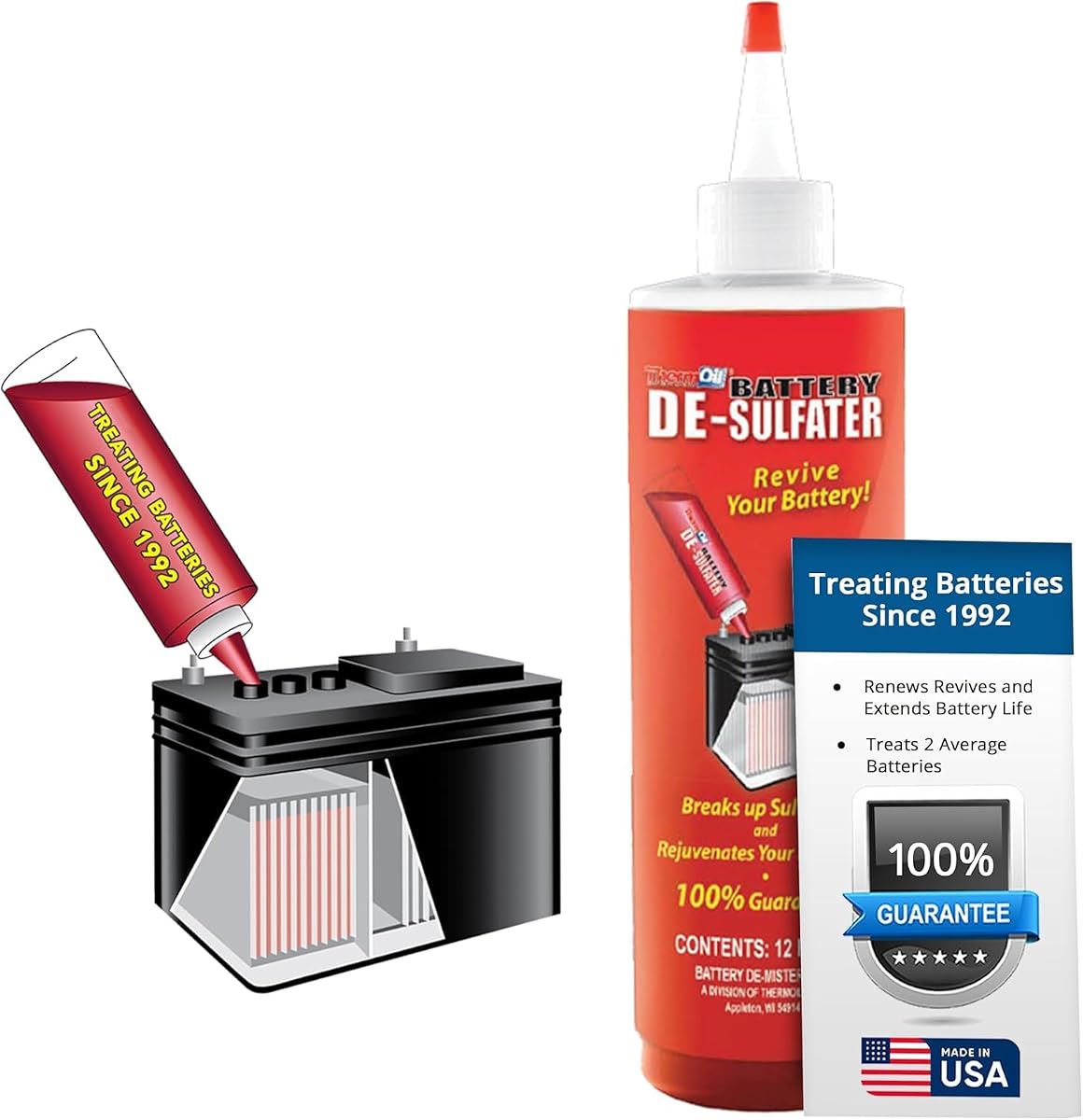
The 12-ounce Thermoil DeSulfater is a compact liquid battery-care product with a 3.8 rating. It uses a non-acid electrolyte additive intended to break down sulfation corrosion on battery plates and insulators, helping reduce internal heating, resistance, and power inefficiency.
We may earn a commission when you buy through this link, at no additional cost to you.
Its defining detail is the absence of Epsom salts, which the manufacturer contrasts with other liquid desulfators. The formula is described as non-hazardous and suitable for all lead-acid batteries, and the company states that it has offered battery treatment since 1992. A 100 percent guarantee is also advertised, giving the product a distinct assurance compared with most listings.
The primary limitation is quantity. A 12-ounce container is most convenient for a car, a smaller battery bank, or maintenance of a limited number of cells. It is less compelling for a complete golf cart fleet, especially when the larger Thermoil version can treat the same chemistry with more volume. As with any additive, the battery must remain mechanically sound for meaningful results.
This is an attractive option for an individual who wants a compact, non-hazardous treatment without an electronic device. It may be especially appealing for maintenance of mechanically sound lead-acid batteries of different makes, ages, and sizes. Read the label for dosing, confirm the battery is serviceable, and use normal charging to allow the treatment to work.
The zero-Epsom-salt claim is the most notable technical distinction in the listing. For buyers who have encountered electrolyte additives of different compositions, this gives the product a clearly defined formulation that can be compared with alternatives.
The 12-ounce size works well when a single vehicle or small battery group needs attention. It also reduces the amount of liquid stored between maintenance sessions, although larger fleets should consider a higher-capacity container.
We may earn a commission when you buy through this link, at no additional cost to you.
The 64-ounce Thermoil DeSulfator offers the same general treatment concept as the company's smaller bottle but with enough volume for more batteries or repeated service. It has a 3.8 rating and is marketed as a non-acid electrolyte additive for mechanically sound lead-acid batteries.
We may earn a commission when you buy through this link, at no additional cost to you.
The formula is described as containing no Epsom salts. According to the listing, it targets sulfation corrosion on plates and insulators, helping reduce internal heating and resistance while preserving new and used batteries. It is also said to be safe across lead-acid batteries regardless of make, age, or size, which makes the large format useful for mixed fleets.
The important limitation is the condition of the cells. A chemical treatment cannot reconstruct a cracked case, replace a shorted cell, or restore a battery that has reached the end of its service life. The listing also provides less specific application-rate information than some competing gallon-sized products, so users should consult the physical label and battery documentation before applying it.
Choose this bottle when you maintain several mechanically sound lead-acid batteries and prefer a non-hazardous liquid over a powered pulse device. It is a larger-format alternative to the 12-ounce Thermoil product, making repeated maintenance easier to support. The manufacturer's guarantee adds reassurance, but sound battery condition and correct application remain the basis of any realistic outcome.
The larger volume reduces the chance of running short when treating multiple batteries. It is a more practical choice than a small personal bottle for golfers, boat owners, or service technicians who expect to use the formula throughout the season.
Desulfation is most relevant when plates and cells are intact but chemical deposits are restricting performance. A mechanically sound battery gives this additive a reasonable foundation, while damaged or end-of-life units may still need replacement.
We may earn a commission when you buy through this link, at no additional cost to you.
The 400AH Lead-Acid Battery Desulfator Maintainer is a compact electronic device with a 4.0 rating. It uses high-frequency peak pulses intended to prevent lead sulfate crystals from adhering to electrodes and gradually break down existing deposits, supporting longer battery life.
We may earn a commission when you buy through this link, at no additional cost to you.
The capacity ceiling is its most useful technical feature. It supports 12V through 48V systems and batteries up to 400AH, which covers many automotive, deep-cycle, and stationary lead-acid installations. It can also be used with a charger, and its automatic voltage recognition simplifies setup after connecting the red lead to the positive terminal and black lead to the negative terminal.
The main constraint is the need to assess voltage before use. The instructions advise charging first when a 12V battery is below 11.5V; above that threshold, the maintainer can be used. Results may take two to three weeks and vary with battery use and the amount of crystallization. Its voltage ceiling is also lower than that of the 12V–72V electronic option in this guide.
This is a sensible choice for an owner who wants an affordable electronic alternative to a liquid additive and has batteries within the 12V–48V and 400AH limits. It is particularly practical for a large deep-cycle bank that can benefit from sustained pulse maintenance. Test the battery first, ensure polarity is correct, and pair the device with charging when voltage is low.
Automatic voltage recognition reduces the chance of selecting the wrong mode manually. Once connected correctly, the device identifies the battery voltage and begins its pulse-maintenance function, which is convenient for recurring use.
The 400AH ceiling gives the device room for substantial stationary or deep-cycle installations. It remains below larger multi-battery voltages, so check the complete battery bank's nominal voltage before purchasing.
We may earn a commission when you buy through this link, at no additional cost to you.
This SPARK Battery Restore Solution is a 64-ounce liquid desulfator aimed primarily at golf cart batteries. Its 2.6 rating is the lowest in this comparison, so buyers should examine recent customer feedback carefully. The product information nevertheless presents a conventional flooded lead-acid treatment with clear application rates.
We may earn a commission when you buy through this link, at no additional cost to you.
It supports 6V, 8V, and 12V batteries and lists golf carts, cars, trucks, motorcycles, boats, RVs, tractors, ATVs, marine batteries, forklifts, and solar systems among its applications. One bottle can treat a complete six-battery golf cart pack with solution remaining. The dosage is 2 ounces per cell for 6V batteries, 1.5 ounces per cell for 8V batteries, and 1 ounce per cell for 12V batteries.
Its lower rating is the most important reason for caution. AGM, gel, frozen, and completely dry batteries are excluded, and best results are generally expected from batteries that are one to five years old and still accept a charge. Allowing seven to ten days of normal charging is necessary to judge the result, and annual use with no more than three treatments over the battery's life is recommended.
This product may still fit a well-maintained golf cart owner who wants a convenient liquid solution, but the rating warrants more diligence than the better-reviewed SPARK listing. Confirm the battery's chemistry and condition, compare customer comments, and test performance before and after treatment. Its dosing clarity and large container are positives, but the lower rating prevents a stronger recommendation.
The 64-ounce volume is proportioned to treat all batteries in a typical six-battery cart with solution left over. That makes the product easier to use for a complete pack than a small personal bottle.
A 2.6 rating signals that experiences may be inconsistent, even though the stated formula and dosing are sensible. Reviewing customer feedback, verifying recent availability, and understanding the non-compatibility limits can prevent avoidable disappointment.
We may earn a commission when you buy through this link, at no additional cost to you.
The PL04C-400AH Blue is an automatic pulse lead-acid battery reconditioner with a 3.9 rating. It uses controlled pulse technology to help dissolve sulfate crystal buildup on battery plates, restore capacity, and extend service life without requiring manual operating cycles.
We may earn a commission when you buy through this link, at no additional cost to you.
The installation process is straightforward. It connects to battery terminals and is designed for continuous maintenance and reconditioning, making it suitable for owners who prefer an always-connected device over a liquid treatment that must be added and followed by a specific charging schedule. The stated applications cover car, marine, RV, and deep-cycle batteries.
The limited specifications are the drawback. Compared with the better-documented pulse devices in this guide, the listing does not provide a clear supported voltage range, chemistry-by-chemistry compatibility list, or detailed safeguards. The 400AH appears in the model designation, but users should verify the complete electrical specifications before connecting a large bank.
This is a practical choice for a common battery that a user can identify as compatible and wants to maintain automatically. It is best for a straightforward installation where clear terminal access and ongoing connection are acceptable. For a complex fleet with mixed voltages, the 12V–72V reconditioner offers more explicit compatibility information and a broader operating range.
Automatic pulse operation removes the need to run repeated manual desulfation selections. Once properly connected, the device can focus on continuous maintenance and gradual capacity recovery.
Because the listing gives fewer detailed limits than competing devices, confirm battery voltage, capacity, and polarity from the product documentation. Safe connection and a suitable charger remain important even with an automatic reconditioner.
We may earn a commission when you buy through this link, at no additional cost to you.
Choosing a desulfator starts with the battery's chemistry, condition, voltage, and capacity, followed by a comparison between liquid additives and electronic pulse devices. The right product should support your installation, match your maintenance habits, and set realistic expectations without implying that damaged batteries can be repaired.
Compatibility is the first filter. Many liquid products in this guide work only with flooded, serviceable lead-acid batteries and explicitly exclude AGM, gel, maintenance-free, frozen, or completely dry units. Electronic devices may support a wider selection, including AGM, gel, VRLA, and SLA batteries, but you should still verify the manufacturer's instructions. Using the wrong treatment can waste money, reduce the value of the product, or create handling problems around a battery that should be serviced differently.
Desulfation is most useful for a battery that still accepts a charge but has reduced capacity, shortened runtime, or unusual heating. A completely dry, dead, cracked, shorted, or end-of-life battery is a different problem. Several products in this guide state that the best candidates are approximately one to five years old and mechanically sound. Testing the battery before treatment establishes a baseline and helps you distinguish chemical restoration from damage that replacement will be required to solve.
Liquid additives are convenient, require less equipment, and can be dosed into individual cells according to voltage and cell count. Their effects usually unfold over repeated charging cycles, so patience and a normal charger are necessary. Electronic pulse devices offer automatic or ongoing maintenance and can cover more battery chemistries, but they require a connection to the battery, may need to remain attached, and use more specific voltage and safety considerations.
Voltage range must match the entire battery bank rather than only a single battery. The liquid products commonly support combinations of 6V, 8V, and 12V batteries, while the electronic options range from 12V–48V to 12V–72V. A six-battery golf cart pack may consist of several individual units, and mixed series banks can exceed the input of a lower-range device. Confirm nominal voltage, cell count, and system arrangement before selecting a product or calculating additive dosage.
Capacity determines how far one container or device will stretch. Twelve-ounce bottles suit occasional individual-battery service, while 64-ounce and one-gallon liquids can cover complete golf cart packs or groups of batteries. The listed gallon products generally treat three to six batteries depending on voltage and cell count. Electronic models use capacity ratings such as 400AH to indicate the size of battery they can support. Match that limit to the actual Ah rating of the bank, not just the number of batteries.
Liquid products require careful cell-level dosing, normal charging afterward, and sometimes several days or weeks before results become visible. Their simplicity at application time is offset by a scheduled treatment process. Pulse devices generally connect to terminals and may run automatically, but they occupy a setup that must remain accessible and may be used alongside a charger. Choose the method you can actually maintain, because inconsistent charging is a major reason a treatment may appear ineffective.
Even a maintenance product requires sensible handling. Look for explicit polarity instructions, low-voltage cutoffs, fuses, and reverse-polarity protection on electronic devices. For liquids, review the label, use the stated dose, avoid incompatible battery types, and keep the solution away from eyes, skin, and children. A non-toxic or non-hazardous formula can simplify handling, but it does not change the need to protect yourself from battery acid, electrical current, sparks, and contaminated tools.
Set a realistic timeline. Liquid treatments commonly need seven to ten days of regular charging, while electronic devices may require two to four weeks or multiple desulfation cycles. Performance depends on battery age, storage history, charging habits, sulfation severity, and physical condition. A product claiming to restore capacity cannot create new lead, repair a missing plate, or fully recover a battery whose active material has been permanently lost. Measure runtime or performance before and after a fair trial period.
Begin by identifying every battery's chemistry, nominal voltage, age, and condition. Confirm that the battery is mechanically sound, still accepts a charge, and is not frozen, cracked, dry, or at the end of its useful life. Test and record its resting voltage, charging behavior, and performance so you have a baseline for evaluating the treatment.
For a liquid product, read the complete label, identify the number of cells in each battery, and calculate the stated dose per cell. Add the solution only to compatible serviceable cells, secure the caps, and clean any spilled liquid. Then use the battery's normal charger and maintain the recommended charging cycle. For an electronic device, check voltage and polarity, connect the leads correctly, and use a compatible charger whenever the instructions call for one.
Give the product the full stated treatment period without repeatedly changing products or interrupting the charging routine. After treatment, charge the battery fully, allow it to rest as appropriate, and compare its performance with the baseline. Store devices and containers away from extreme temperatures, children, and battery acid, and disconnect powered units during long periods when they are not needed.
A battery desulfator is designed to reduce or dissolve lead sulfate deposits that form on lead-acid battery plates during charging and discharge. Liquid additives work chemically inside compatible cells, while electronic devices use controlled pulse technology. Neither type creates new battery material, so severely damaged or end-of-life batteries may not recover.
No reliable desulfator should be expected to revive every dead battery. Most products are intended for batteries that still accept a charge and are mechanically sound. A battery that is completely dry, frozen, cracked, shorted, or physically damaged needs a specialist assessment, appropriate charging where safe, or eventual replacement.
It depends entirely on the formulation and label. Many liquid products in this guide explicitly exclude AGM, gel, and maintenance-free batteries because they are sealed or valve-regulated. Electronic pulse devices often state support for those chemistries, but you should still follow the manufacturer's compatibility instructions and confirm the battery voltage and charging requirements.
Liquid treatments generally need several days of regular charging, with many listings indicating roughly seven to ten days. Electronic pulse devices often state that visible improvement can take two to four weeks. The result depends on battery age, sulfation level, prior charging habits, physical condition, and whether the battery remains on a proper charging cycle.
Some electronic products are designed to operate alongside a charger, while liquid additives normally require normal charging after application. Follow the product instructions because the charger, device, and battery chemistry must work together safely. Never improvise connections, bypass polarity guidance, or connect equipment to a battery that has leaked, frozen, or sustained physical damage.
Several 64-ounce products are specifically described as treating all six batteries in a typical golf cart pack with solution remaining, while one-gallon products may cover three to six batteries depending on voltage and cell count. Exact consumption varies, so calculate the dose for every cell and consult the bottle label rather than assuming every pack has the same configuration.
No. A charger replenishes energy through a controlled charging cycle, while a desulfator targets sulfate buildup that can interfere with charging and capacity. Some pulse desulfators explicitly need to be paired with a charger, and liquid treatments are also normally followed by regular charging. A desulfator cannot replace a proper charger.
Start with a battery test and a charge attempt. A good candidate is mechanically sound, compatible with the selected treatment, able to accept a charge, and showing symptoms such as reduced runtime or poor charge retention. Record its performance before treatment and compare it after the full recommended cycle, while keeping replacement as an option if capacity does not recover.
The 12V–72V Battery Desulfator Reconditioner is the leading choice for buyers who need broad chemistry and voltage support, while the 400AH Battery Desulfator Maintainer offers a focused electronic option for 12V–48V systems. The one-gallon Battery Restore solution stands out for fleet-scale liquid treatment, clear dosing, and coverage of multiple flooded lead-acid batteries.
Prioritize compatibility before every other consideration. A device with more features cannot help if it does not support your battery chemistry or bank voltage. For liquid additives, verify the cell-level dosage, battery condition, and required charging period. For pulse devices, confirm polarity, voltage, amp-hour capacity, charger compatibility, and the amount of time needed to evaluate a gradual result.
Finally, compare current product details, customer feedback, and prices before ordering, since ratings, availability, and promotions can change. Desulfation is best approached as measured maintenance for a battery that still has usable structure, not as a guaranteed substitute for a sound charger or a replacement battery when damage is already severe.