
VTech VG232
4.3Editor score
Large backlit display
Oversized easy-push buttons
14-minute digital recorder
Explore the best answering machines for landline phones that are easy for seniors, comparing large displays, loud audio, call blocking, and message capacity.
An answering machine for a landline phone should be easy to hear, read, and operate, especially for older adults who may have reduced vision or hearing. The right system also needs dependable message recording, clear caller information, and controls that do not require navigating a complicated setup process.
The guide compares ten answering-machine phones based on accessibility features, display visibility, ringer and speech volume, call screening, recording capacity, corded or cordless design, and compatibility with hearing aids. It covers options for households that prioritize simple controls, loud alerts, photo speed dial, or protection from unwanted calls.
Each pick highlights the features most relevant to seniors, along with practical limitations to consider. Ratings and specifications reflect the supplied product information, while prices and availability can change. Buyers should compare the current product page, their telephone service, and their household needs before purchasing.
4.3Editor score

4.2Editor score
4.1Editor score
This side-by-side comparison focuses on the controls, audio features, answering-system capacity, and calling formats that matter most when selecting a senior-friendly landline phone.


The VTech VG232 combines a cordless handset, full-duplex speakerphone, and a 14-minute digital answering machine in an accessibility-focused design. Its 4.3 rating reflects a strong balance of useful features. The large high-contrast backlit display, oversized buttons, and hearing aid compatibility make it especially approachable for seniors who want straightforward controls without advanced complexity.
We may earn a commission when you buy through this link, at no additional cost to you.
One of the strongest features is the integrated call-screening system. Users can review incoming calls before answering, check messages remotely from any phone, and see the number of waiting messages on the base. Messages remain on the phone without a subscription or recurring service. The full-duplex speakerphone also allows both people to talk at once, which is useful for hands-free conversations in the kitchen or living room.
The main limitation is its 14-minute recording capacity, which is shorter than several other systems in this guide. It also does not announce caller names aloud, so a user with limited vision may still need to look at the display. Nevertheless, the generous button sizes, strong backlighting, and 50-name caller history compensate for those limitations in a practical everyday system.
This is a strong recommendation for a senior who wants a familiar cordless phone, an integrated answering machine, and clearly marked controls without paying for a more specialized amplified model. It is also a sensible starting point for households that do not need a photo speed-dial panel or exceptionally loud ringer. For general accessibility and balanced feature coverage, the VG232 is difficult to overlook.
The large high-contrast backlit display keeps names, numbers, and menu choices easier to read in dim rooms. Oversized buttons reduce the chance of pressing the wrong key, while the built-in caller log stores up to 50 names and numbers for reference.
The answering system stores messages, announcements, and memos directly on the base. Call screening, remote access, and a visible message counter help users understand when someone has called and retrieve a recording without complicated menu navigation.
We may earn a commission when you buy through this link, at no additional cost to you.
The AT&T BL102 DECT 6.0 earns a 4.2 rating by combining a 22-minute digital answering system with one of the most useful accessibility features in this category: spoken caller identification. Instead of requiring a senior to read the display, the handset can announce who is calling. That feature is especially helpful for low-vision users.
We may earn a commission when you buy through this link, at no additional cost to you.
Call management is another major strength. Robocalls can be blocked automatically before they ring, and users can permanently blacklist a number using a dedicated handset key. The blocking directory holds up to 1,000 names and numbers. A full-duplex speakerphone, intercom, and Audio Assist make everyday communication more flexible, while the voice guide supports initial setup.
The 2-inch high-contrast screen, enlarged font, and lighted keypad help users read call information and dial in low-light conditions. Some buyers may find the numerous blocking and menu controls more involved than a simple answering system. Users should also remember that aggressive call filtering can block a legitimate call if a family member does not recognize the number beforehand.
This phone is a particularly good match for a senior who wants fewer visual checks and more spoken information. It also suits households concerned about repeated unwanted calls and needing a larger message capacity than basic models provide. For a broad combination of voice assistance, call screening, and accessible cordless calling, the BL102 stands out.
The caller ID announcer reads the caller's name before the user decides whether to answer. This reduces dependence on the display and makes the phone particularly accessible for low-vision seniors or anyone who has trouble reading small text.
The smart call blocker can filter robocalls automatically, while a dedicated key makes it easy to add a number to the permanent blacklist. The directory can hold up to 1,000 entries, giving the household substantial control over incoming-call clutter.
We may earn a commission when you buy through this link, at no additional cost to you.
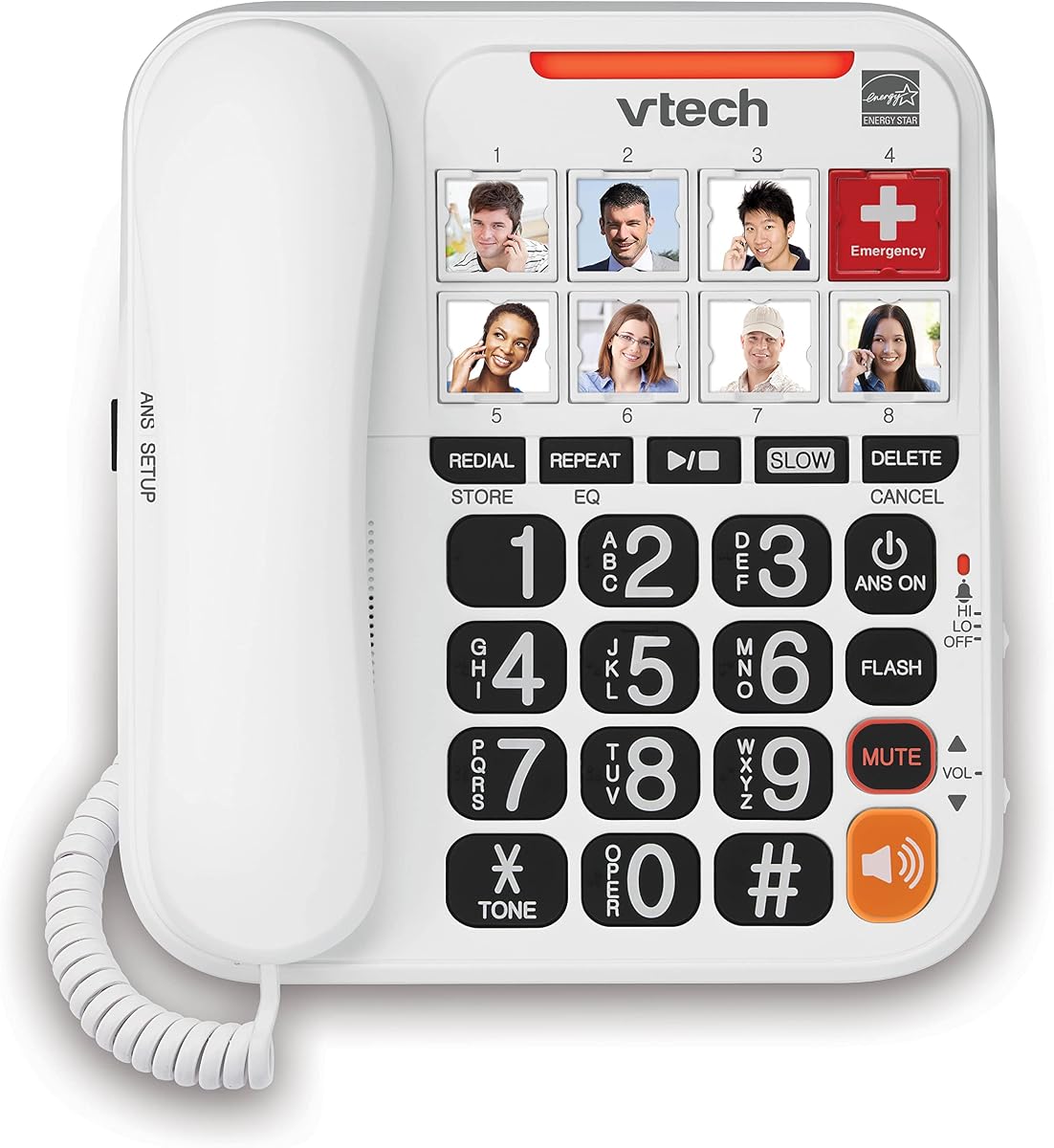
The VTech SN1127 is designed specifically for seniors and combines an integrated digital answering machine with amplified calling features. Its 4.1 rating reflects a specialized approach rather than a basic phone with added accessibility controls. The standout elements are the adjustable 90dB ringer, one-touch 40dB audio booster, visual alert, and eight photo speed-dial buttons.
We may earn a commission when you buy through this link, at no additional cost to you.
The photo speed-dial panel provides a meaningful memory aid. A family member or caregiver can assign a familiar photograph and number to each large key, allowing a user to make an important call with one press. The large high-contrast display, oversized buttons, spoken caller ID, and hearing aid compatibility reinforce the phone's senior-focused design.
Its fully corded construction is both an advantage and a constraint. Because basic calling works during power outages, it can remain available when electricity is interrupted. However, the handset cannot be carried away from the base, which may be less convenient for users who regularly move around the home. Extra-loud and amplified settings may also require occasional adjustment depending on the room and user's hearing needs.
This is the strongest choice in the guide for a senior with meaningful hearing loss, a need for visual call alerts, or a preference for photo-based contact buttons. Caregivers may also appreciate the straightforward one-touch dialing layout. If mobility during calls is unimportant, its loudness, memory support, and dependable corded operation justify selecting this premium senior phone.
Incoming audio can be boosted by as much as 40dB with a one-touch control, while the ringer can be raised to 90dB. A bright visual indicator adds another way to notice incoming calls when the sound alone is insufficient.
Eight large speed-dial keys accept photographs and associated phone numbers. This gives users a visual, one-touch way to reach family, caregivers, and other frequent contacts instead of recalling a name and memorizing a number.
We may earn a commission when you buy through this link, at no additional cost to you.
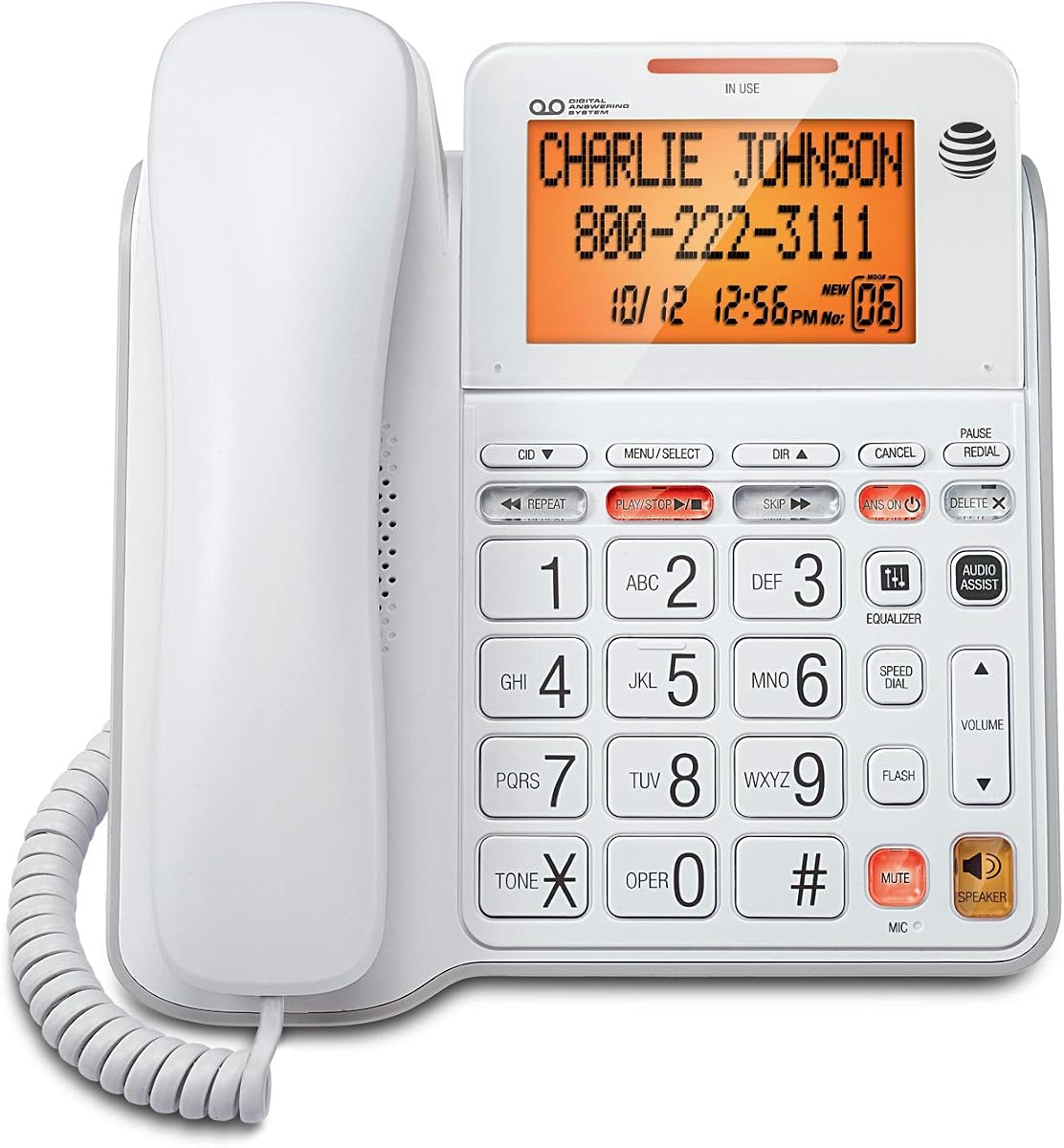
The AT&T CL4940 has a 4.4 rating and combines a familiar corded telephone with a 25-minute digital answering system. It offers generous message capacity in a relatively simple design, making it a practical choice for seniors who do not need a cordless handset but appreciate a large screen and straightforward controls.
We may earn a commission when you buy through this link, at no additional cost to you.
The adjustable backlit tilt display shows caller ID, call history, and menu options from different angles. That flexibility is useful for people who want to place the phone on a desk or side table and still read incoming names clearly. A 50-name caller log, speakerphone, volume control, redial, and wall mounting make the phone adaptable to different homes and small offices.
Its corded design offers reliable line-powered calling during a power outage. That does not mean every feature remains available without electricity: caller ID and the answering system require four AA batteries, which are not included. Buyers should therefore install fresh batteries and periodically check them if uninterrupted message recording is important.
This model suits a senior who values dependable basic calling, a generous answering machine, and a display that can be angled for comfort. It is less suitable for someone who needs to move around while on a call, and households should account for the battery requirement. As a straightforward corded option, however, it remains one of the strongest all-around choices in the list.
The answering system can hold up to 25 minutes of incoming messages, announcements, and memos. Remote access allows a user to retrieve messages from away from home, while familiar playback controls keep message management uncomplicated.
The large backlit screen tilts to accommodate different viewing angles. Users can adjust it for better visibility, which is particularly helpful for low-vision seniors reading caller names and menu options.
We may earn a commission when you buy through this link, at no additional cost to you.
The SWISSVOICE Premium 3355 is a senior-oriented phone system that emphasizes visibility, hearing support, and simple contact access. Its 3.4 rating is lower than those of the other products, but the supplied features show a clear focus on users who need larger controls, a very loud ringer, and photo-assisted calling.
We may earn a commission when you buy through this link, at no additional cost to you.
Four large photo memory buttons include an SOS button and make frequently called people easier to identify. The dialing keys are also extra large. For hearing, the ringer can be adjusted up to 90dB, and the system is hearing aid compatible. A built-in call blocker adds another layer of control over unwanted incoming calls.
The system includes one corded base and one additional cordless handset, giving users more than one way to answer a call. Each base can support up to three additional handsets, which may be helpful for a larger home. The 3.4 rating suggests the overall experience may be less refined than that of the highly rated competitors, so buyers should pay particular attention to the controls they need most.
The Premium 3355 is most appropriate for a senior who wants photo buttons, exceptional ring volume, and the option of using a cordless handset alongside the corded base. It may also suit a household seeking hearing aid compatibility. Its lower rating makes it a more specialized selection rather than the most universally recommended answering machine in this guide.
The adjustable ringer can reach 90dB, making the phone noticeable in a noisy home or by a sleeping user. Oversized dialing keys and four photo memory buttons make the most frequent actions easier to locate and perform.
The package combines a corded base with an additional cordless handset. Users can move around the home with the cordless unit while retaining the stable corded connection at the base.
We may earn a commission when you buy through this link, at no additional cost to you.
The VTech VG208 blends a corded base with one DECT 6.0 cordless handset and receives a 4.2 rating. It offers a balanced set of features for a senior who wants mobility but appreciates having a stationary phone that remains available during a power interruption. The integrated 22-minute answering system can be managed from the base, handset, or a remote location.
We may earn a commission when you buy through this link, at no additional cost to you.
Accessibility comes through large, high-contrast displays, including a 3.5-inch backlit screen on the base and a 2-inch screen on the handset. Lighted keys and big buttons support dialing in dim conditions. Full-duplex speakerphones on both the base and handset allow natural hands-free conversations without the interruptions associated with older half-duplex designs.
Call blocking can store up to 150 names and numbers, offering useful protection from robocalls and telemarketers without overwhelming the user with an excessively large directory. The main inconvenience is that the system has more parts and more controls than a single-handset or basic corded phone. It may therefore feel larger than necessary for a small household.
The VG208 is a strong option for a senior who wants both corded reliability and cordless freedom. It is especially useful when the corded base serves as a dependable home phone while the handset moves between rooms. The generous displays, 22-minute recorder, and blocking features make it a versatile middle-ground recommendation.
The corded base provides a stable connection and basic line-powered operation during outages. The DECT 6.0 cordless handset adds mobility, and both locations support speakerphone use and access to the answering system.
A 3.5-inch backlit base display makes caller information easy to inspect from across a room. The handset's 2-inch screen, illuminated keypad, and high-contrast text support dialing and call screening at night or in dim rooms.
We may earn a commission when you buy through this link, at no additional cost to you.
The VTech VG134 is a straightforward DECT 6.0 cordless phone with a 14-minute digital answering system and a 4.3 rating. It focuses on the essentials seniors need most: a visible screen, illuminated controls, caller information, and uncomplicated message management without a large collection of specialized features.
We may earn a commission when you buy through this link, at no additional cost to you.
The display and keypad light up for use in dim rooms, and common controls for volume, mute, redial, and flash are positioned for easy access. The answering system includes call screening, remote access, and time-and-date stamps. A full-duplex speakerphone supports natural two-way conversations, while DECT 6.0 technology provides interference-free sound and outdoor range of up to 1,000 feet.
Its limitations are conventional rather than unusual. A 14-minute recorder is shorter than the 22- and 25-minute options in this guide, and a cordless phone necessarily relies on handset and base batteries for operation. Users who require a phone to remain available during an outage may prefer a corded or hybrid model. Mounting flexibility also depends on choosing a suitable wall location.
The VG134 is a good match for a senior who wants a conventional cordless handset, clear nighttime visibility, and a dependable answering machine without a steep learning curve. It is especially suitable for users who do not need announced caller names, photo speed dial, or advanced call-blocking directories. Its balanced simplicity makes it an accessible, broadly useful choice.
The backlit display and illuminated keypad make the handset easier to use after dark. High-contrast caller information and quick-access controls reduce the need to squint or remember the location of less-familiar functions.
Call screening allows a user to decide whether to pick up, and time-and-date stamps help identify when a message was left. Remote access makes the recorded messages available from away from home, while easy-access playback controls simplify retrieval.
We may earn a commission when you buy through this link, at no additional cost to you.
The AT&T EL52113 is built around large, illuminated buttons and receives a 4.3 rating for its accessible design. Its extra-large backlit keypad and large font make dialing easier in low-light conditions, particularly for seniors with limited vision or reduced fine motor control.
We may earn a commission when you buy through this link, at no additional cost to you.
The 14-minute digital answering system supports call screening, remote access, and retrieval from the handset. Caller ID and call waiting display the caller's name and number, while a 50-call history helps users identify previous contacts. A full-duplex speakerphone allows both parties to talk simultaneously, making it easier to hear one another during a hands-free call.
Compared with specialized senior phones, this system lacks photo speed-dial keys and an unusually loud ringer. Its 14-minute message capacity is also shorter than the more generous recorders offered by the AT&T CL4940 and several other products. Nevertheless, for a buyer seeking familiar, uncomplicated features with exceptional button visibility, the trade-offs are manageable.
The EL52113 is a good recommendation for a senior who values clearly marked keys more than advanced memory or call-filtering features. It is also appropriate for a household wanting a cordless phone with integrated voicemail, caller history, and night-friendly controls. Its restrained feature set and accessible keypad make it a solid, uncomplicated selection.
Extra-large backlit keys provide a larger visual target and make the dialing layout easier to see at night. This is a meaningful benefit for seniors who struggle with small, closely spaced controls.
The answering system stores up to 14 minutes of messages and supports screening and remote access. A 50-name caller history gives users context for returning calls and filtering unfamiliar contacts.
We may earn a commission when you buy through this link, at no additional cost to you.
The AT&T Corded Answering System has a 4.4 rating and offers a familiar corded design, a 25-minute answering machine, and a large backlit tilting display. Its Audio Assist feature provides a quick volume boost, while an equalizer gives users additional control over the sound of conversations.
We may earn a commission when you buy through this link, at no additional cost to you.
The display makes caller information and menu options easier to read, while the large big-button keypad supports straightforward dialing. Volume, redial, flash, and mute are included, and the base can sit on a desk or be wall mounted. A speakerphone provides a convenient hands-free option for longer conversations or note-taking.
Basic calling works from line power, which is useful during an electrical outage. Other functions require AC power, although an adapter is included. Since the phone is entirely corded, it offers less mobility than a handset-based system and may be less convenient for users who spend much of the day in different rooms.
This model suits a senior who wants a conventional corded telephone, an easy-to-read screen, and an instant way to increase incoming volume. It is less suitable for households seeking a cordless handset or battery-backed answering-machine operation. With its generous message capacity and dependable basic calling, it remains a well-rounded choice for a fixed location.
Audio Assist boosts the incoming sound at the press of a button, helping a user hear a caller without navigating several settings. The equalizer further allows tuning for preferred voice characteristics.
The large keypad, tilting backlit display, and conventional call controls create a straightforward experience. Wall mounting and speakerphone support make the base adaptable to a bedside table, desk, or common living area.
We may earn a commission when you buy through this link, at no additional cost to you.
The VTech CS6529 provides a compact one-handset cordless system with a 14-minute answering machine and a 4.3 rating. It is intended for users who want essential calling, caller information, and voicemail features without the complexity or footprint of a multi-handset system.
We may earn a commission when you buy through this link, at no additional cost to you.
The bright LCD and fully backlit keypad make the phone easier to use in dim rooms, while quiet mode can silence the ringer when needed. Caller ID and call waiting show the caller's name, number, time, and date, and the system stores 50 calls. Remote access and call screening make recorded messages manageable without relying entirely on proximity to the base.
The handset speakerphone allows comfortable hands-free talking, which is useful for cooking, writing notes, or supervising another activity. ECO mode supports energy savings, and DECT 6.0 provides interference-free audio with up to 1,000 feet of outdoor range. As a one-handset model, however, it offers less room mobility than a system with multiple cordless units.
The CS6529 is a good fit for a smaller home, apartment, or bedroom where one cordless phone is sufficient. It offers a balance of visibility, convenient voicemail handling, and a quiet-mode option in a simple package. For seniors wanting more than one handset or a longer recording window, a multi-handset or higher-capacity system would be a better fit.
Quiet mode silences the ringer when an incoming call would be disruptive. This is useful around a sleeping household or in a quiet room, while the backlit display keeps caller information available.
The system displays caller names, numbers, times, and dates, and stores 50 calls. That history makes it easier for a senior to understand who called, when they called, and whether a return call is needed.
We may earn a commission when you buy through this link, at no additional cost to you.
The most suitable phone depends on the user's vision, hearing, mobility, calling habits, and tolerance for setup. These factors help narrow the options without treating every senior as having the same needs.
Look for a large, high-contrast screen that shows caller names, numbers, and answering-system status without requiring the user to lean close to the base. Backlighting is important for nighttime use, while a tilting display can help someone find a comfortable viewing angle. Physical controls should be larger than those on a typical office phone, with spacing that reduces accidental presses. A speakerphone, large call and message buttons, and illuminated keys are especially useful for users who cannot comfortably handle small, closely grouped buttons.
A senior with reduced hearing may need more than a standard volume control. The strongest options in this category offer an adjustable ringer as loud as 90dB, a one-touch audio booster, hearing aid compatibility, or a visual flashing alert. A full-duplex speakerphone can make conversations easier because the user does not have to hold the handset directly against the ear. Compare hearing support with the possibility of excessive volume in a shared home, and consider whether the user wears a compatible hearing device.
Recording capacity determines how many incoming messages, memos, and announcements the system can hold. Products in this guide range from 14 to 25 minutes, and more capacity is helpful for households with frequent callers or users who may not retrieve messages immediately. Remote access, call screening, playback speed controls, and time-and-date stamps can matter as much as raw capacity. A visible message counter is also useful because it confirms that a call was recorded without requiring the user to open a menu.
A corded phone stays in one place and can support basic calling during a power outage when it uses line power. A cordless handset provides freedom to move around the home but depends on rechargeable or replaceable batteries for everyday operation. A hybrid system combines a corded base with one or more cordless handsets, offering a stable phone at the base and mobility elsewhere. Consider the user's mobility, willingness to recharge a handset, and need for outage operation before selecting the format.
Unwanted calls can be confusing and disruptive for seniors. Caller ID provides a name and number, while call screening lets a user answer only when appropriate. Announced caller ID is especially useful for low-vision users because it removes the need to read a small screen. Blocking directories vary widely, from 150 entries in the VTech VG208 to 1,000 in the AT&T BL102. Families should explain how automatic robocall filtering works so a legitimate call is not inadvertently rejected.
Standard caller logs and phonebooks are useful, but photo speed-dial buttons can provide stronger support for memory, vision, or dexterity. The VTech SN1127 includes eight photo keys, while the SWISSVOICE Premium 3355 provides four large photo memory buttons and an SOS function. These controls let a user reach a frequent contact without recalling a name and number. Caregivers can set up the buttons and labels, but they should confirm that the photographs are recognizable and that the programmed numbers remain current.
A senior-friendly product should not require a complicated menu journey or specialized tools. Look for voice-guided setup, clear display prompts, and accessible answering-machine controls. A family member can set the greeting, adjust the ringer, store contacts, and program blocked numbers before the phone is handed over. Cordless systems should be placed where the handset is easy to find and return to its charger. Corded models need clear access to the base, and all models benefit from an uncluttered location with a strong, easily heard ringer.
Begin by placing the base on a stable, uncluttered surface near an outlet and within reach of a frequently used chair or bedside table. Connect the telephone line and power, install any required batteries, and allow a cordless handset to charge fully. Position the handset within easy reach but away from heat, moisture, and direct sunlight. The base should sit where its ringer can be heard clearly without forcing the user to strain to read the display.
Record a short, clear outgoing announcement that identifies the household or person and explains when a return call is likely. Set the incoming volume to a level the user can hear comfortably, then enable the visual alert or Audio Assist if needed. Program frequently called numbers and assign photographs to speed-dial buttons where available. A caregiver should also demonstrate how to review the caller history, answer a call, play a message, delete it, adjust the ringer, and place a call on speakerphone.
Check the message counter and battery level regularly. For a corded model, replace the AA batteries used by the answering system on a regular schedule, particularly if the household wants recorded messages to remain available during an outage. For cordless phones, keep the handset charged and clean the charging contacts periodically. Test remote message access, confirm the outgoing announcement is still appropriate, and review blocked numbers so legitimate contacts are not accidentally filtered.
The easiest choice depends on whether spoken assistance or large visual controls are more useful. The AT&T BL102 offers announced caller names, while the VTech VG232, AT&T EL52113, and VTech CS6529 emphasize large backlit displays and oversized keys. A senior with low vision should also consider whether a photo speed-dial model would make frequent calls easier.
The VTech SN1127 offers the most explicitly hearing-focused feature set, including a 90dB ringer, 40dB audio booster, visual alert, and hearing aid compatibility. The AT&T CL4940 and AT&T Corded Answering System are also relevant because Audio Assist can increase incoming volume quickly. The best match depends on the degree of hearing loss and whether a visual alert is useful.
Basic calling can work during an outage on the AT&T CL4940 and AT&T Corded Answering System because they support line-powered operation. Their advanced features, including the answering system and caller ID, may still require electricity or batteries. The VTech SN1127 is also described as providing reliable corded calling during outages, while the VTech VG208 includes a line-power hybrid base.
The right amount depends on how often the phone rings and how promptly messages are retrieved. The systems listed provide between 14 and 25 minutes of capacity, so households with frequent callers or delayed message review may prefer the 22- or 25-minute options. Remote access and a visible message counter can be more important than a small difference in recording time.
Call screening lets a user see who is calling and decide whether to answer. Call blocking prevents certain calls from reaching the phone or adds numbers to a rejection list. The AT&T BL102 combines both features and can announce caller names, while several VTech systems provide a dedicated key or directory for saving blocked numbers.
Photo buttons can reduce the need to remember names and telephone numbers, making them useful for people with memory or vision challenges. The VTech SN1127 has eight photo speed-dial keys, and the SWISSVOICE Premium 3355 includes four photo memory buttons. A caregiver should set them up and keep the photographs and assigned numbers current.
Cordless phones are more convenient for users who want to move around while talking, but their handsets require regular charging. Corded phones remain at a fixed location and generally provide a more dependable basic connection during outages. A hybrid system is useful for households that want both features, although it includes more parts and controls than a basic model.
The VTech VG232 specifically stores messages directly on the phone without a subscription or monthly fee. The other listed systems also function as self-contained telephone answering systems rather than cloud-dependent services. Features such as remote access may require a functioning landline connection, so buyers should review setup instructions for their particular telephone provider.
The VTech VG232 offers the most balanced general recommendation, combining large backlit controls, a clear display, call screening, and a 14-minute answering system. The AT&T BL102 is ideal for users who benefit from spoken caller identification and extensive call blocking, while the VTech SN1127 stands out for severe hearing support, photo speed dial, and reliable corded calling.
Prioritize the features that address an actual difficulty. Low-vision users should emphasize large high-contrast screens and illuminated keys, while users with hearing loss may need amplification, a very loud ringer, or visual alerts. Households that value simple corded operation should consider the AT&T CL4940, while those wanting mobile flexibility may prefer the VTech VG208 or another cordless system.
Before buying, check the current product page for specifications and availability, as well as the requirements of the household's telephone service. Confirm battery needs, message capacity, compatible handset count, and whether the answering features must remain operational during a power outage. Prices and product conditions can change, but the accessibility priorities in this guide provide a dependable framework for comparing the options.