
Tesla Level 2 Charger NACS 48A
4.7Editor score
Native NACS connector
Up to 48A charging output
Adjustable 6-48A current
Glowing connector holster
Discover the best hardwired 48 amp EV chargers, comparing 240V power, J1772 and NACS compatibility, smart features, safety, and installation needs.
A hardwired 48 amp EV charger delivers the maximum output most vehicles can use from a standard 240-volt home charging circuit. The right unit can shorten charging time, support longer cables, operate outdoors, and add convenient scheduling, but installation requirements and connector compatibility deserve careful attention.
This guide compares ten hardwired 48 amp EV chargers on charging output, connector standard, cable length, safety certifications, app functionality, weather resistance, installation needs, warranty coverage, and the trade-offs associated with each design. It covers both widely adopted J1772 models and a native NACS option for compatible vehicles.
Each review explains who the charger suits, which features distinguish it, and where buyers should remain cautious. Ratings and specifications reflect the supplied product information, while current prices and availability can change at any time, so shoppers should verify both the listing and their electrical requirements before ordering.
4.7Editor score
4.7Editor score

4.8Editor score
The comparison highlights the major differences among these 48 amp, 240-volt home charging stations, including connector type, cable length, app capabilities, electrical certifications, weather protection, installation requirements, and warranty terms. Because vehicle charging limits and home electrical capacity can reduce the benefit of high-output hardware, these factors should be considered alongside the headline amperage.




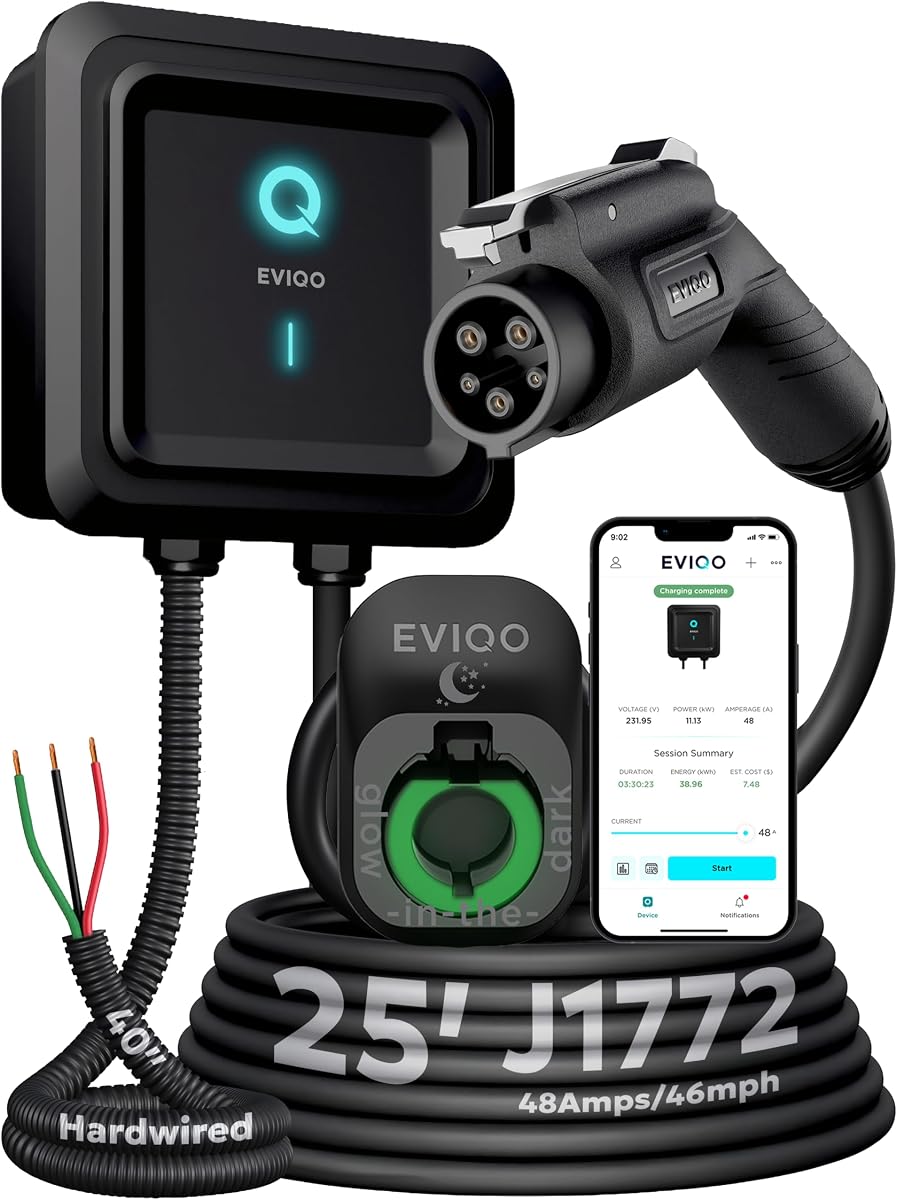
The EVIQO Level 2 EV Charger J1772 48A is a well-rounded hardwired charging station with a 4.7 rating and a strong emphasis on practical home convenience. It supports up to 48 amps at 240 volts, includes a 25-foot cable, and works with the J1772 connector used across a large portion of the North American EV market. Its strongest distinguishing details are the enhanced antenna, glowing holster, and broad app controls.
We may earn a commission when you buy through this link, at no additional cost to you.
At its maximum setting, the charger can deliver 48 amps on a dedicated 60-amp, 240-volt circuit, or it can be configured for 50 amps on a dedicated 70-amp circuit. The app allows charging to start and stop remotely, provides adjustable current from 6 to 48 amps, and displays energy use and charging costs. Scheduling supports off-peak operation, while the stronger antenna is particularly useful when the charger is installed in a garage or basement.
Safety features are extensive for a home charger. The housing carries an IP66 and NEMA 4 rating, internal steel shielding protects the electronics, and the product is listed as independently tested and certified to UL, ETL, FCC, and Energy Star standards. A side reset button and over-the-air updates simplify maintenance. The trade-offs are that a licensed electrician must install the unit, Tesla drivers need the J1772 adapter supplied with their vehicle, and 2.4 GHz WiFi is required for app access.
This is the strongest all-around recommendation for a driver with a J1772 vehicle who wants high-current charging, useful scheduling, detailed energy records, and a long cable. It is particularly attractive when the unit will be mounted in a location with weak cellular or WiFi reception. Buyers should still have their electrician confirm the panel, circuit, grounding, and local permit requirements before installation.
The app gives owners more than simple on-and-off control. Adjustable current, scheduled sessions, charging reminders, energy history, and cost tracking make it easier to shift charging away from expensive periods and understand household energy use.
The sealed IP66 and NEMA 4 enclosure supports indoor or outdoor use, while the stronger antenna improves connectivity in locations where a basic charger might struggle to remain online.
We may earn a commission when you buy through this link, at no additional cost to you.
The Tesla Level 2 Charger NACS 48A is a high-output home station designed around the NACS connector, making it a natural fit for Tesla Model S, 3, X, and Y owners as well as other vehicles that use a native NACS port. Its 4.7 rating reflects a polished feature set, and the built-in push-button release adds a level of convenience that adapter-based J1772 chargers cannot offer.
We may earn a commission when you buy through this link, at no additional cost to you.
The charger provides up to 48 amps at 240 volts, with configurable DIP switches allowing 50 amps when a dedicated 70-amp circuit is used. Its 25-foot cable offers generous reach across garages and driveways. The accompanying app supports remote start and stop, adjustable output from 6 to 48 amps, reminders, charging schedules, and reports covering energy and cost usage.
The enclosure is sealed to IP66 and NEMA 4 standards and carries UL, ETL, FCC, and Energy Star certification, with internal shielding for added electronic protection. Automatic over-the-air updates and an accessible reset button help keep operation and maintenance straightforward. The main limitation is connector universality: non-Tesla J1772 vehicles require a NACS-to-J1772 adapter, and the adapter is not included.
Choose this charger when native NACS compatibility is the priority and the vehicle does not use J1772. The integrated release button, long cable, strong wireless antenna, and polished smart functions justify its premium positioning. As with every hardwired model here, installation should be handled by a licensed electrician after confirming circuit and panel capacity.
A built-in NACS plug removes the need for an everyday adapter, and its release button helps open the vehicle's charge port without reaching for a separate connector handle or tool.
The enhanced antenna, broad app controls, over-the-air updates, accessible reset, and glow-in-the-dark holster create a convenient installation for drivers who want more than basic Level 2 operation.
We may earn a commission when you buy through this link, at no additional cost to you.
The EMPORIA Level 2 EV Charger w/ J1772 Connector is a well-reviewed 4.7-rated station that combines hardwired 48-amp performance with installation flexibility. It is preconfigured for a NEMA 14-50 plug connection at up to 40 amps and can be converted to a hardwired installation for the full 48-amp output. That makes it useful for homeowners who may not initially want a complete hardwired installation.
We may earn a commission when you buy through this link, at no additional cost to you.
At 48 amps, the hardwired configuration can add up to approximately 46 miles of range per hour, while the plug-in configuration is described as delivering up to 38 miles per hour at 40 amps. The 25-foot cable gives owners freedom to mount the unit away from the vehicle. Through 2.4 GHz WiFi, the app provides real-time energy data, remote session management, and scheduling that can accommodate utility-rate periods.
The charger uses a standard SAE J1772 connector and is listed as compatible with numerous North American EVs and plug-in hybrids. Its certification list includes UL 817, UL 991, UL 2231, UL 2251, UL 2594, Energy Star, NEC 625, and SAE J1772. The trade-off is that the versatile lower-output plug-in mode does not match the speed of the hardwired configuration, and professional installation remains advisable for best results.
This model is a sensible option for drivers who value established smart-energy features and want a path to full 48-amp performance. Existing NEMA 14-50 users may appreciate the initial convenience, although anyone intending to operate continuously at 48 amps should plan for a dedicated circuit and electrician-led conversion.
The included NEMA 14-50 configuration offers a lower-current plug-in path, while hardwired conversion unlocks the charger's complete 48-amp capability. This flexibility can make early adoption easier.
Real-time energy data and scheduling help owners follow charging consumption and place sessions in preferred utility-rate periods without constant manual intervention.
We may earn a commission when you buy through this link, at no additional cost to you.
The Upgraded 48 Amp Level 2 EV Charger is a hardwired J1772 station with a 4.8 rating, making it an appealing value-focused option. It provides up to 48 amps at 240 volts and 11.5 kW, with the listing estimating as much as 46 miles of range per hour. A 25-foot cable and plug-and-charge operation make it suitable for routine overnight home charging.
We may earn a commission when you buy through this link, at no additional cost to you.
Its app is unusually detailed for this category. Users can adjust current in one-amp increments from 10 to 48 amps, schedule sessions across midnight, remotely start or stop charging, check status, review history and costs, and manage multiple users. The charger also includes protection against overcurrent, overvoltage, overheating, overcharging, and other electrical faults.
Safety standards include UL 2594 and CSA C22.2 No. 280, with ETL, FCC, and CSA compliance. The IP65 enclosure is designed for indoor and outdoor use in rain, snow, heat, and cold. The important limitation is that the J1772 connector does not directly fit native NACS vehicles; a suitable adapter is required but not included.
This charger best suits J1772 owners seeking a capable 48-amp unit without paying for the most elaborate connector convenience. The 4.8 rating, one-amp current controls, strong app, and three-year warranty make it a particularly strong budget recommendation. Confirm that the vehicle's onboard charger and home electrical service can support the output before ordering.
One-amp adjustments from 10 to 48 amps provide more precise control than preset steps, which can be useful when sharing capacity or matching charging demands to available electrical headroom.
With up to 11.5 kW available, the charger can recharge many compatible vehicles in a relatively short overnight session, although real-world time depends on battery size and vehicle charging limits.
We may earn a commission when you buy through this link, at no additional cost to you.
The Grasside Level 2 EV Charger combines a 4.9 rating with an unusually broad set of access and charging controls. It is a hardwired 48-amp, 240-volt J1772 unit with a 25-foot cable and an 11.5 kW maximum output. The hardware is built around a metal case, built-in GFCI protection, and professional hardwired installation on a 60-amp or higher circuit.
We may earn a commission when you buy through this link, at no additional cost to you.
Charging can operate in plug-and-charge mode, through RFID card authentication, or through smartphone app control. That gives households several ways to balance convenience with access control, particularly when the charger is mounted in a shared garage, private parking area, or other location where unauthorized use is a concern. The app also provides schedules, session history, remote monitoring, and charging-status information.
The charger is ETL listed to UL 2594 and CSA C22.2 No. 280, complies with FCC requirements, and carries an IP65 waterproof rating for indoor or outdoor installation. Current can be adjusted continuously from 10 to 48 amps in the app or selected through screen buttons at 16, 24, 32, 40, and 48 amps. A three-year support program and warranty add useful coverage.
The trade-offs are limited to the need for a 2.4 GHz network and the absence of a native NACS plug. The product is best suited to J1772 drivers who want flexible authentication and detailed app controls. Its top-listed rating reflects a strong overall package, while the installation still needs to follow local electrical requirements.
RFID cards and app-based unlocking offer alternatives to unrestricted plug-and-charge access, giving the owner a practical way to restrict who can use the station.
The metal enclosure, rubberized charging handle, and listed 25-foot cable are designed for repeated use, while the IP65 rating supports installation in exposed locations.
We may earn a commission when you buy through this link, at no additional cost to you.
The IYILO Level 2 EV Charger is a 4.7-rated 48-amp, 11.5 kW station with a strong focus on power management. It can adjust output in one-amp increments from 6 to 48 amps and supports power sharing, allowing two chargers to operate on one circuit breaker without exceeding its limit. When paired with the available Energy Meter bundle, it also supports dynamic load balancing.
We may earn a commission when you buy through this link, at no additional cost to you.
A standout protective feature is the connector's NTC temperature sensor. The app displays connector temperature, and charging stops automatically if the connector exceeds 221 degrees Fahrenheit. Other smart functions include time-of-use rate settings, energy and cost tracking, scheduled charging, RFID card support, multiple user accounts, and remote over-the-air upgrades.
The product's certification coverage includes a UL 2594 test report, ETL, Energy Star, and CSA. It has a built-in GFCI breaker, a 25-foot flexible cable, and a NEMA 4 waterproof rating. The utility program information also lists participation or listings associated with providers such as ComEd, PSEG, Seattle City Light, Portland General Electric, Oregon DOT, and Georgia Power.
This charger is particularly attractive to owners who expect to add a second EV or want more intelligent control over household power. The trade-off is that dynamic load balancing requires the separate energy meter and app configuration, and the network supports 2.4 GHz WiFi only. J1772 owners also need an adapter for native NACS vehicles.
Power sharing and optional dynamic load balancing can reduce the need for a major panel upgrade when multiple charging demands arise, provided the charger is configured correctly.
The built-in NTC sensor monitors the connector and interrupts charging when its temperature rises beyond the stated threshold, adding an extra layer of protection during demanding sessions.
We may earn a commission when you buy through this link, at no additional cost to you.
The Lectron J1772 Level 2 EV Charger NEXUS is a focused hardwired option for drivers who prioritize straightforward 48-amp performance. It has a 4.7 rating, supports up to 48 amps at 240 volts and 11.5 kW, and is described as adding up to 46 miles of range per hour. The included 23-foot cable and J1772 holder support flexible garage, driveway, and carport placement.
We may earn a commission when you buy through this link, at no additional cost to you.
Unlike many connected chargers in this roundup, the product information does not advertise WiFi, an app, or remote scheduling. That simplicity may be useful for anyone who wants fewer electronics and a direct plug-in workflow. It is a permanent installation rather than a portable unit, and professional installation is required to achieve the maximum output.
The safety presentation is comprehensive. The NEXUS is ETL listed under UL 2594, UL 2231, and UL 2251 and is also described as Energy Star and FCC certified. Its listed protections include overcurrent, overvoltage, thermal, and ground-fault handling. The IP66 housing is intended for indoor and outdoor use in rain, snow, heat, and dust.
This is a sensible recommendation for a J1772 owner who wants high-current charging and strong certification without paying for smart features. The slightly shorter 23-foot cable may matter in unusually large parking arrangements, while native NACS vehicles still need an adapter. A three-year limited warranty provides a defined support period.
The hardware focuses on consistent 48-amp output and a hardwired installation, which can appeal to drivers who do not need app-based scheduling or remote session controls.
The IP66 enclosure and included holder allow the charger to be mounted in a garage, outside, or under a carport, depending on local electrical and environmental requirements.
We may earn a commission when you buy through this link, at no additional cost to you.
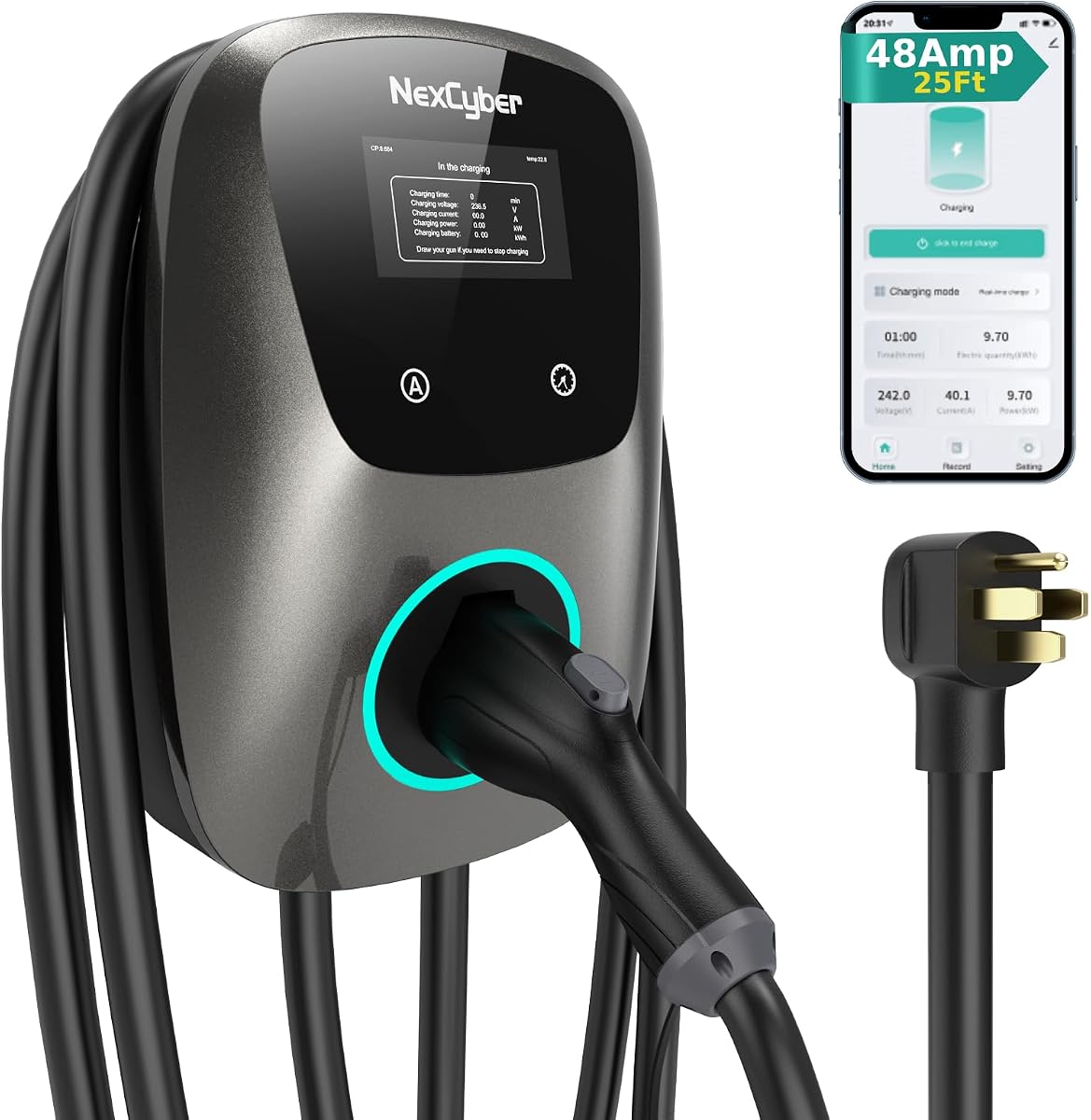
The NexCyber Level 2 EV Charger is a 4.5-rated model that offers both hardwired 48-amp operation and a NEMA 14-50 plug-in mode at up to 40 amps. This dual approach makes it versatile for drivers who may start with an existing outlet or eventually commission a dedicated circuit. It includes a 25-foot cable and a J1772 connector.
We may earn a commission when you buy through this link, at no additional cost to you.
Its touchscreen is a major selling point because core functions do not require the app. The display shows amperage, charging speed, input voltage, and delay time, while buttons allow current adjustment from 16 to 48 amps and charging start-time configuration. A factory-reset function is also available. WiFi features add charging-cost and history information, status tracking, completed-session notifications, and off-peak scheduling.
The charger carries ETL and FCC certification and is listed against SAE J1772, UL 2231-1 and -2, UL 991, UL 2251, UL 1998, and UL 2594 standards. Its enclosure has a degree of IP65 weather protection, although the listing specifically advises against installation in direct sunlight or exposed rainy conditions. That advice tempers the outdoor-use case.
The product is best for a J1772 owner who values a physical interface and plug-in flexibility as much as app control. Its rating is lower than those of the leading selections, and the weather guidance is less permissive than products with NEMA 4 or IP66 protection. Drivers should also check their vehicle port because certain newer NACS-equipped models are called out as requiring an adapter.
The touchscreen provides access to current, timing, voltage, and charging-speed information, so essential functions remain available when a phone or network is unavailable.
Owners can begin with a NEMA 14-50 connection or use a professionally installed dedicated circuit for the full 48-amp hardwired output.
We may earn a commission when you buy through this link, at no additional cost to you.
The Romaa Level 2 EV Charger 48 Amp is a hardwired J1772 wall-mounted station with a 4.3 rating. It supports up to 11.5 kW at 240 volts and 48 amps, and the product information estimates that a typical 65 kWh battery could move from 10% to 80% in about four hours. Actual results will vary with the vehicle, battery temperature, and onboard charging limits.
We may earn a commission when you buy through this link, at no additional cost to you.
A large three-inch color LCD distinguishes it from many competing models. The screen presents charging status, power level, session time, energy delivered, and error codes without requiring the phone app. The app adds real-time status, energy history, schedules, and completion notifications, allowing owners to program charging for off-peak rates.
Safety features include ground-fault, temperature, overvoltage, undervoltage, overcurrent, and short-circuit protection. The charger is ETL Listed and FCC Part 15 compliant, with SAE J1772 and several UL standards cited. Its NEMA 4 and IP66 enclosure supports indoor or outdoor placement, and the 25-foot cable gives vehicles considerable room to maneuver.
This model is worth considering for drivers who prioritize a large onboard display and thorough fault protection. It includes a mounting plate, screws, installation tools, a 24-inch power input cord, and a manual, while professional installation is still recommended. The lower listed rating and two-year warranty offer less reassurance than the three-year coverage offered by several alternatives.
The color touchscreen puts session time, delivered energy, power level, status, and error information directly in view, reducing the need to open the app for routine checks.
Dedicated protection for ground faults, temperature, voltage extremes, excess current, and short circuits supports safer operation and clearer diagnosis if a session is interrupted.
We may earn a commission when you buy through this link, at no additional cost to you.
The Hardwired Level 2 EV Charger 48 Amp J1772 is a 4.6-rated home station with a 25-foot cable and 11.5 kW output. It provides a standard SAE J1772 connection and is listed for a broad range of vehicles, including the Kia EV6 and EV9, Ford Mustang Mach-E and F-150 Lightning, Chevrolet Bolt models, Nissan Leaf, Hyundai Ioniq 5 and 6, Volkswagen ID.4, Rivian R1T and R1S, BMW i4, and Audi e-tron.
We may earn a commission when you buy through this link, at no additional cost to you.
Its app provides remote start and stop, scheduled charging, real-time speed and consumption monitoring, and session history. Scheduling is particularly useful for shifting demand toward off-peak utility periods. The product information also notes that some newer vehicle models began moving toward native NACS ports in October 2026, so checking the exact vehicle connector remains important.
The aluminum enclosure has a corrosion-resistant coating and an IP66 and NEMA 4 rating. A stated operating range of negative 22 to 122 degrees Fahrenheit supports installation in hot and cold climates. The charger is ETL Listed and certified to UL 2594, UL 2231-1, UL 2231-2, and FCC Part 15 standards.
This is a strong option for owners who need a permanent outdoor installation and want smart controls without a more elaborate access-control system. The trade-off is adapter dependence for native NACS vehicles and the need to verify port types because newer models can differ from earlier J1772 standards. Professional hardwired installation is required for dependable 48-amp operation.
The stated operating range and corrosion-resistant aluminum housing make the unit a practical consideration for exposed driveways, detached garages, and climates with substantial seasonal variation.
The app combines off-peak scheduling with real-time charging speed, energy consumption, and session history, helping owners balance convenience with electricity cost control.
We may earn a commission when you buy through this link, at no additional cost to you.
A 48-amp hardwired EV charger is a substantial home upgrade, and the best unit is one that matches your vehicle, electrical panel, connector, parking arrangement, and desired level of smart control. Use the following factors to narrow the field before an electrician begins work.
Connector compatibility is the first non-negotiable check. J1772 remains the standard for many North American EVs and plug-in hybrids, while NACS is increasingly found on newer vehicles and is standard on several Tesla models. A J1772 charger does not directly fit a native NACS port, and a NACS charger does not directly fit a J1772 port. Some owners can use a suitable adapter, but the adapter must support the intended charging setup and is not always included. Inspect the vehicle rather than relying on its make, model year, or brand alone, especially with recent model changes.
Full 48-amp output normally requires a dedicated 240-volt circuit sized for the load and selected according to local electrical code. Most of the listed chargers call for a dedicated 60-amp circuit, while some allow a 50-amp setting using a 70-amp circuit through DIP-switch configuration. An electrician should evaluate the panel's available capacity, existing loads, breaker type, grounding, conduit requirements, permits, and distance to the mounting location. The charger's maximum amperage cannot compensate for an underpowered panel or a circuit that is already near its limit.
A charger rated for 48 amps and 11.5 kW does not force every vehicle to accept that rate. The vehicle's onboard charger, battery state, temperature, charge curve, and selected settings determine the actual power. Drivers should review their vehicle's maximum AC charging rate and consider whether it has an 11.5 kW limit, a lower maximum, or a thermal limitation. Published miles-per-hour estimates are also approximate, but the comparison can still be useful for setting expectations between chargers with identical 48-amp output.
WiFi charging stations can start or stop sessions, track delivered energy and costs, record history, and schedule charging around preferred utility rates. The units in this comparison generally require a 2.4 GHz home network, so double-band routers may need a separate compatible network or careful setup. RFID authentication is valuable in a shared garage, while a large touchscreen helps owners who prefer not to rely on a phone. Choose the control interface that you will actually use rather than paying for functions that duplicate the vehicle's own charging controls.
Most chargers here include a 25-foot cable, while the Lectron NEXUS uses 23 feet. A longer cable offers more freedom when the charger is mounted across a garage, beside a driveway, or near a carport, but it should never be stretched taut or routed where it creates a trip hazard. Measure the path from the proposed mounting point to the vehicle's normal charging position. Also consider whether the connector holster, cable management, and wall placement will remain convenient for every driver in the household.
Look for recognized safety certifications, especially UL 2594 and ETL listing, and consider the related connector and control standards cited by the manufacturer. Weather ratings also matter: IP65 and IP66 indicate protection against dust and water ingress to differing degrees, while NEMA 4 is commonly used for robust outdoor EV charging equipment. Mounting location, sun exposure, temperature range, and manufacturer guidance all influence longevity. A strong warranty is helpful, but certification and environmental specifications provide a clearer view of the hardware's intended use.
Hardwired 48-amp charging is a professional electrical installation in every case represented here. Confirm that the package includes mounting hardware and documentation, and check whether the installer must supply conduit, wire, a disconnect, permits, or other site-specific materials. Compare warranty duration, support availability, firmware update methods, and the availability of installation guides or videos. A three-year warranty is common in this category, while the Romaa model lists two years. These differences are usually secondary to connector fit, safety, and electrical compatibility.
Have a licensed electrician install the charger according to the National Electrical Code, local regulations, and the manufacturer's instructions. Confirm the required breaker size, conductor gauge, grounding, and disconnect arrangements before the unit is mounted. The electrical side of the installation should not be improvised, particularly when operating near the 48-amp limit. After installation, ask the electrician to verify the circuit, grounding, and configured current setting.
Set the charging current to a level supported by both the circuit and the vehicle. In the app, choose scheduled charging for times with favorable utility rates, then plug the connector fully into the vehicle before confirming the session. If using RFID or app unlocking, make sure access permissions are configured before leaving the charger unattended. Do not use an adapter unless it is explicitly compatible with the charger, vehicle, and intended amperage.
Inspect the connector, cable, and mounting area periodically for physical damage, looseness, heat discoloration, moisture, or debris. Keep the connector dry and seated in its holster when not in use, and avoid repeated sharp bends or pulling on the cable. Use the app or screen to review energy history and charging status, and follow the manufacturer's guidance for resets, firmware updates, fault diagnosis, and cleaning.
Most of the chargers in this guide specify a dedicated 60-amp, 240-volt circuit for their full 48-amp output. Some models can be configured for 50 amps on a dedicated 70-amp circuit through DIP switches. Circuit sizing, continuous-load rules, local amendments, and panel capacity vary, so a licensed electrician should determine the correct installation rather than relying only on the product listing.
It can supply more power, but only if the vehicle's onboard charger accepts the higher rate. Many EVs cap AC charging below 11.5 kW, while some support close to that level. A larger charger will not force a vehicle to accept more current, so compare its maximum AC charging specification with the charger's output before expecting a dramatic improvement.
Most J1772 chargers require a J1772-to-NACS adapter for a Tesla that uses a native NACS charge port. The adapter is not included with most of the J1772 models reviewed here. Tesla vehicles that came with a J1772 port can use a J1772 charger directly. Always verify the specific vehicle's port and follow the instructions supplied with any adapter.
Many units in this guide have IP65 or IP66 and NEMA 4 ratings intended for outdoor use, but the enclosure rating alone does not guarantee suitability for every exposure. Check the manufacturer's temperature range, direct-sunlight guidance, and local installation rules. The electrical enclosure, circuit, conduit, and workmanship also need to comply with local code.
Basic charging usually does not require WiFi, but connected features may depend on network access. The smart functions in this category include remote control, energy tracking, charging history, notifications, and scheduling. Most of the listed app-based chargers require a 2.4 GHz network, so ensure that frequency is available before installation.
The answer depends on battery capacity, starting state, vehicle charging limits, temperature, and the charger's output. At the full 11.5 kW rate, many compatible vehicles can gain substantial range per hour, but actual charging usually tapers as the battery approaches full. Published estimates are useful for comparison, yet the vehicle's own charge curve ultimately governs session length.
RFID lets the owner restrict charging to an authorized card rather than allowing anyone with the cable to start a session. That can be valuable in a shared garage or private parking area. If a household does not need access restriction, simpler plug-and-charge operation may be sufficient. The Grasside charger in this guide supports RFID, app unlocking, and plug-and-charge modes.
Power sharing becomes valuable if two EVs may charge on the same circuit and the available electrical service cannot support two full 48-amp loads at once. It can distribute capacity safely when properly configured, while dynamic load balancing can respond to changing household demand. The IYILO model supports these features, with dynamic balancing requiring the optional energy meter bundle and app setup.
The EVIQO J1772 48A stands out as the most balanced overall option, combining a 25-foot cable, adjustable output, app-based energy management, a stronger antenna, strong environmental protection, and a glowing holster. The Tesla NACS 48A is the leading premium choice for drivers who want a native NACS connector and integrated port-release button, while the Upgraded J1772 48A delivers a strong feature set and 4.8 rating at the budget end of the roundup.
Before choosing, start with the vehicle's charge port and maximum AC charging rate, then have a licensed electrician assess the panel and required dedicated circuit. After those fundamentals, consider cable reach, weather exposure, network compatibility, scheduling, access control, certification, warranty, and the value of a larger display or advanced power management. The right charger is the one that works safely with your car and property rather than simply having the largest headline number.
Ratings, specifications, availability, and prices can change, so verify the current Amazon listing and manufacturer instructions before purchasing. Confirm the charger's certification details, installation requirements, included accessories, warranty terms, and return policy. With that final check completed, the comparison should make it easier to select a hardwired 48 amp EV charger suited to your charging habits.