
SOULION R50
4.1Editor score
Compact 30-degree angled design
Bluetooth and auxiliary connectivity
USB-powered desktop operation
Our Single Speaker for TV guide compares 10 top models for dialogue clarity, connectivity, wireless freedom, bass, placement ease, and everyday value.
A single speaker for TV can make dialogue easier to hear, add more presence to music and effects, and provide a simpler alternative to a large home theater system. The most useful model depends on your room, television connections, listening position, and whether priority goes to clear speech, bass, wireless portability, or straightforward setup.
This guide compares ten compact soundbars and TV-focused speakers using the supplied specifications, including audio output, connection methods, placement options, sound modes, dimensions, portability, and support for expanded bass. It covers wired and wireless designs for living rooms, bedrooms, offices, and other viewing spaces without implying that every model suits the same listener.
Each review explains the product's strongest benefits, practical limitations, and ideal buyer. The Bose TV Speaker and Samsung HW B400F provide established all-in-one options, while the Saiyin, MZEIBO, LARKSOUND, and detachable model target value-conscious buyers. Ratings and product details reflect the supplied listings, and prices can change at any time.
4.1Editor score

4.3Editor score

5.0Editor score
The comparison highlights output, connection choices, special features, and practical formats, from a basic USB-powered desktop speaker to wireless systems with extended range and rechargeable batteries.


The Saiyin 11.7-inch Sound Bar is a compact, AC-powered solution for improving television audio without filling the room with multiple components. Its 4.2 rating reflects a generally favorable balance of size, output, and connectivity. At 48W peak power, it is designed to add noticeable volume and fuller presentation to TV speakers, music, and games.
We may earn a commission when you buy through this link, at no additional cost to you.
Its main attraction is flexibility for the money. Bluetooth, optical, and 3.5mm auxiliary connections cover common source devices, while the dedicated sub-out opens a path to stronger bass through a compatible powered subwoofer. The 11.7-inch body can sit beneath a screen or on a narrow shelf, and wall-mounting hardware is included.
There are practical caveats. It is not battery-powered, so cable placement matters, and a television's digital audio settings may need adjustment. The manufacturer specifically recommends PCM, stereo, or another non-surround source for the optical connection to avoid cracking or missing sound. It also lacks a wireless subwoofer system of its own.
This is a strong pick for a small or medium room where one unobtrusive speaker must handle television, phone, and computer audio. It is particularly suitable if adding a powered subwoofer later is part of the plan. Buyers should verify their television's output compatibility before installation.
Bluetooth handles convenient wireless streaming, while optical and auxiliary support direct television and source-device connections. This variety makes the soundbar useful beyond a permanently paired television.
The low-profile enclosure preserves screen visibility, and the subwoofer output allows buyers to add deeper low-frequency impact without replacing the entire system.
We may earn a commission when you buy through this link, at no additional cost to you.
The MZEIBO 17-Inch Sound Bar combines 50W output with a broad selection of connections, earning a 4.4 rating in the supplied data. Four speakers and a built-in bass system are designed to distribute sound around the room, making it a practical one-piece upgrade for television, streaming, gaming, and music.
We may earn a commission when you buy through this link, at no additional cost to you.
HDMI ARC, optical, AUX, and Bluetooth 5.3 cover both modern and older equipment. The 17-inch enclosure remains relatively compact for a soundbar and is intended for desks, shelves, and smaller living areas. Music, Movie, and News modes let listeners adjust the presentation without navigating a complicated interface.
The tradeoff is that the product is wider than the Saiyin and other very small units, so buyers with a narrow media console should measure first. No dedicated subwoofer output is listed, meaning its bass is fixed to the internal system. As with many soundbars, the final result will depend on room acoustics and television settings.
This model fits buyers who want several connection options and built-in modes in a single package. It is especially appealing for mixed-use spaces where a computer, projector, game console, and television may all be connected over time. Its 4.4 rating makes it one of the strongest general-purpose choices in this roundup.
HDMI ARC offers the most television-friendly option, while optical, AUX, and Bluetooth give buyers alternatives for older sources, computers, and mobile devices.
Music, Movie, and News modes provide quick tonal adjustments for different content, reducing the need to fine-tune every setting manually.
We may earn a commission when you buy through this link, at no additional cost to you.
The detachable soundbar is the most structurally unconventional option in this guide, with an 80W output and four separately powered driver sections. Its 4.1 rating reflects a distinctive feature set rather than a conventional soundbar design. Buyers can rearrange the sections to suit a screen, table, wall, or room layout.
We may earn a commission when you buy through this link, at no additional cost to you.
Four placement methods are listed: horizontal, vertical, tabletop, and wall mounted. Each orientation is intended to distribute audio differently, with horizontal positioning presented as a way to reduce distortion. The automatic loudness function targets faint material, while Movie, Music, and News modes shape the sound for different content.
Its flexibility comes with more setup decisions than a standard bar. The detachable layout may not suit renters or anyone wanting one seamless object, and buyers must understand which pieces connect to one another. The listing mentions support and a replacement policy, but it does not specify a separate subwoofer connection.
This model suits experimental buyers, gamers, and users who want to change their audio arrangement as their room evolves. It can be especially useful where a long bar is inconvenient or where wider sound dispersion matters. For a traditional under-television setup, a simpler fixed design may be easier to live with.
The four detachable sections can be arranged around the room rather than confined to one narrow strip, giving the system unusual flexibility for unusual spaces.
Automatic loudness addresses quiet source material, while three equalizer modes provide a practical starting point for speech, music, and movies.
We may earn a commission when you buy through this link, at no additional cost to you.
The Bose TV Speaker is an all-in-one 2.1-channel-style soundbar created to clarify speech while presenting a wider soundstage than a television's built-in speakers. Its 4.3 rating reflects a strong overall package, and the included remote adds a dedicated dialogue mode and bass boost. Two angled full-range drivers provide the spatial presentation.
We may earn a commission when you buy through this link, at no additional cost to you.
Connectivity is refreshingly flexible. HDMI, optical, and auxiliary inputs support direct television connections, while Bluetooth allows music and podcast streaming from a paired device. The optical cable is included, so many buyers can begin without purchasing an additional cable. A single connection is all that is required for basic operation.
The speaker is just over two inches tall and can sit in front of a television or be wall-mounted with separate brackets. Bass Module 500 and 700 compatibility provides an upgrade path, but the modules and connection cable are sold separately. An HDMI cable is also sold separately for buyers not using optical or another input.
This is a compelling all-around recommendation for anyone prioritizing dialogue and a polished, uncluttered setup. It balances compact dimensions, simple operation, multiple source connections, and optional bass expansion better than a model requiring complex configuration. Choose it when clarity and ease of use matter more than having a subwoofer included.
Angled full-range drivers and a dedicated dialogue mode are designed to lift vocals and pronunciation, which can make news, captions, and quiet scenes easier to follow.
Compatibility with the Bose Bass Module 500 or 700 provides a straightforward path to more low-frequency impact without replacing the compact speaker.
We may earn a commission when you buy through this link, at no additional cost to you.
The 2.4G Wireless TV Speaker is the most flexible premium option, combining television audio, portability, and private listening in one rechargeable unit. Its 5.0 rating is the highest listed among these products. A dedicated TV mode emphasizes vocal frequencies, while 2.4GHz transmission is designed to keep sound synchronized with the picture.
We may earn a commission when you buy through this link, at no additional cost to you.
The supplied transmitter can feed television audio through optical, RCA, AUX, or compatible USB-C connections. The speaker can then travel through the home with a stated open-area range of up to 98 feet, making it useful in a kitchen, patio, or bedroom. One transmitter can also serve multiple compatible Evinof speakers, each with independent volume.
Its main limitation is the absence of HDMI. The manufacturer recommends PCM television output for the clearest result and advises raising the television's own volume if the perceived level remains low. The unit also has a separate Bluetooth mode for music, so it is not restricted to proprietary wireless use.
This is a particularly strong choice for anyone who wants to follow television audio around the home or listen privately after the household has gone to bed. Headphone output, a rechargeable battery, voice enhancement, and the full cable kit make it a premium convenience package. It is less suitable for buyers who require HDMI.
The 2.4GHz system is intended to deliver stable, synchronized television sound, avoiding the synchronization problems that can accompany some wireless speaker arrangements.
Up to 24 hours of playback lets listeners move the speaker to a secondary room, while the headphone jack supports private viewing without disturbing others.
We may earn a commission when you buy through this link, at no additional cost to you.
The LARKSOUND 16-Inch Mini is designed for buyers who want a clearer, more capable television speaker without accepting a long soundbar. Its 3.9 rating is the lowest in the group, but the product remains appealing for a specific reason: it is approximately keyboard-sized and offers several ways to connect.
We may earn a commission when you buy through this link, at no additional cost to you.
Bluetooth 5.0, USB, AUX, HDMI, and optical provide broad source support. HDMI ARC allows compatible television remotes to control volume, although the HDMI cable is not included. Music, Movie, Voice, and Normal modes cover common uses, and a distinct Night Mode can immediately reduce volume by 50 percent.
The lowest rating may reflect limited output or general performance rather than a serious flaw, but buyers seeking room-filling authority for a large living room may prefer a higher-output system. The listing also emphasizes reduced voice delay, though no independent timing measurements are provided.
This mini bar is a good match for a bedroom, dorm, study, or modest viewing area where every inch of console space matters. Night Mode makes it particularly useful for late viewing. It is also a straightforward way to improve computer or game audio when Bluetooth or the included auxiliary cable is preferred.
The 16-inch body is easy to position beneath a screen and will not visually dominate compact entertainment furniture or a computer workstation.
A one-step 50 percent volume reduction gives household members a faster way to lower television audio during quiet hours.
We may earn a commission when you buy through this link, at no additional cost to you.
The Samsung HW B400F is a 2.0-channel soundbar with a built-in subwoofer, offering more integrated low-frequency capability than many compact alternatives. Its 4.0 rating reflects a balanced feature set. Surround Sound Expansion aims to project audio in multiple directions, while Voice Enhance Mode makes dialogue more prominent.
We may earn a commission when you buy through this link, at no additional cost to you.
One of its most useful features is direct control through a compatible Samsung television remote. Listeners can manage power, volume, and sound effects without reaching for a separate controller. The integrated woofer reduces the need for an additional subwoofer box and keeps the physical arrangement relatively unified.
The listing does not provide a detailed wired-input list, so buyers with unusual television or source requirements should confirm compatibility before purchase. Samsung TV remote integration is also a narrower benefit than universal remote support. The nighttime feature lowers volume and minimizes bass rather than offering a fully independent late-night listening solution.
This model suits Samsung television owners who want a single upgrade that provides enhanced voices, broader sound, and some bass without assembling separate components. It is a logical choice for a modern living room, particularly when minimizing visible equipment and remote complexity are priorities.
The built-in woofer adds low-frequency weight without requiring a separate subwoofer, keeping setup and visual clutter to a minimum.
Compatible Samsung television remotes can handle core operations such as power, volume, and sound effects for a more streamlined experience.
We may earn a commission when you buy through this link, at no additional cost to you.
The ANSTEN Wired Speaker takes a deliberately simple approach to television audio. It connects through a 3.5mm jack, receives power from a dedicated USB adapter, and avoids wireless pairing. Its 4.2 rating and emphasis on vocal clarity make it a practical option for listeners who prioritize immediate, uninterrupted sound.
We may earn a commission when you buy through this link, at no additional cost to you.
The fixed cable is five meters long, which allows the speaker to be placed near the preferred seat rather than directly beneath the television. This can bring dialogue closer to the listener and make it easier to understand at moderate volume. A headphone output also supports private listening with a standard 3.5mm headset.
Its biggest limitation is dependence on wired connections. The television must have a compatible 3.5mm audio output, and modern sets increasingly emphasize HDMI or optical output instead. Buyers should not substitute a different power adapter because the manufacturer warns that this may generate noise.
This speaker is best for someone who wants a simple, stable solution for a bedroom, retirement home, or secondary television. The one-knob control is approachable for seniors, and the long lead supports flexible placement. It is less suitable for modern televisions lacking a headphone or analog audio output.
The generous cable permits the speaker to sit close to a favorite chair, which can make vocals feel more direct without raising the television's overall volume.
A continuous wired signal avoids pairing, charging, interference, and wireless synchronization concerns, making the system predictable for everyday use.
We may earn a commission when you buy through this link, at no additional cost to you.
The ANSTEN RCA-Compatible Speaker offers a wider choice of wired television connections than its closely related 3.5mm-focused counterpart. It can use either a 3.5mm audio jack or RCA outputs and carries a 4.0 rating. The design is aimed at clear speech, stable playback, and uncomplicated control.
We may earn a commission when you buy through this link, at no additional cost to you.
Its five-meter cable gives users freedom to position the speaker near a sofa or listening area. The dedicated USB power adapter handles electricity, while a single knob combines power and master volume. A headphone jack provides another way to listen privately, and the same signal can also feed compatible phones, laptops, PCs, and music players.
The limitation is clear: the optical output cannot be used with this system. That matters for many modern televisions whose built-in speakers are connected through optical audio. There is also no Bluetooth, so the product is less versatile than several compact soundbars in the roundup.
Choose this model when a television offers analog 3.5mm or RCA audio and the priority is a stable, low-complexity installation. It is particularly useful for older adults or anyone who prefers one simple control. Verify the available television outputs before ordering, particularly if the set has only HDMI and optical connections.
Both 3.5mm and RCA paths make the speaker approachable for older televisions, stereo equipment, and compatible secondary sources.
Combining power and volume into one knob minimizes the number of operations users must remember, which is helpful for uncomplicated daily viewing.
We may earn a commission when you buy through this link, at no additional cost to you.
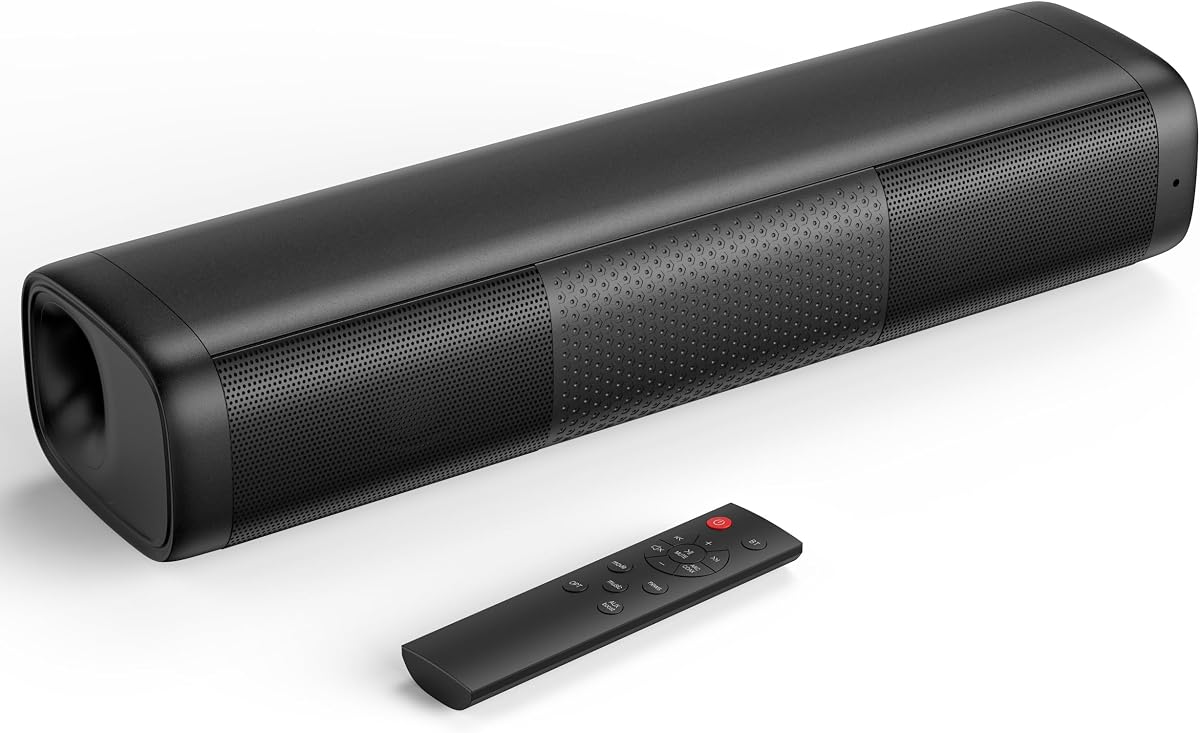
The SOULION R50 is primarily a compact computer soundbar, but it can also serve televisions, tablets, and phones that support its USB power and 3.5mm or Bluetooth connections. Its 4.1 rating reflects a strong basic package, with two independent diaphragms, internal boosters, and a physical volume knob.
We may earn a commission when you buy through this link, at no additional cost to you.
USB power keeps installation simple, while the 3.5mm jack provides a stable wired route and Bluetooth offers cable-free playback within approximately 33 feet. The control is familiar: USB supplies power, the mode button selects Aux or Bluetooth, and the light button manages four lighting effects.
The main limitation is its lack of television-specific features such as HDMI ARC, optical input, dialogue modes, and a remote-controlled sound system. Its angled enclosure is optimized for a desktop or beneath a monitor, so it may not project sound toward a sofa as naturally as a long television soundbar.
The R50 is an excellent budget choice for a computer setup, dorm room, or small television that offers a headphone output or Bluetooth. It is also a simple way to add richer sound to a laptop or tablet. Buyers seeking long-range room filling or advanced television integration should look elsewhere.
The 30-degree tilt directs audio upward toward a desk listener, while the compact body and breathable cloth cover suit monitors, shelves, and other small spaces.
The 3.5mm input offers direct wired playback, while Bluetooth removes the cable for compatible phones, tablets, and computers.
We may earn a commission when you buy through this link, at no additional cost to you.
A suitable television speaker depends first on how your television outputs sound and where you sit. Input compatibility, speech clarity, bass expectations, room size, power requirements, and control preferences should guide the decision.
Begin by inspecting the television's ports and current audio settings. HDMI ARC, optical digital audio, 3.5mm headphone output, and RCA sockets support different products, and the best speaker is useless if its input is unavailable. Optical systems may require changing the television from surround output to PCM, stereo, or another non-surround format. Wireless products may still need a wired transmitter connection before the speaker itself operates wirelessly.
Much of television viewing depends on speech intelligibility, especially for news, captions, and quiet dialogue. Look for angled drivers, voice or dialogue modes, and a natural overall balance rather than excessive bass. The Bose TV Speaker, MZEIBO, LARKSOUND, Samsung HW B400F, and both ANSTEN models all place emphasis on vocal presentation. A mode is convenient, but a well-balanced speaker should remain useful without it.
Output claims alone do not guarantee a particular loudness level, but they provide a useful comparison among these models. The detachable model lists 80W, the MZEIBO 50W, and the Saiyin 48W peak output. The Bose focuses on driver quality and spatial presentation rather than a wattage figure. A small desktop unit may be sufficient for close listening, while a larger living room benefits from more output and broader sound distribution.
Wired speakers offer immediate connections and stable synchronization, but cables must reach the television and the unit remains stationary. The 2.4GHz model provides portable television sound, while the Saiyin, MZEIBO, LARKSOUND, and SOULION use Bluetooth mainly for secondary devices. Wireless convenience is most valuable when you want to move the speaker or listen away from the screen.
The Samsung HW B400F includes a built-in subwoofer, and the Saiyin includes a dedicated output for a compatible powered subwoofer. Bose TV Speaker owners can add a Bass Module 500 or 700, although both modules and required cabling are separate. Other models emphasize integrated bass or four-speaker distribution. Decide whether deeper impact is worth extra equipment, another connection, and additional visual clutter.
Compactness matters when a television sits on a narrow console or wall. The Saiyin measures 11.7 inches wide, the LARKSOUND 16 inches, the MZEIBO 17 inches, and the Bose 23.38 inches. The SOULION R50 has a shallow, angled desktop format, while the detachable model can be arranged in four ways. Measure the available surface and check whether the speaker can direct sound toward the main seating area.
Remote control can improve daily convenience, especially for older users. The Bose includes a remote, the LARKSOUND provides one, and the Samsung supports a compatible Samsung television remote. Some models use physical buttons, mode selection, or a single knob. Voice, news, movie, music, and night modes are useful when sources vary, but they should supplement rather than replace good fundamental tuning.
Most television soundbars use continuous AC power, making placement dependent on outlets. The SOULION is powered by USB and suits desks. The 2.4GHz model offers up to 24 hours of listening after a four-hour charge and supports use while charging. This portability is the decisive feature for secondary-room viewing, late-night listening, or households without a nearby outlet.
Start by selecting the correct television audio output and connecting the speaker with the supplied or appropriate cable. For optical or HDMI ARC setups, set the television to the output that the soundbar supports and, when advised, choose PCM, stereo, or a non-surround signal. Power the unit on, select a moderate starting volume, and adjust the television output so dialogue is clear without distortion.
Position the speaker near the screen if it will be shared by the room, or move a portable model closer to the primary listener. Keep the unit unobstructed, use the supplied power adapter where specified, and leave ventilation space around the enclosure. For wireless systems, complete pairing or transmitter setup before changing modes, and avoid placing the transmitter where the signal path is blocked.
For daily care, wipe the surface with a soft, dry cloth and avoid liquids, moisture, and abrasive cleaners. Keep cables from being sharply bent, and do not substitute a different power adapter when the manufacturer specifies the included one. When using headphones or a subwoofer, power down before changing connections, and periodically check battery health if the unit is used mostly on the move.
The easiest choice depends on the television's available outputs. HDMI ARC and optical connections are common on modern soundbars, while the SOULION R50 and ANSTEN products are straightforward with televisions offering 3.5mm audio. Read the included guide, select the matching television output, and test at a low volume before final placement.
A single speaker can provide clearer dialogue, higher perceived volume, and more presence than built-in television speakers, but it cannot reproduce the same separated surround effects as a complete multi-speaker system. It is best viewed as a compact all-in-one upgrade for everyday viewing rather than a direct replacement for dedicated rear channels and a powerful subwoofer.
The television may be sending an incompatible digital signal. For optical connections, Saiyin specifically recommends changing the output to PCM, stereo, or another non-surround format. Also confirm that the correct input is selected on the soundbar, the audio cable is fully seated, and the television's own volume is raised enough to pass sound to an external device.
Wireless is better when portability, secondary-room listening, or reduced visible cabling matters. Wired systems can be more predictable, require no pairing, and avoid wireless interference. The 2.4GHz model also provides a stated low-latency television connection, while the ANSTEN speakers use a five-meter cable to allow some placement flexibility.
Start with a model designed around voice enhancement, such as the Bose TV Speaker, Samsung HW B400F, LARKSOUND mini soundbar, or either ANSTEN speaker. Placement also matters: placing a portable or wired speaker closer to the seat can make speech feel more direct. Adjust the television's dialogue and sound settings only after establishing a clear baseline.
Most can. The MZEIBO and LARKSOUND support computers and mobile devices, the Saiyin accepts auxiliary and Bluetooth sources, and the SOULION R50 is explicitly designed for USB-powered computer use with 3.5mm or Bluetooth audio. Check the required power, mode, and cable requirements for each product.
Not necessarily. The Samsung HW B400F includes one, while the MZEIBO and detachable models provide integrated low-frequency systems. The Saiyin and Bose TV Speaker support separate bass expansion, but compatible hardware is sold separately. For small rooms and moderate viewing distances, the built-in system may be sufficient.
Keep the front unobstructed and avoid covering vents or controls. Do not place the unit directly against a wall unless the manufacturer specifically permits it, and use the supplied mounting hardware for a wall installation. Allow enough room to reach cables, remote controls, buttons, and any subwoofer or transmitter connections.
The Bose TV Speaker is the most balanced all-around choice for dialogue, understated design, flexible inputs, and optional bass expansion. The SOULION R50 is the practical budget selection for computers, small rooms, and listeners who want simple USB power with Bluetooth or auxiliary audio. The 2.4GHz Wireless TV Speaker earns the premium position because it adds portability, extended range, private listening, and a rechargeable design.
Start with television compatibility, then prioritize the problem you need to solve. Choose voice-focused models for speech, higher-output systems for louder viewing, and the detachable design for flexible placement. Wired speakers provide predictability, while Bluetooth and 2.4GHz options reduce visual clutter or allow secondary-room listening. Always check the supplied connection requirements before making a final decision.
Ratings, availability, features, and prices can change, and promotions may alter the relative value of these models. Review the current listing, confirm the television's output format, compare the included cables and adapters, and read the latest instructions before purchasing. Those final checks will help ensure the selected speaker integrates smoothly with your setup.