
MAZAVA HX02 Battery Equalizer
4.1Editor score
Detailed LCD voltage display
Wide 7-18V input range
Supports multi-module parallel use
Aluminum alloy housing
Compare the best 12V 24V 48V Battery Equilizer Balancer options for capacity, compatibility, protection, monitoring, and reliable battery-bank balancing.
A battery equalizer helps keep cells or battery strings operating at a similar voltage, which can improve consistency, charging behavior, and long-term battery-bank performance. The right device depends on bank voltage, battery chemistry, wiring arrangement, current handling, and the monitoring and protection features you need.
This guide compares ten equalizer balancers covering 12V, 24V, 36V, 48V, and larger systems. We examined supported battery types, maximum balancing current, connection methods, automatic balancing behavior, standby consumption, display options, and safeguards, while noting differences between two-battery and multi-battery designs.
The recommendations range from compact units for a single 24V string to models capable of balancing four 12V batteries at once. Each review explains the most useful features and practical limitations, including differences in installation, display visibility, and scalability. Product availability and pricing can change, so check current listing details before buying.
4.1Editor score

4.3Editor score

4.3Editor score
The following comparison shows each equalizer's supported voltage range, maximum balancing current, battery compatibility, and key practical feature, helping you identify the model that best fits your battery-bank layout.



The LiTime 48V Battery Balancer is a four-connection active balancer intended for 24V, 36V, and 48V battery banks, with a 4.3 customer rating. Its strongest attraction is the combination of four connection ports and a maximum balancing current of 10A, allowing it to address more than a simple two-battery string without changing to a smaller unit.
We may earn a commission when you buy through this link, at no additional cost to you.
The stated battery range is 3-20V per battery, and the manufacturer lists compatibility with LiFePO4, lithium-ion, lead-acid, GEL, SLA, and flooded lead-acid types. Automatic operation begins when a voltage difference appears and continues until that difference falls below 10mV. Once the batteries are closely matched, standby mode reduces consumption to less than 5mA, making continuous connection practical for energy-storage, RV, trolling-motor, and off-grid installations.
Protection features include reverse-polarity and high-temperature mechanisms, reducing the consequences of common installation mistakes or overheating. A larger balancing current can be useful when differences are pronounced, although a stronger correction rate does not eliminate the need to use matched battery types and a sound charging system. The product is an equalizer rather than a replacement charger, so it should be installed as part of a complete battery-management setup.
This is the most flexible choice in the group for a four-battery 48V bank. It suits users who want one unit to cover several nominal voltages, value automatic low-power standby, and need a higher balancing current than the 1A or 5A alternatives. It is less appropriate for a single 12V battery or a simple 24V pair, where a smaller two-channel equalizer would be more direct.
Four connection ports allow the LiTime unit to balance a 48V arrangement made from four 12V batteries while also supporting 24V and 36V layouts. For series-parallel installations, the manufacturer advises connecting four parallel groups first and then joining those groups in series.
The 10mV trigger and automatic standby behavior allow the balancer to remain connected continuously. Once voltage differences become small, the low-power state preserves the balancing function without demanding continuous operation.
We may earn a commission when you buy through this link, at no additional cost to you.
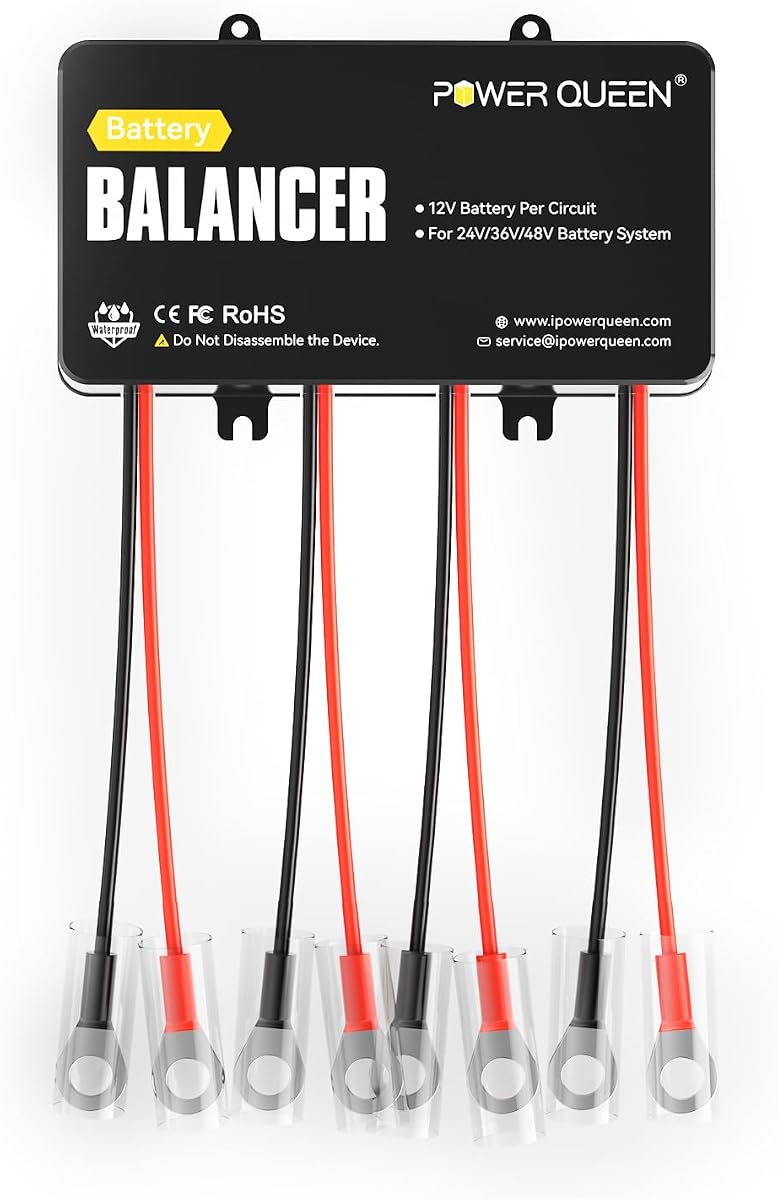
The Power Queen 48V (4 × 12V) Battery Balancer has a 4.3 rating and is designed around a four-port layout for 24V, 36V, and 48V systems. It is particularly relevant to RV, marine, trolling-motor, solar, and off-grid users who want a single active balancer to manage a group of 12V batteries rather than adding separate units to every pair.
We may earn a commission when you buy through this link, at no additional cost to you.
Its stated operating range covers batteries rated from 3V to 20V. Compatible types include LiFePO4, lithium-ion, and lead-acid GEL, SLA, and flooded varieties. The device activates when the system's voltage difference exceeds 10mV and switches to a 5mA standby mode when balancing is complete. That automatic behavior supports continuous use, provided the wiring matches the battery bank's series-parallel arrangement.
Reverse-polarity protection and high-temperature protection are both listed. These safeguards are useful because incorrect terminal connections and heat are recurring concerns in enclosed battery compartments. The product cannot compensate for mismatched battery capacities, incorrect cell types, poor interconnects, or a charger with unsuitable absorption behavior, so system design remains more important than the balancer alone.
The Power Queen is a strong alternative for users who value a four-battery format, broad chemistry compatibility, and automatic correction. Its practical limitation is that the listed multi-voltage support does not mean it can balance arbitrary numbers of batteries independently. Check the number of strings and required balancing positions in your bank before installation.
The product supports several common lead-acid and lithium families within its 3-20V range. Within a single series string, however, batteries should still be of the same type, capacity, age, and state of health to achieve meaningful and stable balancing.
Automatic activation and low-current standby make the balancer suitable for systems that remain connected over long periods. Its role is to correct differences, not to replace periodic battery inspection, charger maintenance, or individual cell testing.
We may earn a commission when you buy through this link, at no additional cost to you.
The Victron Energy Battery Balancer carries a 4.2 rating and takes a focused approach: it equalizes two 12V batteries connected in series, or parallel strings made from series-connected batteries. Rather than offering a broad multi-voltage housing, it concentrates on correcting differences between a matched pair, making it a natural choice for compact 24V systems.
We may earn a commission when you buy through this link, at no additional cost to you.
According to the supplied information, the balancer turns on when the charge voltage of a 24V system rises above 27V. It then compares the voltage across the two series-connected batteries and draws up to 1A from the battery or parallel-connected group with the higher voltage. The resulting current difference helps the batteries converge toward a similar state of charge.
Its primary limitation is current output. A 1A maximum is substantially lower than the 5A and 10A options elsewhere in this list, so it may correct differences more gradually. The benefit is that multiple balancers can be paralleled, allowing a 48V bank to be balanced with three units. This modular approach may be attractive to users who prefer one-balancer-per-pair organization.
Victron is a sensible choice for a 24V installation with two series batteries, especially when low current and a straightforward architecture are priorities. A 48V owner should account for the need for three balancers and confirm that the cable routing and terminals fit the installation. Regardless of brand, the batteries should be similar in type and condition for equalization to deliver useful results.
The unit targets a pair of 12V batteries and activates during the higher charge-voltage stage. This simple arrangement makes it easier to understand and maintain than a more complex multi-bank controller.
Three Victron balancers are specified for a 48V bank, allowing a two-battery balancing method to scale across the complete string. This modularity adds installation work but provides a clear way to serve each relevant section.
We may earn a commission when you buy through this link, at no additional cost to you.
The iSunergy Battery Equalizer has the highest customer rating in this group at 4.5 and supports an unusually broad range of nominal bank voltages from 12V through 96V. Its basic operating unit handles a pair of batteries, with the listing stating that multiple equalizers can be installed in parallel to cover larger systems.
We may earn a commission when you buy through this link, at no additional cost to you.
Each battery must fall within a 7V to 18V range. The equalizer is listed for GEL, flooded, and AGM lead-acid batteries, as well as Li-ion, LiFePO4, nickel-cadmium, and nickel-hydrogen types. That broad chemistry list makes it useful for mixed equipment inventories, although batteries within the same series path should still match in type, capacity, and condition.
The rail-style buckle and distribution-box installation concept is a practical differentiator. It is better suited to a fixed electrical cabinet than to a portable setup, and installers should verify available space, cable reach, ventilation, and access to the balancing nodes. Its purpose is to maintain charge and discharge balance between batteries in a connected pack, not to conduct equalization as a charger feature.
This model is the strongest fit for a user who needs broad nominal-voltage support or a scalable pair-based architecture. It can handle 48V, 60V, 72V, or 96V banks when the correct number of modules is installed, but it is not a one-device solution for balancing every battery simultaneously. Its top rating and flexible chemistry support are meaningful advantages, provided the modular layout fits.
The listed voltage coverage extends to 96V, making this one of the few options here aimed at larger systems. Because each equalizer corresponds to two batteries, the number of modules must match the number of balancing sections in the bank.
The rail-style enclosure is intended for installation inside a distribution box, where it can remain close to the battery interconnects. Fixed installations still need secure wiring, adequate clearance, and accessible disconnects.
We may earn a commission when you buy through this link, at no additional cost to you.
The HC02 48V Battery Voltage Balancer combines four-battery support with an LED display and has a 3.7 rating, the lowest among the ten products. It is designed for 24V, 36V, and 48V arrangements, with the default configuration described as four 12V batteries connected in either series or parallel.
We may earn a commission when you buy through this link, at no additional cost to you.
The display provides a practical way to inspect voltage without relying entirely on indicator lights or external meters. Protection features include reverse-polarity handling and a low-voltage disconnect intended to preserve battery condition. The product is also listed for use with GEL, AGM, flooded lead-acid, and lithium batteries across common automotive, marine, golf-cart, solar, truck, RV, and electric-forklift applications.
For systems of 96V or higher, multiple 48V equalizers can be connected in parallel, giving this model a degree of expansion beyond its standard configuration. One weakness in the supplied specifications is the absence of a stated maximum balancing current. As a result, it is difficult to compare correction strength directly with the 5A, 10A, or 1A devices.
The HC02 may appeal to users who prioritize a visible voltage readout and four-battery capability more than a documented high-current correction rate. Its lower rating warrants more attention to installation quality and customer feedback. A buyer should confirm battery chemistry, current requirements, terminal arrangement, and the available panel space before committing.
The integrated LED display makes it easier to confirm the battery-bank voltage during inspection. A visible reading is useful when troubleshooting, but it should not replace a quality multimeter when checking individual battery health.
The stated ability to parallel multiple 48V modules supports 96V and higher arrangements. This expands the unit's usefulness for larger systems where a single four-battery device would be insufficient.
We may earn a commission when you buy through this link, at no additional cost to you.
The Redodo 24V (2 × 12V) Battery Balancer has a 4.4 rating and focuses on a single pair of 12V batteries. Its maximum equalization current of 10A places it among the strongest correction devices in the selection, making it attractive for users who want a dedicated 24V two-battery solution.
We may earn a commission when you buy through this link, at no additional cost to you.
An LED display shows the voltage of the two connected battery strings, while included 50cm cables and M8 OT terminals simplify connection to common battery posts. The product can be used in a direct series system or a parallel-first, series-later arrangement. Its stated single-battery working range is 3-18V, covering LiFePO4, GEL, SLA, and flooded lead-acid batteries within the supported limits.
Reverse-connection and high-temperature protection are included, and the manufacturer states that the unit can remain connected for extended periods. The product also carries a one-year warranty and access to technical support. Correct polarity remains important, and the listing specifically advises against leaving the system reversed for long periods.
This is a compelling option for a compact 24V bank, especially where the two batteries show meaningful voltage differences or the owner prefers a high correction current. It is not the right one-device choice for a 48V bank containing four batteries. For that layout, choose a four-connection model or install one unit per appropriate battery pair.
A 10A maximum equalization current offers rapid correction compared with 1A and 5A alternatives. The battery bank's charger, wiring, and interconnects must still be properly sized and matched.
The supplied M8 OT terminals and 50cm leads are intended to make direct installation easier. Their length may be restrictive in large battery compartments, so measure the actual spacing and routing path before installation.
We may earn a commission when you buy through this link, at no additional cost to you.
The Power Queen Battery Equalizer 48V (4 × 12V) has a 4.1 rating and is built for a four-port, multi-battery arrangement. It supports 24V, 36V, and 48V systems, making it useful for RV, boat, trolling-motor, and off-grid applications where several 12V batteries form a larger bank.
We may earn a commission when you buy through this link, at no additional cost to you.
Automatic balancing begins when the detected voltage difference exceeds 10mV. When the difference moves below the threshold, the unit enters standby and draws about 5mA. The listed battery range is 3-20V, with compatibility stated for LiFePO4, lithium-ion, GEL, SLA, and flooded lead-acid batteries. The correction method is intended to help the bank maintain more consistent performance and longer service life.
Reverse-polarity and high-temperature protection are included. The product's four-port design reduces the need to install separate one-pair units, but the series-parallel structure still needs to be configured correctly. Power Queen specifically instructs users to connect in parallel first and then in series for series-parallel systems.
This model is a practical fit for a four-battery bank that needs automatic, low-maintenance balancing across several nominal voltages. Compared with the similarly named Power Queen listing in second place, the supplied descriptions are closely matched, while this listing has a slightly lower rating. Buyers should compare the current product page, package contents, warranty terms, and exact terminal arrangement before selecting between them.
The four-port layout targets a 48V bank made from four 12V batteries while retaining support for 24V and 36V arrangements. This is more direct than a modular one-unit-per-pair approach.
At approximately 5mA in standby, the device is designed to remain connected while minimizing unnecessary consumption. Effective balancing still depends on matched batteries and a charger that completes the appropriate charging stages.
We may earn a commission when you buy through this link, at no additional cost to you.
The 48V Universal Voltage Balancer has a 4.3 rating and offers a compact way to balance series-connected 12V batteries. It is designed for 24V, 36V, 48V, and other N × 12V arrangements, with multiple 24V balancers able to operate in parallel for higher-voltage systems.
We may earn a commission when you buy through this link, at no additional cost to you.
Automatic operation begins when the discrepancy exceeds 10mV, and maximum compensation current is 5A. That output places it between the Victron unit's 1A and the 10A devices in the group. Indicator lights communicate operating status, while reverse-polarity protection and low-voltage cutoff help reduce installation and operating risks.
The listed chemistry support includes LiFePO4, lead-acid, lithium, GEL, SLA, Ni-Cd, and Ni-MH batteries, making the unit adaptable to varied collections of equipment. Its compact format may appeal to RV, marine, solar, and off-grid installations where panel space is limited. The lack of a full voltage readout means users who want continuous numerical monitoring need an external meter.
This is the best budget-oriented recommendation for buyers who want more capability than a two-battery-only module without moving to a four-port design. Its most important qualification is scalability: larger series systems may require several equalizers. Confirm that the number of modules covers the intended connections and that all leads can reach the relevant battery nodes without creating strain or unsafe routing.
The unit's compact design is useful in battery compartments where a larger display-equipped model may be inconvenient. Status lights provide a simple indication without requiring a panel-sized numeric readout.
Five amps is enough to correct differences more directly than a low-current pair balancer while remaining below the output of the strongest options. Actual results depend on cable resistance, battery condition, and the size of the voltage difference.
We may earn a commission when you buy through this link, at no additional cost to you.
The HA01 Battery Equalizer has a 4.3 rating and combines an LED digital display with a 0-5A compensation range. It is intended primarily for two series-connected 12V batteries, but the supplied information says it can be used with 24V, 36V, 48V, and other N × 12V systems when the appropriate number of modules is used.
We may earn a commission when you buy through this link, at no additional cost to you.
The device starts balancing when it detects approximately 20mV between two batteries. Its 5A maximum current provides moderate correction, while the LED display allows the user to check the relevant voltage during operation. The listing highlights a flame-retardant shell, high-precision chips, low power consumption, and reverse-polarity and low-voltage-disconnection protection.
Battery compatibility covers 12V GEL, flooded, and AGM lead-acid batteries along with lithium battery packs. The two batteries being balanced must be of the same type, and they should also have similar capacity, age, and condition. A nominal 2 × 12V configuration and three-wire connection are described, with the white wire identifying the midpoint between the two batteries.
HA01 is a good fit for a user who wants more information than simple status LEDs but does not need a four-battery integrated enclosure. Its pair-based architecture means larger banks may need several units. Verify wire color coding locally, since installations vary in color conventions, and connect the black lead to negative, the red lead to positive, and the white lead to the middle connection as described.
The LED display gives users a visible voltage reading, making it easier to confirm operating conditions than a simple on/off indicator. A dedicated meter remains useful for checking each battery independently.
The listed 0-5A compensation range provides some flexibility for different battery-bank conditions. It also means users should verify the setting or operating behavior permitted by the connected battery type and installation.
We may earn a commission when you buy through this link, at no additional cost to you.
The MAZAVA HX02 LCD Display Active Balancer has a 4.1 rating and is the most monitoring-focused model in the selection. Its LCD combines equalizer and voltage-monitor functions, giving users an on-device numerical view rather than relying only on simple indicator lights or an external measuring instrument.
We may earn a commission when you buy through this link, at no additional cost to you.
The product is marketed as a 4S unit covering 12V, 24V, 36V, and 48V arrangements, and its stated single-battery working range is 7-18V. That range is narrower than the 3-20V and 3-18V ranges of several competing products, so it is important to confirm that the batteries fall within the supported limits before installation.
Voltage differences can be displayed to the thousandths, and the equalizer is described as fast. Multiple modules may be connected in parallel, which provides a way to extend balancing across larger banks. Its aluminum alloy shell is a notable physical feature because metal construction can improve heat dissipation compared with an entirely enclosed plastic enclosure.
MAZAVA is the premium-oriented pick for users who prioritize visibility, monitoring, and enclosure construction. The trade-off is that the product carries a higher price than most alternatives in the group, and the supplied information does not state a maximum balancing current. That omission makes it harder to compare correction output directly. It is best for buyers who regard the detailed display and monitoring function as worth the additional expense.
The LCD display reports fine voltage differences, which can make the balancing process easier to observe. It adds visibility but does not replace routine testing for internal damage, poor capacity, or damaged cells.
The aluminum alloy enclosure is designed to dissipate heat more effectively. Ventilation, secure mounting, and protection from moisture or conductive debris remain important even with a metal case.
We may earn a commission when you buy through this link, at no additional cost to you.
Choosing an effective battery equalizer means matching the device to your exact bank layout, voltage, battery chemistry, correction current, and monitoring needs. The following factors are the most important considerations before installation.
Start by identifying the nominal voltage of the complete bank and the nominal voltage of each battery. A 24V system may use two 12V batteries in series, while a 48V system commonly uses four 12V batteries in series or a parallel-first arrangement of four 12V groups. Some products balance one pair, some handle four batteries through four ports, and others scale by adding modules. The stated system voltage alone is not enough; verify the number of connection points and the number of battery sections that genuinely require balancing.
Look for explicit support for the chemistry in your system, such as LiFePO4, lithium-ion, GEL, SLA, AGM, or flooded lead-acid. A broad compatibility list can be convenient, but it does not mean chemically different batteries should be mixed in one series string. For the best results, use batteries of the same type, capacity, age, voltage, and general condition. A balancer can correct a difference that develops between suitable batteries, but it cannot safely reconcile fundamentally incompatible cells.
Maximum balancing current indicates how aggressively the unit can correct voltage differences. Available specifications range from 1A to 10A, and the appropriate figure depends on battery capacity, cable size, and how large the difference is. A high current can respond quickly, but it also requires sound interconnects and correct protection. Lower-current devices may act more gradually. Regardless of output, an equalizer works best when the charger and battery bank are properly configured, because it addresses imbalance rather than supplying the primary charging current.
Pay close attention to the number of terminals, the role of each lead, and the required series-parallel order. Several four-battery products specify parallel-first, series-later construction, while pair-based balancers sit between two adjacent batteries. Incorrect node identification can produce undesirable results even when reverse-polarity protection is present. Draw the complete bank, label every battery and connection, and verify the diagram with a meter before attaching the equalizer. Keep high-current battery cables short and appropriately sized.
A numerical LED or LCD display makes voltage and imbalance easier to inspect than a basic status light. A display is particularly useful during initial setup, when diagnosing differences, and during routine maintenance. Some premium-style units show voltage to fine increments, while compact models offer only operating indicators. No display replaces individual battery testing, but it can make day-to-day troubleshooting more convenient. Consider the size of the display, nighttime visibility, and whether the enclosure fits the available panel space.
Reverse-polarity protection helps contain the consequences of an incorrect connection, while high-temperature protection can shut down the unit under excessive heat. Low-voltage cutoff is also useful because it prevents operation when the connected battery voltage is too low. For long-term installations, examine standby consumption and automatic activation behavior. A device that begins at a defined voltage-difference threshold and then draws only a few milliamperes is designed to remain connected without demanding constant manual attention.
If the bank may expand, determine whether extra equalizers can be connected in parallel and how the manufacturer defines that arrangement. Pair-based systems often scale by adding one module for each required section, whereas four-port units can cover a complete 48V string in one enclosure. Multi-module wiring increases complexity, so leave enough space for secure connections and future service. Confirm that the advertised maximum bank voltage remains valid after adding modules and that the charger can support the intended final configuration.
Battery compartments can be hot, damp, cramped, and exposed to conductive debris. Look for an enclosure suited to the location, secure mounting provisions, adequate cable reach, and a readable display if monitoring is important. Heat dissipation matters because continuous balancing generates heat, particularly at higher output levels. Keep the device away from battery terminals where a short could occur, and provide appropriate fusing and disconnection. Installation quality is as important as the balancer's specifications.
Before installation, fully charge the battery bank using a charger appropriate for its chemistry and nominal voltage. Test each battery for resting voltage, capacity, and signs of damage, then replace or separately service any weak or mismatched unit. Label the positive and negative terminals and every midpoint connection. Compare the intended wiring diagram with the actual physical arrangement, especially in series-parallel systems where parallel groups should be formed before being connected in series.
With the power source safely disconnected, connect the equalizer to the specified battery nodes. Verify polarity and node placement with a meter before enabling the circuit. Start with the charger inactive to confirm there are no unexpected readings, then operate the system within the balancer's specified voltage and current limits. Do not use the equalizer as a substitute for a charger, and avoid leaving reversed connections or exposed terminals unattended, even when protection circuitry is present.
After installation, observe the display or status indicators and compare individual battery voltages with an accurate meter. Allow the charger to complete the appropriate charging stages, since balancing may become more apparent near the end of charge. Periodically inspect connections for looseness, corrosion, heat discoloration, or damaged insulation. Keep the enclosure dry and unobstructed, confirm that standby consumption is appropriate for the installation, and disconnect the unit before servicing batteries or altering the bank layout.
An active battery equalizer detects voltage differences between connected batteries and helps transfer charge from the higher-voltage battery toward the lower-voltage battery. This can improve consistency within a series string and help maintain more even battery-bank performance. It does not replace a charger, and it cannot correct a battery that has suffered permanent capacity loss or internal damage.
Some multi-voltage products support more than one nominal bank voltage, but their connection count still matters. A four-port model may cover 24V, 36V, and 48V arrangements, while a two-battery unit may serve only one pair. Confirm that every balancing node in the selected bank is connected and that each battery falls within the stated per-battery voltage range.
A higher maximum current can correct larger differences more quickly, but it is not automatically the better choice for every installation. Battery capacity, cable resistance, charger behavior, heat, and the size of the imbalance all matter. The equalizer should be installed with suitable wiring and protection, and the batteries should be of matching type, capacity, and condition.
Many models in this selection explicitly support LiFePO4, but compatibility must be confirmed for the exact product and connection arrangement. The balancer should also be used with a charger designed for lithium chemistry. Do not assume that lead-acid absorption settings or equalization behavior are appropriate for LiFePO4 systems.
No. A balancer addresses differences between otherwise serviceable batteries; it does not restore lost capacity, damaged cells, or a faulty charger. A battery that repeatedly runs far out of alignment, overheats, swells, or fails to reach the expected voltage should be tested and replaced or serviced before the bank is reconnected.
Several products are explicitly designed for continuous connection. Their automatic activation and low-power standby modes reduce the need for manual switching. Continuous operation is still appropriate only when the battery chemistry, charger, wiring, and installation conditions are compatible, and only after the initial voltage and polarity checks are complete.
It depends on the design. A four-port equalizer may manage four 12V batteries as one bank, while many two-battery modules require one unit for each pair or balancing section. A 48V bank built from three 16V strings may also need a different arrangement. Follow the manufacturer's topology and confirm the number of accessible midpoint connections in the actual bank.
A display is not essential for balancing, but it makes voltage differences and operating status easier to inspect. Models with simple indicator lights are adequate when an external multimeter is used regularly. LED or LCD displays are more convenient for installation, troubleshooting, and ongoing monitoring, particularly in larger RV, solar, marine, and off-grid systems.
The LiTime 48V Battery Balancer stands out for four-connection flexibility, a 10A maximum current, broad chemistry support, and automatic low-power standby. The MAZAVA HX02 is the premium pick for detailed LCD monitoring, multi-module expansion, and aluminum-alloy heat dissipation, while the compact 48V Universal Voltage Balancer offers a budget-friendly middle ground with 5A compensation and status lights.
Prioritize exact bank topology, supported per-battery voltage, chemistry compatibility, and correct wiring over features alone. Higher current can be beneficial, but the charger, interconnects, battery condition, and physical installation determine whether balancing works as intended. For a two-battery 24V system, the Redodo and Victron options are especially direct choices, while four-battery banks are better served by a four-port model or properly scaled pair-based modules.
Before purchasing, review the current product listing, package contents, warranty, and installation instructions, and confirm that the model covers every connection in your battery bank. Product features, availability, and pricing can change, so current details should be checked before ordering. A correctly matched, securely wired, and regularly inspected equalizer can be a valuable component of a well-maintained battery system.