
Akai Professional LPK25
4.7Editor score
Responsive 25 velocity keys
Eight programmable preset slots
Arpeggiator and transport clock
Portable MIDI Keyboard for Travel guide comparing ten compact controllers for portability, key feel, wireless MIDI, battery life, and creative control on the
A portable MIDI keyboard for travel should make creating music easier wherever you unpack, without turning every train ride, hotel room, or rehearsal space into a complicated setup. The best models balance compact dimensions, responsive keys, dependable connectivity, and enough performance control to sketch ideas or finish arrangements away from a permanent studio.
This guide compares ten options for mobile composing, practice, beat making, and compact performance. We considered key count and size, velocity sensitivity, USB and wireless MIDI support, battery capability, built-in sounds, DAW controls, portability, and the usefulness of included learning or production software rather than treating key count as the only measure of value.
Each review highlights a different reason to consider a travel keyboard, from a remarkably simple budget controller to folding instruments and a battery-powered standalone model. Ratings and specifications reflect the supplied product information, while current availability, software offers, and prices can change, so readers should verify the latest listing before buying.
4.7Editor score

4.6Editor score

4.7Editor score
The table below compares key count, sound generation, connection methods, and the most relevant travel features. Because a portable MIDI keyboard may be a bare controller, a self-contained instrument, or a folding 61-key piano, these differences are more meaningful than a simple ranking of size.


The Akai Professional MPK Mini IV earns the Editor's Choice position because it combines an exceptionally complete control surface with a genuinely compact footprint. Its 4.6 rating reflects a well-rounded feature set, and the standout qualities are clear: velocity-sensitive mini keys, eight assignable knobs, a full-color screen, a push-and-turn encoder, and eight RGB MPC pads. Those elements make it more capable than a basic three-octave controller while remaining suited to a carry-on or compact mobile rig.
We may earn a commission when you buy through this link, at no additional cost to you.
The keyboard handles melody, bass lines, synth leads, and sample triggering, while the controls let a traveling creator adjust software-instrument settings without repeatedly reaching for a computer. The arpeggiator adds Pattern, Freeze, Mutate, Chord, and Scale functions, and the expanded DAW-mapped transport section supports a faster production workflow. A full-size MIDI output broadens the possibilities, while USB-C connectivity and plug-and-play operation for Mac, PC, and mobile systems reduce setup friction. The included software package adds 1000-plus sounds from AIR, Akai Professional, and Moog, alongside Ableton Live Lite 12 and lessons through Melodics.
There are reasonable trade-offs. Twenty-five mini keys are not as immediately comfortable as a larger set of full-size keys, particularly for pianists accustomed to conventional spacing. It also has no built-in sound engine or speaker, so it needs a connected computer, phone, tablet, or another sound-producing device. The full complement of knobs, pads, display, and encoder can also make the unit less pocketable than a barebones controller. Even so, the MPK Mini IV provides a more deliberate and musical control layout than most ultra-compact alternatives, which makes those compromises acceptable for a travel-focused creator who wants one device to cover composing, beat making, and mobile control.
Choose the MPK Mini IV when you want a single portable MIDI controller that can follow you from a hotel workspace to a rehearsal room and still offer serious hands-on control. It is especially suitable for beat makers, singer-songwriters, producers, and streamers who value compactness without giving up pads, knobs, displays, or software integration. For someone who only needs a few functions, a simpler model may be sufficient, but this is the most complete general-purpose choice in the group.
The MPK Mini IV places the controls most frequently needed during software-instrument performance within easy reach. That makes it practical for adjusting synth parameters, navigating presets, recording, and shaping a performance while the computer remains out of view.
The arpeggiator and chord-oriented modes are useful for testing ideas quickly. Beginners can explore patterns without extensive setup, while experienced players can use them as controlled starting points for melodies, bass parts, and beat sketches.
We may earn a commission when you buy through this link, at no additional cost to you.
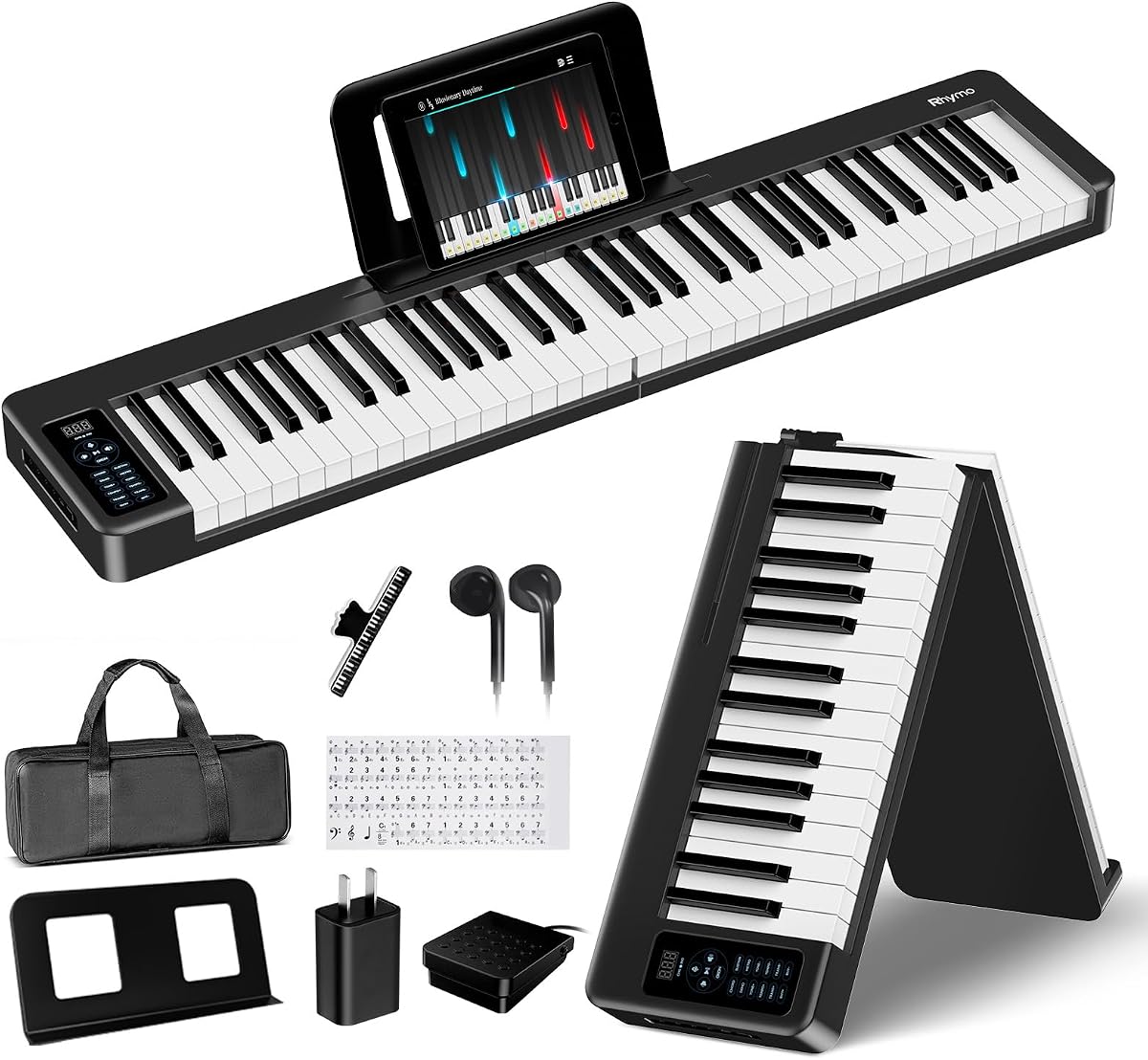
The Rhymo Folding Piano is the Best Budget option here for travelers who want a broad playing range and wireless freedom. It carries a 4.3 rating and stands apart from conventional desktop controllers through a 61-key folding design, an onboard sound engine, 128-note polyphony, 128 built-in timbres, and Bluetooth MIDI. When unfolded, it provides a standard 61-key layout at 90 by 19 centimeters, offering much more melodic range than the 25-, 32-, or 37-key alternatives.
We may earn a commission when you buy through this link, at no additional cost to you.
Its slightly weighted, touch-sensitive keys and dynamic response are designed to approximate the resistance of an acoustic piano while the body folds to 45 by 11 by 19 centimeters. The stated weight of 2.3 kilograms and included padded gig bag make it more realistically portable than a rigid 61-key digital piano. An integrated lithium battery supports up to 10 hours of cordless operation, and the power system permits charging through USB-C while playing. Bluetooth MIDI also removes the need for a dedicated cable when communicating with compatible electronic devices.
The compromises are inherent in the portable piano format. Even when folded, this is a larger and heavier object than a mini MIDI controller, and a folding seam can make long sessions less comfortable than a conventional rigid keybed. Its 61 keys provide three full octaves, which is useful for melodies and basic arrangements but still short of a full 88-key instrument. The 4.3 rating and beginner-oriented positioning also suggest a model that prioritizes accessibility over the deep customization offered by specialist production controllers.
Buy this Rhymo model if your travel plans require real playing space, wireless MIDI, and several hours away from an outlet. It is a strong fit for hotel practice, commuting, small apartments, and mobile songwriting sessions where a mini keybed would feel too restrictive. It may be unnecessary for someone who only edits software or triggers samples, but for a traveler prioritizing range and self-contained operation, the folding design makes the compromise worthwhile.
The hinged body reduces the footprint required by a full-length 61-key keyboard before transport. Once set down, it restores a conventional span and makes it practical to compose full passages rather than relying exclusively on short octaves.
Bluetooth MIDI and the ten-hour battery let the instrument operate without a constant tether to a computer or power outlet. This is particularly useful in rehearsal rooms and locations where connection access is unpredictable.
We may earn a commission when you buy through this link, at no additional cost to you.
The Akai Professional LPK25 is the Best Budget pick because it delivers the essential ingredients of a portable MIDI controller without an elaborate set of extras. Its 4.7 rating is the highest among the listed products. The 25 responsive keys support melody, bass, composition, and beat-oriented playing, while dedicated octave buttons, a sustain button, a built-in arpeggiator, and a clock provide a surprisingly capable control package in a simple format.
We may earn a commission when you buy through this link, at no additional cost to you.
Eight programmable preset slots let users recall mappings for DAWs and virtual instruments without rebuilding the layout every session. Compatibility extends to popular applications including GarageBand, Logic, Studio One, Cubase, Ableton Live, Pro Tools, FL Studio, Digital Performer, and Adobe Audition. USB power and plug-and-play behavior for Mac or PC minimize setup time, which is one of the most important qualities for a controller used away from a permanent studio. Its sleek design also takes up relatively little room beside a laptop or in a mobile workspace.
The main limitation is that it is a controller, not a standalone instrument. You will need a computer or another compatible source to produce audible sound, and there is no Bluetooth MIDI, battery, built-in speaker, or onboard sound library. The 25 mini keys may feel restrictive during extended melodic work, and the lack of a display or dedicated performance pads makes it less engaging for hardware-style beat production. For a traveler who needs a dependable writing and editing tool, those omissions are understandable rather than serious flaws.
The LPK25 is a strong recommendation for beginners, songwriters, and mobile producers who want simple setup and broad software support at an accessible level of complexity. Choose it when your priority is a compact, responsive way to operate software instruments and record ideas, not a self-contained instrument for playing without a host device. Its 4.7 rating and restrained feature design make it a particularly balanced travel companion.
USB power and plug-and-play operation reduce the number of steps between unpacking and playing. A creator can connect the controller to a Mac or PC, open the chosen application, and begin working with minimal configuration.
Eight programmable slots let different projects retain useful controller assignments. This is valuable for travel because it avoids repeating a detailed setup each time a laptop, software instrument, or DAW changes.
We may earn a commission when you buy through this link, at no additional cost to you.
The M-Audio Keystation Mini 32 MK3 offers a balanced middle ground for travelers who find 25 keys too restrictive. It has a 4.2 rating, 32 miniature piano-style velocity-sensitive keys, and a compact body intended for Windows and Mac laptops. Compared with a three-octave controller, the added range gives a little more room for bass lines, chords, and melodic ideas without approaching the footprint of a full keyboard.
We may earn a commission when you buy through this link, at no additional cost to you.
A standout feature is the choice of selectable velocity curves, allowing the response to be adjusted for traditional piano technique, synthesizer behavior, or key-based beat making. Pitch bend and modulation buttons add expression beyond the keys, while octave controls, a volume knob, and a sustain button cover common controller tasks. The controller connects by USB to Mac or PC without additional drivers or an external power supply, making setup especially straightforward in borrowed or unfamiliar workspaces.
Its trade-offs are the familiar limitations of the mini-key format. The keys require an adjustment period compared with full-size piano keys, and the controller remains dependent on a computer and software instrument for sound. It lacks Bluetooth MIDI, onboard sounds, a display, and dedicated drum pads. Its 4.2 rating sits below the strongest options in the list, although that should not obscure the useful balance between range, expression, and simplicity.
This Keystation model is well suited to students, writers, and producers who want more melodic reach than the smallest controllers without dragging a full-size instrument through a journey. Its educational options, including Melodics access, make it especially approachable for new players. For advanced beat makers who need pads or assignable controls, one of the Akai MPK models is more complete, but for focused keyboard control the Mini 32 is refreshingly direct.
Selectable velocity curves allow users to match the key action to a preferred playing style. That flexibility makes the controller useful for both melodic writing and rhythm-focused software workflows.
The expanded range supports broader phrases and easier navigation of a software instrument's register. It remains compact, but offers a little more creative space than a basic 25-key layout.
We may earn a commission when you buy through this link, at no additional cost to you.
This second Rhymo Folding Piano listing shares the core strengths of the ranked version while giving travelers another option to compare. It carries a 4.3 rating and combines 61 folding weighted keys with 128-note polyphony and 128 built-in timbres. The full-size 90-by-19-centimeter unfolded layout is far more useful for complete passages, chord progressions, and two-handed practice than a compact controller keyboard.
We may earn a commission when you buy through this link, at no additional cost to you.
Portability comes from folding the instrument into a 45-by-11-by-19-centimeter package weighing 2.3 kilograms. A padded gig bag is included, and the integrated lithium battery provides up to 10 hours of operation. The system can charge through USB-C while playing, with a stated full recharge time of 1.5 hours. Bluetooth MIDI allows wireless transmission and reception of MIDI data, reducing cable clutter when recording with compatible equipment.
The LCD monitor adds useful information about chord progressions, sustain, metronome synchronization, and transposition. However, the product is still primarily an accessible electric piano rather than a feature-dense studio controller. There are no dedicated MPC pads, assignable rotary knobs, DAW faders, or extensive performance modes comparable with the Akai and Arturia models. Its physical size and weight also remain greater than those of compact MIDI controllers, even when folded.
Travelers who want a substantial keyboard range, internal sounds, and battery-powered wireless operation will find this model compelling. It works well for hotel practice, festive trips, business travel, rail commutes, and compact living spaces where a rigid 61-key instrument would be impractical. It is less appropriate for a user who needs only a lightweight DAW control surface, but for portable full-range playing, the folding form and wireless features directly address common travel obstacles.
The onboard sound engine and broad set of timbres allow practice without a connected computer. This makes the instrument useful when the goal is simply to play, compose acoustically, or record ideas into another device.
USB-C charging during operation helps prevent a dead battery from interrupting rehearsal or practice. The stated one-and-a-half-hour recharge also makes it practical to top up the instrument between travel activities.
We may earn a commission when you buy through this link, at no additional cost to you.
The Arturia MiniLab 37 is the Best Premium pick because it offers the most balanced combination of playing range, control layout, and portability. Its 4.7 rating matches the highest score in the group. Thirty-seven slim keys give users room for two-handed performance while maintaining a shallow, desktop-friendly form factor, and the design avoids the bulk of a full production keyboard.
We may earn a commission when you buy through this link, at no additional cost to you.
The hardware is thoughtfully arranged for creative work. Eight pads in a 2-by-4 stacked layout support finger drumming and clip launching, while DAW-integrated faders offer tactile control over common application functions. A real-time mini display provides visual feedback, and the built-in arpeggiator, Chord mode, transposition, and custom DAW mappings support both structured composition and improvisational sketching. These features make the MiniLab 37 more than a simple set of keys.
It remains a MIDI controller rather than a self-contained instrument, so a computer and sound source are necessary. The product information does not indicate Bluetooth MIDI, battery operation, or a built-in speaker, meaning the supplied benefits are strongest for users who already rely on a laptop or mobile production setup. Its slim keys may also feel different from a full-size weighted action. Even with those limitations, the 4.7 rating suggests a particularly satisfying combination of features.
The MiniLab 37 is an excellent choice for producers, composers, and performers who want more musical range than a 25-key controller but still travel with a compact device. It is particularly useful for DAW-centered mobile workflows because the faders, pads, display, and mappings reduce the need to navigate software with a mouse. Those who need onboard sounds and battery power should consider a self-contained alternative, but for premium desktop-style control, this model leads the category.
The added keys make sustained chords, bass support, and fuller melodic arrangements more natural. This expands creative possibilities while retaining a shallower form factor than traditional 49- or 61-key controllers.
Hardware controls for clip launching, mixing, and common navigation reduce dependence on mouse movement. That efficiency is especially valuable on a laptop screen when working in a small or temporary studio space.
We may earn a commission when you buy through this link, at no additional cost to you.
The Akai Professional MPK Mini MK3 is a strong choice for travelers who create beats as often as they write melodies. It has a 4.6 rating, 25 velocity-sensitive mini keys, eight backlit MPC-style pads, eight assignable knobs, and a distinctive four-way thumbstick for pitch and modulation. The result is a compact controller with enough physical control to make mobile production feel tactile rather than dependent entirely on a trackpad.
We may earn a commission when you buy through this link, at no additional cost to you.
Its MPC-style pads support note repeat and full-level behavior, which makes drum programming, sample triggering, and virtual-instrument control efficient. The arpeggiator includes adjustable resolution, range, and modes, while the knobs can be assigned to virtual-instrument and effects parameters. Native Kontrol Standard integration allows users to browse compatible Native Instruments presets and sound libraries, and the bundled package includes MPC Beats, three virtual instruments, and 2GB of sound content.
The main drawback is generational competition. The newer MPK Mini IV adds a full-color display, an encoder, RGB pad feedback, expanded transport controls, and modern USB-C connectivity, while this MK3 uses an older control arrangement. It also has no built-in speaker, sound engine, or battery, so it remains dependent on a host device. Its 25 mini keys and relatively compact layout are reasonable for travel, but not ideal for pianists wanting full-size key dimensions.
Choose the MPK Mini MK3 if its familiar MPC workflow, thumbstick, and extensive included production content appeal to you more than the newest display-based features. It is well suited to beat makers, producers, and users who already work with MPC Beats or NKS-compatible instruments. A first-time buyer may find the MPK Mini IV more current, but this model remains a capable and well-equipped option for portable production.
Velocity-sensitive, backlit pads support finger-drumming, sample launching, and note-based effects. These dedicated controls are valuable when a traveler wants to build a groove quickly without navigating a dense software interface.
MPC Beats, multiple virtual instruments, and 2GB of sound content give new users material for immediate experimentation. The included sounds are especially helpful when reliable access to a personal sample library is limited.
We may earn a commission when you buy through this link, at no additional cost to you.
The M-Audio Keystation 49 is the best option in this list for a traveler who prioritizes full-size keys and traditional controller ergonomics. Its 4.6 rating reflects a well-regarded balance of features, and the 49 velocity-sensitive keys provide roughly four octaves in a relatively compact desktop design. That larger playing surface is more approachable for pianists and makes sustained chords or extended arrangements easier than on a 25- or 37-key model.
We may earn a commission when you buy through this link, at no additional cost to you.
A volume fader, transport controls, directional buttons, octave controls, sustain pedal input, and dedicated pitch and modulation wheels cover the functions commonly expected from a serious MIDI controller. The wheels offer a more familiar way to shape expression during software-instrument performance, while the transport section allows recording and playback management without moving the mouse. Plug-and-play USB operation for Mac and PC requires no drivers or separate power supply, keeping the initial setup simple.
Portability is relative. Full-size keys require more space and produce a larger instrument than mini-key controllers, so the Keystation 49 is better suited to a hotel room, rehearsal venue, or fixed table than a minimalist daypack setup. The product information also notes iOS compatibility through an Apple to USB Camera Adapter sold separately. It has no built-in sound engine, wireless connection, or battery, meaning it depends on a host computer for sound and power.
Buyers should select this model if conventional key feel and broad range matter more than extreme compactness. It is appropriate for pianists, composers, educators, and performers who want a recognizable controller layout in a portable studio package. The bundled MPC Beats, Ableton Live Lite, Velvet, XPand2, Mini Grand, and Touch Loops, along with Skoove and Melodics lessons, also make it attractive for users who want productive software access from the outset.
Traveling musicians who already know a conventional piano can adapt more quickly to this layout. The larger keys also make chord voicings and longer phrases more comfortable than they are on mini-key controllers.
Pitch and modulation wheels provide familiar tactile control over compatible software instruments. The sustain input, volume fader, and transport buttons round out a controller designed for both writing and expressive playing.
We may earn a commission when you buy through this link, at no additional cost to you.
The Akai Professional MPK Mini Play MK3 is the most clearly self-contained travel option among the compact production keyboards. It has a 4.5 rating, a built-in speaker, over 100 internal drum and instrument sounds, and support for battery operation. A musician can therefore power it up and play melodic parts, chords, or drum patterns without first connecting a laptop, making it particularly useful during travel downtime.
We may earn a commission when you buy through this link, at no additional cost to you.
Its 25-key Gen 2 dynamic keybed includes velocity sensitivity, while the OLED display, eight velocity-sensitive backlit MPC pads, arpeggiator, note repeat, and four encoder knobs offer more control than a barebones learning keyboard. The internal sound selection includes acoustic and electric pianos, synth leads, pads, and other basic categories, giving the player a credible starting point for portable practice and songwriting. USB MIDI and the included Type-B-to-Type-A cable also allow connection to a computer when deeper production work begins.
The key limitation is that batteries are not included, so true cordless use requires purchasing suitable batteries separately. The 25 mini keys remain insufficient for players who need a broad piano range, and the small enclosure may offer less room for two-handed technique than the MiniLab 37 or Keystation 49. The integrated speaker is convenient rather than a substitute for a high-quality monitoring system. It also becomes a controller rather than a standalone instrument once connected to software.
Choose the MPK Mini Play MK3 when portability includes the ability to make sound without a computer. It is well suited to hotel-room songwriting, spontaneous jam sessions, music lessons, and quick ideas that need to be captured away from a studio. Buyers who need only silent control and the broadest DAW features can save space with a pure controller, while this model is better for musicians who want sound and performance packed into one compact unit.
The internal instruments and integrated speaker allow meaningful musical activity without a computer. That lowers the barrier to playing during a journey and avoids dependence on internet access, compatible software, or a power outlet.
Eight backlit MPC pads support rhythm and sample work, while the OLED display provides compact visual feedback. These features make the unit more engaging than a basic educational keyboard without adding much bulk.
We may earn a commission when you buy through this link, at no additional cost to you.
The Akai Professional MPK Mini Plus rounds out the list as a versatile 37-key controller with unusually broad studio connectivity. Its 4.5 rating reflects a strong feature set for travelers who may work with more than a conventional computer-based DAW. Three full octaves of dynamic keys support melodic and harmonic playing, and the unit includes eight assignable rotary knobs, eight RGB MPC pads, a transport section, Chord and Scales modes, and NKS integration.
We may earn a commission when you buy through this link, at no additional cost to you.
Its standout travel advantage is adaptability. MIDI input and output, CV Gate, USB-powered operation, and a 64-step sequencer let the keyboard work with software, sound modules, synthesizers, and modular equipment. The built-in sequencer has one drum track and one melody or chord track, with up to eight notes each, allowing a user to create a pattern without a computer. That is particularly useful for capturing ideas quickly in a rehearsal space or building a groove before moving to a full production setup.
The trade-offs are size and dependency. Thirty-seven keys and a full set of controls make this larger than the most compact 25-key models, and there is no built-in speaker, sound engine, battery, or wireless connection. Consequently, the sequencer supports composition rather than self-contained sound generation unless a separate sound source is connected. The supplied information also leaves the exact mobile connectivity less prominent than on models explicitly designed for phone, tablet, or wireless workflows.
The MPK Mini Plus is a compelling recommendation for musicians who want one controller to cover songwriting, beat making, sequencing, modular control, and conventional DAW production. It is especially useful for someone who changes creative setups frequently and values future-compatible connectivity over maximum portability. A traveler who only needs a simple laptop controller may find the LPK25 or Mini 32 more streamlined, but this model delivers the broadest hybrid workflow in the group.
The 64-step sequencer can store a drum pattern and a melodic or harmonic pattern without requiring a running DAW. A creator can build the foundation of a song in a rehearsal room and transfer the idea into a larger setup later.
CV Gate and MIDI connections allow the controller to work with compatible modular systems and external sound modules. This makes it useful for travelers who build with hardware rather than relying exclusively on laptop-based software.
We may earn a commission when you buy through this link, at no additional cost to you.
The right travel keyboard depends on how you create, what equipment accompanies you, and how much space you can carry. Key count, sound generation, power, connectivity, and control layout should be considered together rather than treating the smallest or largest model as automatically the most useful.
Key count determines the musical range you can access without octave shifting, while key size affects comfort, technique, and realistic use of chords. A 25-key controller is highly compact and works well for melodies, bass lines, beat triggers, and software-instrument control, but it offers limited room for two-handed arrangements. A 32- or 37-key model offers a more useful middle ground, with the Arturia MiniLab 37 explicitly designed to support two-handed play and the M-Audio Keystation 49 adding full-size keys. A folding 61-key instrument provides a much wider range and conventional spacing, but its folded package remains larger and heavier than a mini controller.
In short, choose the fewest keys that still support your normal playing style. Mini keys save space, while full-size keys improve familiarity and technique.
Velocity sensitivity means the keyboard can detect how forcefully a key is pressed and transmit that information to software. It adds nuance to virtual instruments, drum pads, and sample triggers, making a controller feel less mechanical. The Akai MPK Mini IV, LPK25, MPK Mini MK3, and MPK Mini Play MK3 all use velocity-sensitive keys, while the M-Audio Keystation Mini 32 goes further by offering selectable velocity curves. Dedicated pitch, modulation, sustain, and expression controls can further improve musical phrasing, although they require a suitable sound source and software support.
Prioritize responsive velocity when expressive playing matters. Choose adjustable curves or dedicated wheels if you need detailed dynamic control.
A pure MIDI controller sends musical instructions but does not necessarily make sound by itself. This keeps the device small and versatile because a Mac, PC, phone, tablet, synthesizer, or modular system supplies the voice. The MPK Mini IV, LPK25, M-Audio models, Arturia MiniLab 37, and most Akai MPK controllers generally require a connected source. By contrast, the Rhymo folding piano includes an onboard sound engine, and the MPK Mini Play MK3 includes internal sounds and a speaker. A self-contained instrument is valuable for practice and spontaneous sessions, while a controller is usually more appropriate for DAW-based production.
Choose onboard sounds for portable playing without a host device. Choose a controller when your priority is software control and a lighter, simpler setup.
Wired USB MIDI is dependable and often the easiest way to establish a connection, but cables can become an avoidable inconvenience in a rehearsal room or on a stage. Bluetooth MIDI is explicitly available on the Rhymo folding piano, while the MPK Mini Play MK3 can run on batteries, although batteries are not included. The battery-powered Rhymo model offers up to 10 hours of cordless operation and can charge through USB-C while playing. Most of the mini controllers in this guide require USB power, so compatibility with a mobile device and the relevant adapter should be confirmed before purchase.
Prioritize wireless control when traveling without dependable outlets or cables. Verify battery inclusion, runtime, and mobile compatibility before relying on cordless operation.
The number of keys says little about how quickly a producer can manipulate sounds, arrange a session, or trigger samples. The MPK Mini IV adds eight knobs, a full-color screen, an encoder, RGB pads, and transport controls. The MPK Mini MK3 provides eight assignable knobs, a thumbstick, and eight MPC pads. The Arturia MiniLab 37 combines eight pads, DAW-integrated faders, a display, and mapping options, while the MPK Mini Plus adds a transport section, rotary knobs, RGB pads, and a 64-step sequencer. These controls reduce reliance on a trackpad and are especially valuable when working on a small laptop display.
Match the control layout to your production style. Pads suit beat triggering, faders aid mixing, and assignable knobs support detailed sound shaping.
Portability is not determined only by the number of keys. The Rhymo folding piano reduces its length when packed and includes a padded gig bag, but at 2.3 kilograms it remains heavier than a compact controller. The mini Akai, M-Audio, and Arturia models are designed around compact desktop footprints, with the Arturia MiniLab 37 also highlighted for a shallow form factor. Consider the entire travel bag, the length and weight of cables, and whether a protective case is available. A slightly larger keyboard that fits securely in a case may be more practical than a smaller unit forced into a loose compartment.
Measure the packed instrument, not just the exposed dimensions. Include the case, accessories, and cables in your travel plan.
Before buying, confirm that the keyboard supports the operating system and applications you use. The LPK25 lists broad compatibility with GarageBand, Logic, Studio One, Cubase, Ableton Live, Pro Tools, FL Studio, Digital Performer, and Adobe Audition. The M-Audio Keystation 49 supports Mac and PC and notes iOS use through a separately sold adapter. The MPK Mini IV is described as plug-and-play for Mac, PC, and mobile setups, and the MPK Mini Plus supports MIDI and CV Gate for external and modular gear. Software integration should also be checked, particularly when NKS, MPC Beats, virtual instruments, or included lessons are important to your routine.
Confirm operating system, DAW, mobile device, and hardware compatibility first. Software support can shape the value of included sounds and mappings.
Bundled resources can shorten the path from setup to a first useful idea. MPC Beats appears across several Akai products, and the MPK Mini IV adds a broad virtual-instrument collection plus Ableton Live Lite 12. The MPK Mini MK3 includes three virtual instruments and 2GB of sound content, while the MPK Mini Play MK3 provides more than 100 internal sounds and included expansion packs. Melodics lessons appear with the LPK25, M-Audio Keystation Mini 32, and other models, and the Keystation 49 includes Skoove plus Melodics. These packages are useful, but they should complement rather than replace an assessment of the hardware, connectivity, and musical range.
Treat bundled software as a valuable bonus, not the deciding feature. Prioritize the hardware that matches your playing and production method.
Begin by selecting a suitable power source and connection method. For a USB controller, connect the supplied or required cable to a compatible Mac, PC, phone, or tablet, power on the keyboard, and open the intended DAW or music application. Confirm that the application recognizes the controller and assign its keys, pads, knobs, buttons, and transport controls before trying to record. If the product includes saved programs or preset slots, load the appropriate mapping for the current software environment rather than repeatedly changing settings by hand.
For Bluetooth MIDI, pair the keyboard with the intended host device and select the same MIDI input in the recording application. A stable physical arrangement is important because touring musicians may move between rooms without adjusting the setup. For a self-contained model, select an internal sound, set a comfortable level, and use the included display or LCD to confirm settings. Test recording, metronome, sustain, and arpeggiator functions before beginning a full session, and save or back up custom mappings where the manufacturer's editor permits it.
Protect the instrument by keeping the case or padded bag around it during transport and avoiding pressure on the LCD, display, keys, and connection ports. A folding keyboard should be opened and closed by its intended hinges rather than by twisting the key sections. Clean the exterior with a soft, lightly damp cloth, avoid spraying liquid directly onto controls, and keep the unit away from extreme heat, moisture, and direct contact with loose objects. Before every trip, reconnect the controller, update required software, verify custom mappings, and place essential cables in the case so a working session is not delayed by a missing accessory.
A portable MIDI keyboard is most useful if you want to compose, practice, perform, or control music software away from a fixed studio. It can turn a laptop, tablet, synthesizer, or other compatible sound source into a playable instrument. If your travel activities do not involve music creation, a full-size controller may be unnecessary, but for frequent mobile musicians the ability to capture ideas and rehearse is a substantial advantage.
It can be enough for melodies, bass lines, chord sketches, and beat programming, especially when octave-shift buttons are available. The limitation appears when writing arrangements that require sustained two-handed parts or a wide register. A 32- or 37-key model offers more room, while a 61-key folding piano is better for extended passages and full-range practice.
A MIDI controller primarily sends performance and control data to a computer or another sound-producing device. A portable digital piano generally includes its own sounds, speakers, and controls for playing without a host computer. The MPK Mini Play MK3 and the Rhymo folding piano occupy the more self-contained side of the category, while the LPK25, MiniLab 37, and MPK Mini IV are designed primarily for control of external software or hardware.
The Rhymo folding piano explicitly supports Bluetooth MIDI, allowing wireless MIDI data exchange with compatible devices. Other models in the guide are primarily presented as USB controllers, so their host-device support should be confirmed through the current product information and application requirements. Confirm that your phone or tablet supports the relevant Bluetooth MIDI workflow and that any necessary adapters are available.
Mini keys are compact and can teach fundamentals such as note placement, scales, chords, and keyboard geography, but they do not reproduce full-size key spacing or weight. A learner focused on piano technique may eventually need a full-size keyboard, while a learner interested in production can begin productively on a mini controller. The LPK25, Keystation Mini 32, and included Melodics or Skoove options are particularly relevant to this use case.
Check the airline and rail operator's size and weight rules before packing any keyboard. Mini controllers are generally easier to accommodate, while the 61-key folding model needs a stable case and more allowance. Keep the instrument, cable, adapter, and computer in separate protective compartments where possible, and avoid checking it without suitable protection because impact and pressure can damage keys, screens, and hinges.
Use the manufacturer's preset system or editor where available. The LPK25 provides eight programmable preset slots, the MPK Mini MK3 supports downloadable customization software, and the MPK Mini IV includes expanded DAW-mapped controls and software integration. Save separate mappings for each likely DAW or device, and test them after reconnecting because software updates or different host applications can change control behavior.
The Rhymo folding piano and Akai MPK Mini Play MK3 are the clearest self-contained choices. The Rhymo model offers 61 weighted folding keys, internal timbres, Bluetooth MIDI, and up to 10 hours of battery operation, while the MPK Mini Play MK3 combines 25 dynamic keys, more than 100 internal sounds, a built-in speaker, and optional battery use. Their trade-offs are greater size for the Rhymo and the need to supply batteries for the Akai.
The Akai MPK Mini IV stands out as the most complete general-purpose travel controller, combining velocity-sensitive keys, eight knobs, a full-color display, RGB pads, USB-C, and a broad software package. The Akai LPK25 is the straightforward budget selection for users who want a responsive 25-key controller and broad application compatibility. At the premium end, the Arturia MiniLab 37 offers the most attractive balance of 37-key range, DAW-integrated controls, a display, and a shallow footprint.
Prioritize the feature that removes the greatest obstacle from your mobile work. Choose wireless MIDI and internal sounds if you need to play without a host device, full-size keys if technique and familiar spacing matter, and a 25-key controller if saving space is the primary concern. Pads, knobs, faders, and displays are worthwhile when they replace slow software navigation, while a 61-key folding instrument is the stronger choice for players who need a broad range and traditional key layout.
Before ordering, verify the latest specifications, current software offers, host-device compatibility, and accessories included with the selected model. Product features and availability can change, and current prices fluctuate. With the right balance of range, connectivity, sound, and control surface, a portable MIDI keyboard can become a dependable companion for writing, rehearsing, and producing away from home.