
MG Chemicals 8341 No Clean Flux
4.7Editor score
Pneumatic-style syringe dispenser
Instant wetting capability
Non-conductive moisture-resistant residue
Our Solder Flux Paste guide compares 10 leading options for electronics repair, PCB work, precise dispensing, residue control, no-clean use, and easier
Solder flux paste helps heat move efficiently across a joint, breaks down stubborn oxidation, and gives molten solder a better chance to wet the base metal. Choosing well matters because inconsistent application can cause sluggish solder flow, excessive residue, poor wetting, or unreliable connections on circuit boards and wires.
The products in this guide were compared using their stated flux type, container format, dispensing method, residue characteristics, solder compatibility, and intended electronics applications. The list covers jars, syringe-style pastes, liquid alternatives, and kits that pair flux with desoldering wick for repair and rework.
Each pick highlights a different practical advantage, from controlled dispensing to low-residue no-clean performance. Ratings and product details reflect the supplied listings, while availability and pricing can change, so readers should confirm the current listing before purchasing.
4.7Editor score

4.7Editor score

4.6Editor score
This side-by-side overview compares each solder flux paste by format, dispensing method, cleaning claims, and recommended use, helping you identify the most suitable option for routine soldering, detailed board work, or component removal.



SRA Solder 135 is an established-looking jar option for electronics hobbyists and technicians who want a paste that is easier to place than ordinary liquid flux. It carries a 4.7 rating, and its most attractive feature is the semi-solid, wax-like consistency. That format gives users more control over where flux goes while retaining the wetting action needed to promote clean solder flow.
We may earn a commission when you buy through this link, at no additional cost to you.
The listing describes an acid-free Type RA rosin flux with an active temperature range of 93–315°C, or 200–600°F. It is formulated for both lead and lead-free solder, making it a flexible choice for mixed work involving circuit boards, copper wire, RC vehicles, audio equipment, computers, game consoles, instruments, and microcontroller projects. Its no-clean approach also reduces one common source of extra bench work after a successful joint is formed.
There are some practical limitations. A jar does not provide the pinpoint control of a syringe, so users who work around very small SMD pads may prefer a metered dispenser. The stated active range is also finite, and the paste should not be assumed to perform equally well below or above it. Nevertheless, the controllable consistency, broad alloy compatibility, and 4.7 rating make this an easy recommendation for a general-purpose bench.
Choose SRA Solder 135 if you want one dependable paste for wiring, through-hole soldering, hobby electronics, and board-level repairs. It is particularly suitable for users who dislike runny liquid flux but do not need a specialized fine-tip applicator. For most general electronics work, it offers the strongest balance of usability, versatility, and positive customer feedback in this list.
The semi-solid consistency lets you dip a wire or apply a small amount directly to a pad. It stays where placed, reducing the chance that flux will migrate into nearby components or leave a broad oily film on the board.
Compatibility with lead and lead-free alloys makes the paste suitable for projects that may include older connections and newer boards. Its active range also covers a broad span of typical soldering temperatures.
We may earn a commission when you buy through this link, at no additional cost to you.
This four-syringe no-clean flux paste is designed for users who need more deliberate application than a jar can offer. It has a 4.5 rating and uses a push-style syringe with two fine tips, allowing flux to be placed near individual pads, tight gaps, and small SMD components. The paste format also stays in place better than a liquid, which is useful when working around sensitive or densely populated boards.
We may earn a commission when you buy through this link, at no additional cost to you.
The listing emphasizes a high-activity rosin formulation intended to remove oxidation, improve solder wetting, and help reduce cold joints and poor adhesion. It is marketed for PCB work, SMD and SMT assembly, desoldering, phone repair, appliances, instruments, general circuit repair, and DIY projects. The included syringes make it easy to dedicate one to a specific bench, board family, or type of work rather than repeatedly transferring material.
The trade-off is storage and temperature management. The seller notes that the paste has normal flow at room temperature but can thicken in extremely cold conditions. Each syringe should be tightly resealed after use, and all four containers need protection from heat and direct sunlight. Despite those caveats, the dispensing precision and broad repair applications justify the rating.
This option is a strong match for fine electronics work, especially when a little flux in exactly the right place is preferable to brushing a liquid flux over an entire area. It is also appealing for a shared repair workspace because the multiple syringes can remain dedicated to separate tasks. Choose it when control and low residue matter more than the convenience of a single jar.
The narrow tips make it easier to add a small amount beside a solder pad without flooding the surrounding area. This control is particularly valuable around connectors, fine-pitch components, and exposed traces.
Four separate syringes are useful for organizing different flux types, keeping one at another workstation, or preventing a small amount of contamination from affecting a later repair.
We may earn a commission when you buy through this link, at no additional cost to you.
The SRA Solder 135 and Wick Kit combines a 10cc no-clean flux paste with 10 feet of desoldering braid, creating a compact repair solution for both joining and removing solder. Its 4.7 rating reflects a broadly favorable customer response, while the pairing addresses one of the most common workshop needs: correcting mistakes and replacing components on populated circuit boards.
We may earn a commission when you buy through this link, at no additional cost to you.
According to the supplied information, the paste is halogen-free, non-corrosive, and formulated for good fluidity. The wick consists of precisely woven copper wires, and its capillary structure is intended to absorb unwanted solder efficiently. The 0.1-inch width makes it particularly useful on small PCBs, relays, keyboard switches, old wire connections, computer parts, and motherboard components that need to be removed.
Buying a paired kit does mean the buyer receives a specific amount of braid along with the flux, rather than choosing a separate wick width or spending the entire purchase on paste. Heat must still be applied carefully: wick is most effective when it has good contact with both the solder and the pad. The listing also describes industrial and laboratory suitability, although most buyers will use it for electronics repair and hobby work.
This kit is a sensible pick for anyone who expects to perform desoldering as well as soldering. It reduces the need to search for a compatible removal braid separately and provides a ready combination for correcting bridges, removing components, and replacing old connections. Pick it when a versatile repair-and-rework package is more useful than the largest possible quantity of flux.
Paste supports the initial joint, while the copper braid helps remove excess solder or detach a component. That combination makes the kit practical for iterative repair work rather than only first-time construction.
The 0.1-inch width is intended for small boards and compact components. It can reach tighter areas more easily than a broad strip while still providing enough contact area for effective solder absorption.
We may earn a commission when you buy through this link, at no additional cost to you.
The Two-Jar Rosin Flux is a straightforward choice for electronics repair and DIY work where a semi-solid paste is easier to manage than a liquid. It carries a 4.6 rating and includes two jars with a combined quantity of 70 grams. Keeping a second jar on hand can also be useful when one is being used at a different bench or reserved for a particular category of work.
We may earn a commission when you buy through this link, at no additional cost to you.
The product is described as a non-corrosive rosin paste that is not conductive when dry. It is intended to improve the soldering process by providing oxidation resistance and supporting work involving instruments, gold, copper, tin, iron, and other metals. The semi-solid format is especially attractive for through-hole joints, larger pads, hookup wire, and other applications where a small amount can be applied manually with a tool.
Its limitations are mostly about precision and documentation. Unlike the syringe options in this guide, it does not provide a controlled narrow stream, and the listing makes fewer specific claims about the composition and long-term behavior of the residue. Users who work constantly on microscopic SMD joints may want more targeted dispensing. Those doing general repair, prototyping, and component installation may find the simple jar format more convenient.
This is a compelling selection for budget-conscious buyers who want more than a tiny sample and value having two containers. It fits a range of metals and common electronics tasks, and its semi-solid texture is easier to place than a freely running liquid. Choose it for general DIY soldering and bench replenishment, especially when the second jar can be kept at a second workspace.
Separate containers make it possible to dedicate one jar to a specific project, share it with another user, or avoid repeatedly opening the same supply. The combined quantity also supports steady bench use.
The paste is not described as especially fluid, which helps reduce accidental dumping onto a work surface. That makes it manageable for larger pads and conventional through-hole electronics repairs.
We may earn a commission when you buy through this link, at no additional cost to you.
The Crivon Flux and Wick kit is a balanced rework package for PCB maintenance, SMD repair, component replacement, and general electronics soldering. It has a 4.6 rating and pairs a no-clean rosin flux paste syringe with copper desoldering wick. The core idea is straightforward: apply flux to improve bonding, then use the wick when excess solder or a component needs to be removed.
We may earn a commission when you buy through this link, at no additional cost to you.
The paste is described as having controlled viscosity that stays stable on PCB traces and dispenses more cleanly than a loose liquid. The listing says it improves heat transfer and solder flow, which can support more even wetting on pads, traces, and SMD components. The included wick provides the means to remove excess solder, address solder bridges, and create room during component replacement.
As with any bundled kit, the package is less flexible than buying a specialized wick separately. Users with very particular board layouts may need a different braid width, and the listing does not state the exact amount of flux in the syringe. Nevertheless, the combination is well aligned with the rework process, where a technician often needs both removal and reconnection supplies within easy reach.
Choose the Crivon kit if you want an organized apply-remove-rework setup rather than a single jar. It is especially attractive for beginners who want one package supporting common repair stages and for experienced users who value a paste syringe for controlled placement. The 4.6 rating and broad compatibility claims make it a solid general-purpose rework choice.
The combination supports both sides of typical electronics rework. Flux prepares the joint for better flow, while the braid helps clear solder before a component is removed or a bridge is corrected.
A paste that remains on the intended trace can make small repairs more manageable. It offers a more localized application than a free-flowing liquid without requiring the fine precision of a narrow-tip syringe.
We may earn a commission when you buy through this link, at no additional cost to you.
This RMA Liquid Solder Flux Dropper provides a fast, fluid alternative to the paste products in the guide. It carries a 4.6 rating and comes in a 30ml bottle with a dropper for direct application. The formula is described as a high-purity, mildly activated rosin flux with RoHS certification and an organic composition intended for electronics soldering.
We may earn a commission when you buy through this link, at no additional cost to you.
The listing says it removes oxides from tin-lead and lead-free alloys as well as gold, silver, and copper alloys. It is also advertised for soldering, desoldering, rework, and reflow-related processes. Because a liquid can be distributed quickly across a pad or group of pads, it may suit users who regularly work on larger boards, perform repeated connections, or prefer flux already spread with a brush or applicator.
Its fluid nature is the central trade-off. Unlike a semi-solid paste, it can spread beyond the intended area, and it will not provide the same sense of localized placement. Care should be taken when working around sensitive components. The no-clean residue claim, neutral pH, and non-corrosive description help address concerns about long-term board condition, but each project should still be evaluated for its own cleaning requirements.
This dropper is best for users who specifically want a liquid RMA flux rather than a paste. It provides a conventional way to add flux while soldering, supports several alloy families, and is designed for electronics rather than general metal fabrication. Choose it when rapid, fluid coverage matters more than holding a compact bead of material directly beside a small component.
A dropper is more controlled than pouring from a wide bottle and more fluid than a paste syringe. It works well when the goal is to place a small drop directly onto a joint before heating.
The stated use with tin-lead, lead-free, gold, silver, and copper alloys gives it broad relevance. The listing also positions it for soldering, desoldering, rework, and reflow applications.
We may earn a commission when you buy through this link, at no additional cost to you.
The Three-Piece Wick Kit combines no-clean flux paste with two desoldering wick braids, targeting electronics repair where old components need to be removed and board connections corrected. Its 4.5 rating reflects a generally favorable response, while the KL-558 paste is described as highly active, capable of removing oxide layers, and capable of supporting strong wetting with low residue.
We may earn a commission when you buy through this link, at no additional cost to you.
The plunger-style dispenser is designed to release flux smoothly and reduce waste. The wicks are made from high-purity oxygen-free copper and are intended to absorb excess solder quickly. Because the listing mentions BGA, SMT, mobile phones, home appliances, and instruments, the kit is positioned for a fairly broad range of repair tasks, especially those involving repeated disassembly.
Highly active is not necessarily the right starting point for every user, though the no-clean and low-residue claims make this product more approachable than the term alone might suggest. The two wicks are also useful for separating tasks or reducing the chance that a strand contaminated with old solder will be used on a cleaner joint. Users should follow the included application and heating guidance rather than treating the activity level as an instruction to add extra flux.
Choose this kit when removal work is a major part of your repair routine. It provides both the chemical aid for wetting and the physical means for solder removal in one package. The product is best suited to users who already understand heat control and component removal, and who want a compact no-clean setup for phones, instruments, appliances, and SMD assemblies.
Keeping separate braids available helps avoid carrying residue or dissolved solder from one joint to another. It also gives users a spare when a strand becomes saturated or damaged.
The highly active rosin formulation is intended for surfaces where oxidation can slow wetting. It is especially relevant during rework, when heat exposure and disturbed surfaces can make a joint more difficult to form.
We may earn a commission when you buy through this link, at no additional cost to you.
MG Chemicals 8341 is a compact, controlled-dispensing option for users who value repeatability over bulk quantity. It has a 4.7 rating and packages 10 milliliters of no-clean flux paste in a dispenser with a plunger and dispensing tip. The small format and dedicated applicator are well suited to professional repair benches and careful work on individual joints.
We may earn a commission when you buy through this link, at no additional cost to you.
The supplied details highlight superior fluxing ability, instant wetting, and residue that is non-corrosive, non-conducting, and moisture resistant after soldering. It is also compatible with both lead-free and leaded solder systems. These characteristics make the product relevant to users who require a controlled material delivery system or who work on boards where residue behavior is especially important.
The principal drawback is capacity. A 10ml dispenser is not intended to supply a busy hobby bench indefinitely, and the specialized format may cost more per unit than a simple jar. Users accustomed to brushing liquid flux may also find that the tip requires deliberate pressure and positioning. Even so, precise dispensing can reduce excess material and keep the heated area focused on the joint.
Choose the MG Chemicals 8341 when your work calls for a dedicated, controlled paste application and the surrounding claims around residue quality matter. It is particularly attractive for advanced electronics repair, prototyping, and rework where consistency is more valuable than having a large supply on hand. Among the products reviewed, it stands out as the most deliberately engineered dispensing option.
The complete plunger and dispensing tip is designed to place small amounts where needed. This focused delivery can be especially useful around fine-pitch work, densely populated boards, and repeated repair jobs.
The listing describes the remaining rosin residue as non-corrosive, non-conducting, and moisture resistant. Those properties are particularly reassuring for assembled boards that will remain in service after repair.
We may earn a commission when you buy through this link, at no additional cost to you.
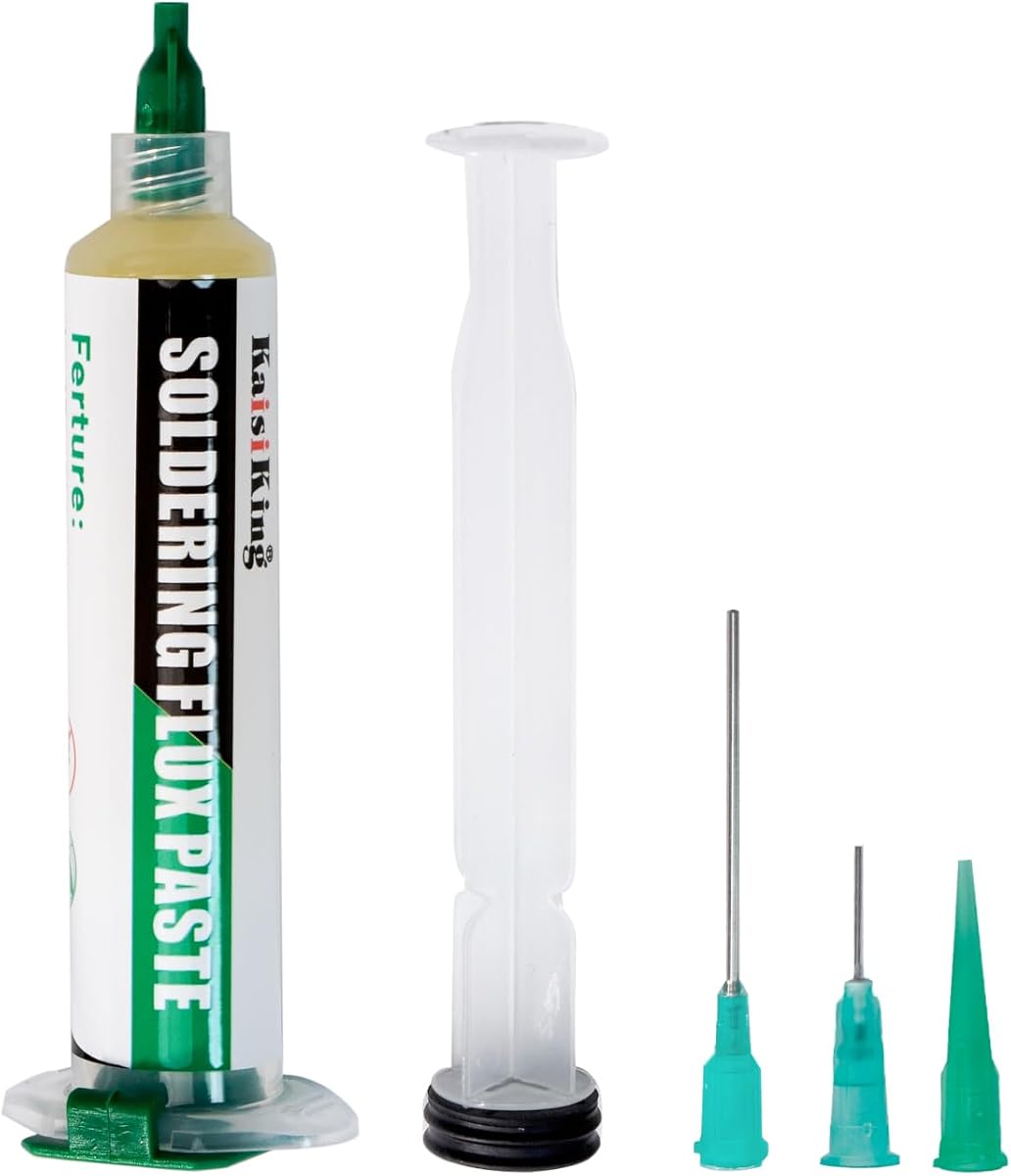
Kaisiking No Clean Soldering Flux Paste combines a push-style syringe with a rosin formulation intended to make controlled application easy. It has a 4.5 rating and is described as high-purity, lead-free, halogen-free, non-corrosive, and capable of assisting both lead-free and lead-based solder.
We may earn a commission when you buy through this link, at no additional cost to you.
The syringe is operated by gently pushing the rod so that the paste slowly flows out. This slower action can reduce waste and make it easier to keep material close to the intended joint. According to the listing, the flux has stable performance, low volatility, less smoke, and good flow ability. It is also claimed to remove stubborn oxide layers and improve wetting so solder can spread more smoothly.
The listing identifies instruments, gold, copper, tin, and iron among the compatible materials, giving it broader relevance than only conventional soldered joints. The exact syringe capacity is not stated, however, and no separate fine tips are identified in the supplied information. Users needing extremely localized application on the smallest components may want to compare it with a multi-tip option.
This is a good pick for a general electronics repairer who wants more control than a jar but values a simple push mechanism. It supports a wide range of soldering and rework tasks, and the resealable design helps protect the paste between sessions. Choose it when straightforward dispensing, low residue, and broad metal compatibility are the priorities.
The push rod allows the user to meter the amount of flux gradually. That control is useful when a small addition is enough to improve wetting and a large flood would only create extra residue.
The claimed low volatility and reduced smoke can make prolonged repair sessions more comfortable. The product is also positioned as suitable for both newer lead-free work and repairs involving older lead-based solder.
We may earn a commission when you buy through this link, at no additional cost to you.
The SRA Solder 135 Two-Pack is a high-volume version of the well-regarded SRA paste format. It has a 4.7 rating and includes two 2oz jars, making it suitable for users who solder frequently, maintain several types of equipment, or prefer keeping a reserve supply. The formulation remains a semi-solid rosin paste designed to avoid a goopy, difficult-to-control application.
We may earn a commission when you buy through this link, at no additional cost to you.
According to the listing, the paste can be used with tin-lead and lead-free alloys and does not need to be cleaned after soldering. It is intended for circuit boards, copper electrical wire, car audio, computers, RC vehicles and FPV projects, musical instruments, gaming consoles, model railroads, and Arduino or Raspberry Pi builds. That range reflects the product's general-purpose electronics positioning.
The tradeoff is precision. A jar is simple and durable, but it cannot match the placement accuracy of a syringe or dispensing tip. Someone working almost exclusively on microscopic SMD joints may prefer one of the controlled-dispenser options. For wiring, through-hole soldering, kits, and classroom or hobby projects, however, the straightforward jar format is often easier to manage and carry between tasks.
Choose this two-pack for steady, high-volume electronics work or for stocking a workshop. It combines the same easy-to-place consistency and no-clean convenience with a larger total quantity. The two containers can serve separate work areas, and the product is particularly appropriate for builders who expect to move through many hobby or repair projects over time.
The semi-solid formulation supports repeated application without behaving like a runny liquid. It can be dabbed onto a joint or used by dipping a copper wire before solder is introduced.
The product is listed for everything from audio systems and model trains to drones, instruments, computers, and microcontroller kits. This makes it a versatile supply for general-purpose electronics builders.
We may earn a commission when you buy through this link, at no additional cost to you.
The right solder flux paste depends on the size of the joint, the type of soldering you perform, your need for removal tools, and how much control you want over application. Review the following factors before selecting a container and formulation.
A paste is generally easier to place and less likely to spread than a liquid, making it useful for controlled work around pads, traces, and components. It can be dabbed from a jar or expelled from a syringe, and its higher viscosity is helpful when you want flux to remain close to the joint. Liquid flux wets surfaces quickly and covers broad areas efficiently, but it requires more careful application to avoid excess material. Choose the format that matches your working style rather than assuming one is universally cleaner.
A no-clean flux is formulated to leave residue that can generally remain on the board after soldering, subject to the manufacturer's instructions and the requirements of the assembly. Look for explicit claims about non-corrosive, non-conductive, low-residue, or moisture-resistant residue, but do not assume every no-clean product is identical. Some applications, including high-voltage, high-impedance, or contamination-sensitive work, may call for additional cleaning or a different flux classification. Always evaluate the residue against the needs of the device being repaired.
A jar offers simplicity and durability, while a syringe or dispenser provides more repeatable placement. Fine tips are valuable for SMD pads, tight spaces, and small components because they reduce the amount of flux that must be heated. A plunger-style syringe is useful for moderate precision, whereas a larger pneumatic-style dispenser may suit repeated professional work. Consider the size of your joints and how often you will need to replenish or replace the applicator before deciding how much control is worthwhile.
Most modern electronics work involves lead-free solder, but older equipment and mixed inventories may still contain leaded connections. A flux explicitly compatible with both can provide useful flexibility. The listing may also mention compatibility with gold, silver, copper, tin, iron, or other metals. Check these claims against the actual materials in your project. Also review the stated active temperature range, because a flux can be chemically suitable yet perform poorly outside the temperatures at which it is intended to activate.
A small 10ml dispenser is appropriate for occasional precision work, while 35-gram jars and multi-jar packs can support frequent hobby or service activity. Larger quantities are not automatically better, because paste can thicken, dry, or become difficult to dispense if storage is poor. Look for a package that matches your consumption rate and provides enough capacity to avoid constant refilling. Multiple syringes or jars can also be useful for separating tasks, but each container must be labeled and closed properly.
A basic flux paste is enough when your main task is forming new connections. Repair and rework often require a way to remove old solder, bridge a pad, or detach a component. In those cases, a kit with desoldering braid saves you from sourcing a second tool. Copper wick works through capillary action when properly heated and placed in contact with the joint. Its width should suit the density of the board: narrow braid is better for small components and tight areas, while wider braid can remove more solder from larger joints.
Different activity levels indicate how strongly a flux is intended to remove oxidation and other contaminants. More active formulations can be valuable on heavily oxidized or difficult-to-solder surfaces, but they are not automatically necessary for clean, well-prepared work. Highly active paste may produce more residue or fumes than a mildly activated product. Beginners should favor a no-clean rosin paste with clear application guidance, while experienced users working on stubborn joints may appreciate a stronger formula. The safest approach is to use the lowest activity that reliably completes the task.
Protect paste from heat, direct sunlight, contamination, and unnecessary air exposure. Syringes should be resealed immediately after use, and jars should be closed tightly to reduce drying or changes in consistency. Some listings specify a room-temperature shelf life, while others note that cold conditions can thicken the product. A paste that becomes difficult to expel may still be usable after returning to a suitable temperature, but prolonged temperature excursions are best avoided. Store containers upright, clearly labeled, and away from metal dust or other workshop contaminants.
Prepare the connection before applying flux by cleaning the pad or wire end and removing oxidation, grease, and old residue. A light abrasive, suitable cleaner, or a freshly soldered surface will help the flux do its job. Place the work on a heat-resistant surface, secure the board, and make sure the soldering iron is at a suitable temperature for the joint and solder being used.
Apply a small amount of flux directly to the joint. With a jar, use a clean applicator to dab on a modest quantity; with a syringe, place a small bead beside the pad or wire rather than flooding the area. Heat the connection and feed solder into the warmed joint. The flux should help remove surface oxide and allow the solder to spread, but adding more solder or more flux will not correct unsuitable heat, dirty surfaces, or an incorrectly sized connection.
After soldering, allow the board to cool, inspect the joint for a smooth and complete connection, and remove any loose wick or debris. Residue from a no-clean flux generally needs no special removal, but the component and manufacturer instructions determine the proper finishing procedure. Reseal jars and syringes, wipe the tip without introducing contamination, and store the paste away from heat, direct sunlight, and freezing conditions.
Solder flux paste improves solder wetting by removing or disrupting oxide layers and helping molten solder spread across the joint. It is commonly used on circuit boards, copper wire, connectors, and electronic components. The paste is usually applied before heating, while the solder itself is supplied separately as wire, paste, or another suitable form.
No-clean flux is formulated to leave a residue that can generally remain after soldering, but you should still follow the product instructions and the requirements of the finished assembly. Sensitive, high-voltage, high-impedance, or contamination-critical projects may need additional cleaning. Inspect the board and remove residue if it interferes with a connector, sensor, coating, or subsequent repair.
Yes, when the flux listing explicitly states compatibility with lead-free solder. Many products in this guide support both lead-free and leaded alloys, which is useful for mixed electronics work. Confirm the solder type, base metal, and the flux's stated active temperature range before beginning.
Neither format is universally better. Paste stays localized and is easier to control around small components, while liquid flux spreads quickly and can be convenient for broader coverage. The best choice depends on joint size, application method, personal workflow, and how much residue you are comfortable handling.
Flux paste is used to improve solder flow, while solder wick physically absorbs unwanted or excess solder. They serve different purposes, so wick is valuable for removing components, clearing bridges, correcting mistakes, or preparing a pad for replacement. A combined kit is convenient when both installation and rework are common parts of your work.
Use enough to cover the surface being joined, but avoid flooding the board. A small bead or thin local coating is usually enough for ordinary electronics work. Excess flux adds material that must be heated, can spread into nearby areas, and may create unnecessary residue without improving the joint.
Flux can help solder release from oxidized or contaminated surfaces, but it does not replace a mechanical removal method when you need to lift a component or clear excess solder. Desoldering braid, a solder sucker, or another appropriate removal tool is usually needed for dependable component extraction.
Keep the container tightly closed, clean, and protected from heat, direct sunlight, and contamination. Reseal syringes immediately after use and keep the dispensing tip from contacting dirty surfaces. Follow any stated storage-temperature and shelf-life guidance, especially for products that can thicken in cold conditions.
SRA Solder 135 is the strongest all-around selection because its semi-solid consistency, no-clean formula, and compatibility with both lead and lead-free solder suit a wide range of electronics tasks. MG Chemicals 8341 stands out for controlled professional dispensing and clearly described residue properties, while the two-jar rosin option offers a practical budget choice for general work.
Prioritize the application method that matches your work. Choose a jar for simple, high-volume use; a syringe for small pads and repeated precision work; a liquid dropper for rapid coverage; and a kit with desoldering braid when component removal is part of the job. Always verify solder compatibility, active temperature range, residue claims, and storage instructions before use.
Ratings and product details can change as manufacturers update their listings, and prices and availability also vary over time. Review the current product page before purchasing, confirm that the included container or accessories match your needs, and choose the flux that offers the right balance of control, wetting, and cleaning for your particular electronics projects.